Review | The Bone Clocks, David Mitchell

20819685How can I even begin to talk about David Mitchell’s The Bone ClocksTouted as Mitchell’s most ambitious, most “Mitchell-esque” novel ever, this massive beauty of a book kept me enthralled for an entire weekend. I devoured this book, unable to put it down. I took it with me as my sister and I went around Toronto, lugging the 600+ pages just for the briefest snippets stolen on the subway, or the blissfully long wait for a movie to begin… and the weight was so worth it.

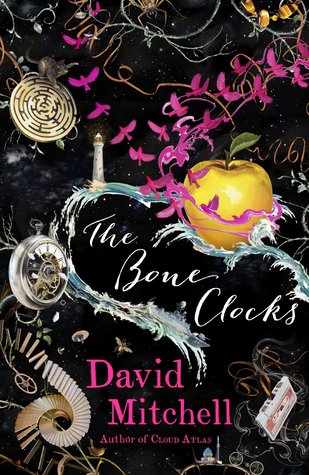
First: major, major kudos to Peter Mendelsund and Oliver Munday for this beautiful cover. All respect for the UK cover, but this one has such ethereal beauty that I would encourage purchasing a copy just for the cover art (something that in the past, I’ve only really suggested for Chip Kidd covers).

Then, the story itself is a series of layers that spans about a century, with all of the stories delicately, intricately intertwined. I wish I were more familiar with Mitchell’s body of work, as I’ve heard he includes a lot of characters from previous books in this story, and it would have been pretty mind-blowing to recognize them as they appeared. The story begins with fifteen-year-old Holly Sykes, who runs away from home after an argument with her mother. As a child, she used to hear what she called “the radio people,” mysterious figures who we barely understand till much later in the book. A psychologist “cures” Holly of these visions, but unfortunately, she can never truly escape. The story follows her journey, and the lives of the people she touches — a Cambridge scholarship boy, a war journalist unable to connect with his family, a middle-aged writer who goes too far in beating down his rival, and so on. Each of these figures narrates a section of the story, and each of them encounters “the radio people,” at times with horrifying results.

The story reminds me of Stephen King’s books, with its creepy, surreal feel, and also of Kate Atkinson’s Life After Life in its epic sweep yet intimate tone. While I felt that Atkinson’s Life After Life fell short of its promise, Mitchell holds the narrative together well, and I found The Bone Clocks to be a much better constructed book. The book jacket describes the novel as “kaleidoscopic” and that’s a great way to describe it. Every time I felt like I was just beginning to grasp the story, something else happens, and it always felt like I was just glancing off the edge of what the story was really about.

Around three quarters of the way into the novel, we finally learn what the mysterious radio people are about, and the story settles pretty firmly into supernatural thriller mode. We learn about an age old battle between good and evil, with Holly and the other characters merely innocent pawns. I was expecting the stakes to be somewhat higher and the battle to be somewhat more epic, but I still love how all the threads came together, especially the significance of the image on the US cover.

My only real disappointment with this book was the final section. I’m sure Mitchell had his reasons for extending the story that far into the future, but after such a fantastical, epic, sweeping narrative in the previous sections, this one just felt like a letdown. It was a return to a feeling of reality, and a way to tie up remaining loose ends, and I just felt about it like I did about the epilogue of Harry Potter.

Still, overall, a beautiful, fantastic story. I love David Mitchell’s Ghostwrittennumber9dream and Thousand Autumns of Jacob de Zoet — a wide range of stories that demonstrates how versatile this author isThe Bone Clocks, by many accounts, is his most ambitious yet, and in true David Mitchell form, he pulls it off with flair.

+

Thank you to Random House Canada for a copy of this book in exchange for an honest review.
Review | Playing with Matches, Suri Rosen

20578768When her sister’s heart is broken, 16 year old Raina Resnick decides to set up the anonymous matchmaking service “Match Maven” and help her sister find true love. Leah, after all, is twenty-three and unmarried, and as Raina points out, this is a big deal because “you have to think in dog years when you’re single in a traditional Jewish community” (page 31).

Playing with Matches is a hilarious tale of matchmaking, filled with increasingly ludicrous scenarios and yet anchored throughout by Raina’s very real desire to reconnect with her sister. The Match Maven dates are hilarious — a scene involving a Porta Potty is just so over the top that all you can do is laugh. For anyone who’s tried online dating and had some pretty horrific experiences, this book will make you feel better about your love life. And yet there is also the story of Esther, an elderly woman who lost her husband to a brain aneurysm years ago and is now looking for a second chance at love. Just as Raina does, we can’t help but feel invested in these singles asking for help, and just like Raina, we want them to find their perfect match.

However, it is Leah’s search for a match that really propels the story. As the anonymous “Match Maven,” Raina is able to offer advice and connect with Leah at the same time as Leah is pulling away from her sister in real life. Honestly, Leah’s conversations with Match Maven made me really uncomfortable — it’s Leah’s decision whom to trust with her feelings, and she was really being tricked into revealing them to her sister. I understood why Raina felt she had to do it, and how because of her persona as Match Maven, Raina couldn’t really do much to stop it. Still, it felt like an invasion of her privacy, and despite the way things eventually turn out, it still felt like a betrayal of trust. More a criticism of a character’s actions than a criticism of the book itself, but I do wish this aspect of it had been explored a bit more.

The novel also stretches credibility, though that might just be my unfamiliarity with Jewish matchmaking customs in the 21st century. If a matchmaker is supposed to broker the deal from the first date all the way to the wedding, and if, like a wedding planner, she must be on hand to help deal with disasters as Raina is, is it believable that the matchmaker remain anonymous? Also, do matchmakers render the service for free, or are they usually paid? None of Raina’s clients ever enquire about fees, or, if she is anonymous, about methods of payment. Given the level of commitment required and the significance of the task, I’d think matchmaking would be a profession, and therefore a paid service, rather than something one does for strangers just out of the goodness of their hearts. I of course know nothing about traditional Jewish matchmaking rituals — for example, I didn’t realize it was still so prevalent in the 21st century — and this book makes me want to learn more.

Still, Rosen speaks of Jewish customs with an ease and confidence that Eve Harris lacks in The Marrying of Chauni Kaufman, an “Orthodox Jewish Pride and Prejudice” that struck me as presenting an expertise on a culture without adequate understanding. I don’t know how accurate Rosen’s portrayal of Jewish customs is, but her book is at least much more natural in tone and affectionate about these customs. Playing with Matches is also less concerned with detailing all the various aspects of the traditions — rather, it concerns itself much more with the story, providing enough details that I knew what was going on but not bombarding me with so much information that it felt like more like a Wikipedia article than a novel.

Playing with Matches is a great book for the weekend. The book blurb describes Raina’s matchmaking service as a cross between Jane Austen’s Emma, Dear Abby and Yenta the matchmaker, and that’s pretty much on point. Some of the plot threads were too neatly resolved and at times, Raina’s streak of bad luck felt like a ploy by the author to garner sympathy for the character. But overall, the story was a lot of fun to read, and featured a cast of characters you want to succeed in their search for true love.

+

Thank you to ECW Press for an advance reading copy of this book in exchange for an honest review.
 

Review | Project Superhero, E. Paul Zehr and Kris Pearn (illus.)

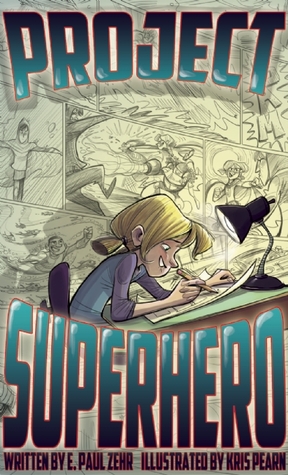
20578719I have to admit, the minute I saw this cover, Project Superhero went right to the top of my TBR pile. I also have to admit that I mistakenly thought it was a graphic novel about a young girl who creates actual superhero powers for herself. The actual premise of the story is somewhat similar, though much more grounded in reality and real-life heroes than the caped crusader teen my mind had conjured up from this cover.

13 year old Jessie and her classmates are given a year-long research project on superheroes, which culminates in the Superhero Slam, a head-to-head debate about which superhero reigns supreme, given a set of characteristics like agility, recovery and teamwork. A shy comic book nerd, Jessie is both thrilled by the subject of the assignment and terrified at the need for public speaking at the end of the project. She decides to champion Batgirl, who doesn’t have superpowers but rather relies on training and hard work to achieve great things. Through the year, Jessie documents her work on the project, which involves training in karate to become as strong as Batgirl, and which also connects her with real life heroes such as Olympian Hayley Wickenheiser, NASA astronaut Nicole Stott and Batgirl writer Brian Q. Miller, among others.

According to the advance reading copy I received, author E. Paul Zehr is known for using superheroes as a metaphor to communicate science. The book does a good job of teaching scientific principles, using both Jessie’s research on superheroes and her karate lessons. For example, an observation about how karate lessons are affecting her mentally as well as physically leads to a brief description of the cerebellum and the 100 billion neurons in the brain. Because the science is presented in line with something tangible like karate training or Batgirl powers, it’s a fun, easy way to learn. Heck, I learned things I don’t even remember taking up in school.

I love the premise behind this book, particularly the question on what makes a hero, and the vibe that girls can do anything, because science! Even a shy comic book nerd like Jessie can become a physically strong karateka with the confidence to debate her classmate in front of the entire school. I love that real-life heroes took the time to contribute to this project, and practically every other chapter is a brief interview or note from a notable name that inspires Jessie (and therefore the reader) to have confidence in her ability to achieve her goals.

The book is most valuable as an educational resource and a source of inspiration from these real life individuals, rather than for the story itself. The idea of the Superhero Slam held promise, but the debate itself wasn’t exciting. Part of me wishes Jessie’s class had been allowed to create their own superheroes rather than use ready-made DC and Marvel characters. If you could be any kind of superhero, what would you be and why? I believe those answers will be much more interesting, and much more revealing, than a canned debate on why Ironman isn’t as agile as Captain America. As well, due to the format of the story, superheroes other than Batgirl herself are given fairly short shrift — we learn next to nothing about the actual superhero characters, and so Jessie’s nervousness about some of her match ups fail to register any actual impact. And the way the debate ended made no sense to me. The framing device helps target the message towards its readers, but almost feels superfluous by the end.

Jessie is 13, but the book itself seems to skew more towards a younger demographic. The illustrations are absolutely awesome, and will definitely keep readers turning the page. The premise is inspiring, and I hope the letters from familiar names will inspire young readers to become real-life heroes themselves.

+

Thank you to ECW Press for an advance reading copy of this book in exchange for an honest review.