
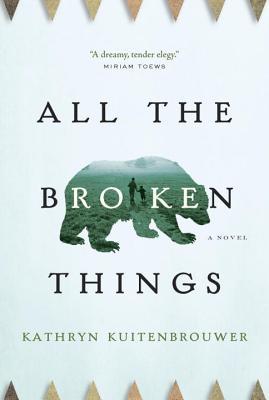
Review | All the Broken Things, Kathryn Kuitenbrouwer

17834903At first glance, the story of Kathryn Kuitenbrouwer’s All the Broken Things appears almost whimsical — a young boy joins the circus to wrestle with bears. Even the book trailer gives the impression of a fantastical adventure… lions and tigers and bears, oh my!

Yet the story itself engages with much more sobering subject matter than that. The book is about Bo, a fourteen year old Vietnamese refugee living in Toronto in 1983. His race makes him an outcast — his best friend and neighbour turns into a purported enemy past a certain intersection in the city. His well-meaning teacher only ends up highlighting his difference by asking him to share with the class his experiences of escaping Vietnam on a boat. Perhaps most troubling of all, his younger sister Orange is physically deformed because of Agent Orange, and rather than help Bo and his sister live with this reality, their mother instead opts to hide the young girl from the world. For Bo, full of frustration and bitterness, getting into fights with the school bully turns into an almost comfortable daily routine, part and parcel of his route home from school.

There’s a lot going on in the story, and when Bo stumbles upon the opportunity to fight bears in a circus, it is easy to see why this would provide a welcome sense of direction and purpose. He’s a young boy forced all too soon into an adult world, and readers will want him to succeed. I love the descriptions of his fights with Bear, the overwhelming assault on the senses and the feeling of utter right-ness within the physicality of motion. I love the small romantic subplot as well, and how Bo’s crush is lovely not just because of physical beauty, but also because she’s practically the only character who makes a conscious effort to connect with Orange, even to a greater extent than Bo himself.

Orange is perhaps the hardest character to read about — not because of any failing on the part of the author, but rather because it’s horrifying to think of a child who has been disabled, disfigured and treated as a freak from birth because of warfare tactics far beyond even the child’s parents’ understanding. Her struggle to communicate with others is heart-rending, and when the circus owner wants to add her to his group of freaks, I was right there with Bo in his rage.

The author does a great job detailing Bo’s emotional struggles, from the simmering humiliation of being called in class to talk about his family’s escape from Vietnam, to the explosive rage that causes him to do something he later regrets, and every now and then, to the utter joy when fighting Bear. Best of all is that there aren’t really any villains in this story — even the school bully and the circus owner reveal their humanity at certain points. It feels odd to say that a story about a bear in a circus feels very real, but the characters make this so. Broken Things is a striking story about the need for belonging, and how it can take something as unusual as a bear in a circus to make one belong.

+

Thank you to Random House Canada for an advance reading copy of this book in exchange for an honest review.

Guest Post | Gregory Widen on Blood Makes Noise

Thomas & Mercer has kindly provided a guest post from author Gregory Widen. In this, Widen writes about his inspiration for the novel.

17046607I remember the moment I got the idea for Blood Makes Noise. I was visiting a friend in an unnamed Latin American country who was a field officer for the CIA. Now, this friend has been involved in all sorts of craziness, including – on direct orders – supervising not only the murder of certain bad individuals, but “making it hurt.”

Despite a life of anecdotes like this, in the nights we spent drinking, the only time I ever saw him express disgust for anything was the following anecdote: “On 9/11, the FBI office in Miami was given the photos of the hijackers. This was critical – it had to get to Washington immediately – and they sent it by FedEx. Why not e-mail? Because there wasn’t an agent there who knew how to attach a photo. That is all you need to know about the FBI.”

I’d already decided at this point to write a novel titled Blood Makes Noise, centered around the craziness that accompanied the disappearance of Eva Peron’s corpse in 1955 Argentina. I knew my hero would be a troubled CIA officer sucked into those events and nearly destroyed by them. But when you write a novel, character and plot are just two of three things you need. The third, and often most elusive, is a unique background that provides the kind of catalyst to propel characters forward beyond the requirements of plot.

It occurred to me that I might have just found my catalyst.

As my friend’s white-gloved butler served us bourbon martinis at precisely six o’clock, I pressed further. Everyone knows of the historical mistrust between the CIA and FBI, but I quickly learned just how toxic it had been in South America – to the point where the CIA and Hoover’s FBI were nearly in open warfare with each other.

Prior to the CIA’s creation in ’47, the FBI had always been in charge of spying in South America. But Truman, who never trusted J. Edgar Hoover, now wanted to hand that responsibility over to his new agency. From that moment on, Hoover committed himself to strangling the baby CIA in its crib.

As servants built a fire in the living room, “drinks” became a cocktail party as various local spooks arrived. There was the BND (German spy agency) guy, another who’s family ran Cuban Intelligence, and some current and retired CIA. Working through my third martini, I soaked up the stories.

Despite Truman’s change, Hoover managed to keep many of his people in place, effectively creating an FBI-run CIA within the CIA. As the agency fought to get control, Hoover just went to greater lengths to discredit it.

As the party devolved, I remembered a dinner commitment. My friend’s crew decided to join me. Off we went to a large dinner party most memorable for the moment my friend informed me that my host was the son of the country’s biggest narco boss. I worried I’d unknowingly made some terrible mistake. But he only smiled wryly: “No. Thank you. It would have taken me months to make this meeting happen by accident.”

Both the drinks and stories kept coming: how in an effort to discredit the CIA, Hoover had ordered his men – while a CIA team burglarized a foreign embassy – to fire shots outside to alert the security people within. Or the time the CIA had arranged the defection of a KGB officer in Buenos Aires and Hoover, wanting the credit – and to embarrass the CIA – had his boys grab the defector in a restaurant first. But a CIA team arrived at the same moment and a brawl broke out between the two groups, trashing the place.

It was chaos in the CIA stations down there at the time. The old FBI officers still in place did everything possible to frustrate and humiliate the new arriving CIA personnel, including burning their files when they were finally ordered out. Those days in South America, sighed an old hand, were one wild circus.

As evening crawled to dawn, I knew now the atmosphere my character would be thrust into: a freshly minted CIA officer arriving in Buenos Aires and going to war against the old FBI hands still in place. A young man whose greatest threat would turn out not to be the KGB, but the people in his own embassy.

Walking home later, I thought, not for the first time: It’s funny where ideas come from.

+

This is a guest post by Gregory Widen, author of Blood Makes Noise. Gregory studied film and screenwriting at UCLA, and penned scripts for the films Highlander, Backdraft, and The Prophecy. He’s a native of Laguna Beach, California and he lives in Los Angeles. Blood Makes Noise is his first novel.

Review | Blood Makes Noise, Gregory Widen

17046607Gregory Widen’s Blood Makes Noise takes its inspiration from a real life event – the death of Argentina first lady Eva Peron and the mysterious disappearance of her corpse. The story is told from the perspective of CIA officer Michael Suslov, who is given the task of first protecting her corpse, and then fifteen years later, bringing the recovered body back home.

Widen’s story is steeped in the mythology surrounding Eva Peron. Most of what I know of her comes from the musical Evita, and we get a similar sense of almost-worship surrounding her in Widen’s book. His portrayal though is most powerful when firmly grounded — in a fantastic scene, he writes about how when it came time for Peron to choose a vice president, and the people called Eva’s name, even as she graciously accepted, she knew she would never be allowed to be vice president. She was too divisive to be a political figure in the public eye, and her crestfallen expression as she realizes this adds dimension to her character.

Unfortunately, I just couldn’t get into the book. It’s penned by the same man who wrote Highlander, and given the epic nature of that storyline, I had high hopes for this one. The requisite elements are there — intrigue, treachery, characters unsure of whom to trust, and so on. Perhaps there was too much focus on the reverence around Eva Peron, and while I appreciate the point about objects and symbolisms being of great significance to Argentineans, the references to Eva as a saint, and her corpse as sacred, seemed at odds with the grittier reality of inter-agency politicking. The politicking as well seemed cursory — there was a Le Carre type mastermind pulling the strings, but he lacked the charisma to be truly compelling. The story itself was slow and hard to get into, and even though Widen did a good job in setting the stage and explaining anti-Peron sentiments in Argentina at the time, ultimately, the story failed to make me care about the condition of Eva Peron’s corpse, upon which all the action hinges.

+

Thank you to Thomas & Mercer for an advance reading copy of this book in exchange for an honest review.