
Review | FaceOff, edited by David Baldacci

18775278Ever wondered what would happen if Lee Child’s Jack Reacher teamed up with Joseph Finder’s Nick Heller? Or if Ian Rankin’s John Rebus and Peter James’ Roy Grace worked together to solve a cold case? FaceOffedited by David Baldacci and featuring 23 of the world’s best thriller writers, sounds like a thriller fan’s ultimate fantasy, and with such a super star line up of authors, it should come as no surprise that the collection is one of the best page turners I’ve read this year.

The best part for me was the introduction before each story, where Baldacci explains why these authors were paired up, what they decided would be the most natural way for their characters to end up together, and how they collaborated on the story. In the first face-off, for example, we learn that Michael Connelly wrote the first six pages of the story and a few ideas on how the story could go, and expected Dennis Lehane to take a couple of days to finish the story. Instead, Lehane took several weeks and added twenty more pages, “evolving the plot from the shorthand to the complex and humorous.” I love this peek into the working styles of these great writers. The book is purportedly a series of face-offs between popular thriller characters, but these introductions reveal how much it is also a series of collaborations between the authors.

I especially love that the collaboration between these writers I admire goes beyond the collaboration we see in this volume. For example, Steve Berry and James Rollins have inserted sly references to the other’s characters in their own books in the past, and with this anthology, finally got the opportunity to bring Cotton Malone and Gray Pierce together for a full story.

The stories in this anthology are all solid thriller shorts. It’s exciting to see characters you like working together, but that’s a gimmick that could grow old pretty quick. The authors in this anthology had a delicate balancing act — how to feature both major characters equally and still have it be about the story rather than simply a fan fiction mashup of audience favourite cameos? Sure, at times, there was a bit of expository dialogue that served more to highlight the characters as stars rather than the story, but that’s forgivable, given the purpose of this anthology. What’s important is that even with these little asides to wink at the fans, each of the stories here is solidly constructed, and with a compelling plot.

While all the stories were fun reads, there were a few standouts. Gaslighted, by R.L. Stine, Douglas Preston and Lincoln Child pitted Slappy the Ventriloquist Dummy vs Aloysius Pendergast and was creepy as hell. Unlike the other match ups, this one featured a clear battle between the main characters. I’m unfamiliar with both characters — I’d read only R.L. Stine’s Fear Street series and don’t remember Slappy at all, and I’d read only one Preston/Child book years ago, which I found so scary (can’t remember why, to be honest) that I never dared read them again. Unsurprisingly then, this story really gave me the chills, and in a collection primarily of detective stories and real world crimes, it stood out.

Another standout is M.J. Rose and Lisa Gardner’s The Laughing Buddha, which pits the pragmatic police work of D.D. Warren vs the more esoteric Malachai Samuels, using the theft of a Buddha statue to spin a tale of past lives and a crime from centuries ago. It was suspenseful, and while both characters were apparently after solving the same crime, the contrast between Warren’s job and Samuels’ mission made it a race to the solution.

Finally, one of my favourites in the collection is Good and Valuable Consideration by Lee Child and Joseph Finder. I love the unexpected nature of the encounter, and the almost offhand way that the collaboration between Jack Reacher and Nick Heller began. Both characters were watching the same baseball game at a bar and end up sitting near a man in need of their help. Much of the conversation happens in glances between the characters — two men who don’t know each other but instinctively sense the other’s power and somehow reach a silent understanding. The writing as well seemed especially smooth, as if the authors shared the same level of mutual understanding that their characters achieved in a night at a bar. As Baldacci writes in his introduction to this face-off, “Actually, their biggest problem was who would win the Yankees-Sox game that kicks the whole thing off.”

Overall, FaceOff was a lot of fun to read. I’m a fan of thrillers in general, and so I was particularly excited to see that one of my favourite authors ever, Ian Rankin, was paired with another personal favourite, Peter James. I did wish that other personal favourites Stuart MacBride and Val McDermid had been included — can you imagine Logan McRae and Tony Hill working together to catch a super-psychopath? Epic! Volume 2, perhaps, Mr. Baldacci?

+

Heads up on Thrillerfest IX, at the Grand Hyatt, NYC July 8 – 12, 2014. Many of the authors in this anthology will be there, and the conference was organized by International Thriller Writers, the group that brought these authors together for this anthology in the first place.

+

Thank you to Simon and Schuster for a copy of this book in exchange for an honest review.
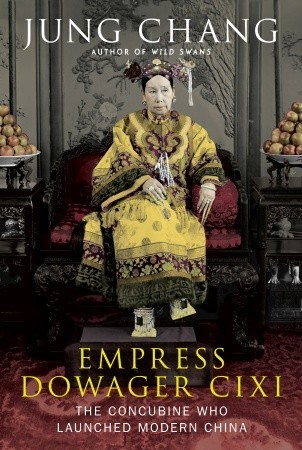
 

Review | Empress Dowager Cixi, Jung Chang

17412743A visit to the Royal Ontario Museum’s Forbidden City exhibition (on view till September 1, 2014) reminded me of a book I had been meaning to read for months, but have somehow never gotten around to: Jung Chang’s biography Empress Dowager Cixi: The Concubine Who Launched Modern China. The ROM exhibit was fascinating, and gave me an idea of how complex the social structure was within the Chinese imperial court. There was even a digital interactive map of the Forbidden City, which had a spot marked with an intriguing tale of a concubine being thrown into a well by the Empress Dowager Cixi. I got the sense of a rather trapped existence, the emperor’s movements restricted within the city and potential spies everywhere. The ROM exhibit left me wanting more, and so I approached Jung Chang’s book eager to immerse myself even more deeply into the world I felt the museum exhibition barely grazed.

Chang’s book was an entertaining glimpse into some pivotal moments in Chinese history. The biography focused on Cixi as a political figure, and apart from one alleged relationship with a eunuch, didn’t give much insight to Cixi beyond her political role. It was also at times boring to read. The narration at times felt workmanlike, and some major historical events (the Boxer Rebellion) are barely glossed over. Why did the Boxers rebel in the first place, was it because of something Cixi did and what policies did Cixi employ to address these concerns? The book also felt one-sided — Cixi and the Western influence in China are good, people who want to keep the West out are bad — which made me feel that the story was not given the complexity it deserved. I later checked Goodreads reviews and learned that majority of historical accounts present Cixi unfavourably, and I wish Chang’s biography had given me a better understanding of why. As it was, she seemed like a total visionary whose results ended up on the right side of history, which then means it makes no sense for history to malign her.

That being said, there are some interesting points in the book, such as the steps Cixi took to obtain and keep power. I was most fascinated by Cixi’s relationship with the Empress — Cixi being the mother to the Emperor’s only son and the Empress being the official wife meant that both had to share the power when the Emperor died. Because there was such a resistance to women holding power, Cixi and the Empress chose to band together and present a united front rather than waste time battling it out. The result was an alliance that none of the male advisers could topple, and I loved that example of female solidarity winning against the patriarchy.

Overall, an interesting glimpse into Chinese political history, but not quite as exciting or as much of a page turner as I’d hoped.

+

Thank you to Random House Canada for a copy of this book in exchange for an honest review.

Review | The Ever After of Ashwin Rao, Padma Viswanathan

18142312How does one deal with the loss of loved ones to a bomb on a plane? How does one cope when, twenty years after the attack, suspects are finally brought to trial for the crime? Psychologist Ashwin Rao, who lost his sister, niece and nephew in a fatal bombing of an Air India flight from Vancouver, deals with his grief by writing a book on the families of other victims on that flight. He becomes particularly drawn into the story of one Canadian family, whose members have dealt with their grief in very different ways.

In The Ever After of Ashwin RaoPadma Viswanathan explores various ways that people respond to loss. Through Rao’s eyes, we see the unique difficulties of facing such a violent, unexpected death for a loved one — in one particularly powerful scene, two men from the same family search through images of bodies salvaged from the crash, looking for anyone from their family. One of them looks through the photographs methodically, column by column and row by row lest he miss faces he recognizes. The other lets his eyes dart around, barely registering on one photo before moving to another spot, haphazardly chosen. The reason, the first man realizes and relates to Rao, is that the second man wants to register only his own family members; he doesn’t want the burden of anyone else’s grief.

Along with grief is an undercurrent of anger throughout the story. Rao refers to a book on the bombing written by Bharati Mukherjee and Clark Blaise, and the inadequacies of the text to properly represent the tragedy. For example, a passage in the book refers to the children on the flight, how well they and their families have assimilated into Canadian life, and how tragic their deaths were. Rao points out, and quite rightly, that the children’s “Canadian” traits were  and should be completely irrelevant — the tragedy of their deaths is simply because they died. Tied in to this is Rao’s anger at the Canadian government’s handling of the bomb. Other than their apparent incompetence in solving the crime, Rao compares the bombing to 9/11, and wonders why America took 9/11 personally whereas Canada seemed to consider the bombing an Indian tragedy, rather than a Canadian one, despite the number of Canadians on board.

The root of this anger is political, and it turns out that Rao was in India when Indira Gandhi is assassinated in 1984 and anti-Sikh sentiment turns violent. The horror of the riots is heightened by its contrast with the silly, manufactured horror of a haunted house Rao has set up for the neighbourhood children to introduce them to Halloween. Viswanathan is at her best when contrasting innocence with horror, and continues in this vein when dealing with victims’ stories, particularly families’ memories of the children on the flight. Later, some of the families blame Sikhs for the Air India bombing, echoing the violence back in India.

The thrust of the book is more personal than political however, and soon Rao sublimates his own grief and anger and focuses on the subjects of his book. While these stories are interesting in their own right — the family patriarch for example turns to religion, his daughter is stuck in a sexless marriage, and so on — the story to me loses some of the momentum that propelled the beginning so well. The writing is still solid throughout, as the author switches between perspectives, but the fire has been dampened somewhat, and the story never quite reaches its peak.

+

Thank you to Random House Canada for a copy of this book in exchange for an honest review.