
Review | What in God’s Name, Simon Rich

Simon Rich’s What in God’s Name is a light-hearted, somewhat ridiculous, yet still rather endearing take on the end of the world. Rich’s novel casts God as the deadbeat CEO of Heaven, Inc. Having phoned it in for years, God decides one day to pack it all up, destroy Earth, and open an Asian fusion restaurant. Rich’s tone is irreverent, reminding me of Christopher Moore’s Lamb, and as in really good comedies, there’s a degree of uncomfortable truth behind the laughter. The idea of God as an incompetent or uncaring CEO, in danger of losing people’s faith or becoming irrelevant, can hit uncomfortably close to home, and in the hands of a different type of comic, this novel could have turned into a much darker, more biting satire.

The edge is certainly there — Rich’s God reminds me somewhat of the benign, rather senile, version of the Authority in Philip Pullman’s The Amber Spyglass — but Rich coats it in such endearing, somewhat slapstick-ish romantic office comedy that it’s easy to ignore. What in God’s Name is told from the point of view of Craig and Eliza, the Jim and Pam of Heaven Inc. Overworked and underpaid angels in the Department of Miracles, Craig and Eliza have developed an affection for humanity and really don’t want the world to end. So they strike a deal with God — if they can make socially awkward humans Sam and Laura fall in love before Armageddon, God will call the whole thing off. Bargaining with God is a tradition that dates back to the Old Testament, and Rich gives it a sweet, Little Mermaid-type twist.

There’s little urgency to the novel’s Armageddon. Rich’s narrative is so cheerful that you can’t help but feel that the writer just won’t let anything really bad happen. Yes, it will suck if the world ends, but Heaven Inc’s lackadaisical attitude toward natural calamities rubs off somewhat. God seems so excited about opening a fusion restaurant, and his employees so eager to take early retirement that we don’t really think about the plagues and earthquakes and other such horrors. Rather, we care about the world ending because we care about Craig and Eliza, and about Sam and Laura. We want both couples to fall in love and, in the case of Sam and Laura at least, we want them to still have a world in which to stay in love.

Romance is at the heart of What in God’s Name, and Rich does especially well with the will-they-or-won’t-they chemistry between Craig and Eliza. Their conversations are funny and awkward, and just really romantic. Take for example one of my favourites, where they discuss Sam and Laura:

“Hey come on,” Craig said. “He asked her out, right? That took some guts.”

“He didn’t ‘ask her out,'” Eliza said. “He asked her if she wanted to ‘grab coffee sometime.'”

“That’s asking her out,” Craig said.

“No it’s not! Asking someone out is ‘Do you want to go on a date with me?’ It’s not ‘Do you want to grab coffee?’ I mean, you ask me that five times a day.”

Craig’s face reddened. After a moment, so did Eliza’s. [p. 181]

Sam and Laura’s romance isn’t quite as exciting, and I cheered them on mostly so that Craig and Eliza would succeed in their mission and perhaps go out on a date themselves. On one hand, it’s a nice change of pace not having the super hot hero/heroine couple usually found in romance, but on the other hand, a side effect of making the Sam and Laura romance mission impossible is, as Eliza observes, “They’re the most unappealing humans I’ve ever seen.” [p. 187] Laura actually isn’t bad, but Sam is a caricature loser. It’s sweet seeing him spend hours drafting and discarding one horribly written email after another to Laura, but the descriptions of him as a complete recluse whose only human contact is the delivery guy makes me think Laura could do much better. Their encounters are awkward, painfully so, though there are some moments, later on in the story, of actual chemistry. Rich goes all out on the ridiculous and the slapstick in Sam and Laura’s romance, and it’s hilarious to see Craig and Eliza scramble to create  the most random miracles just to help Sam and Laura along.

What in God’s Name is funny, touching and romantic. It’s a quick, entertaining read with characters you want to succeed. Even God as a CEO is a rather loveable bumbler, and it’s hilarious how his chosen prophet for the age is a crazy homeless guy at a street corner. The stars, however, are Craig and Eliza, and like Jim and Pam in The Office, they provide warmth, a heart for the book’s centre.

+

Thank you to Hachette Book Group Canada for a finished copy of this book in exchange for an honest review.

Review | Lucretia and the Kroons (Novella), Victor LaValle

Being young didn’t protect anyone. Horrors came for kids too. [p. 163/4]

For twelve-year-old Loochie, the horror is that her best friend Sunny is dying from cancer, and no matter what she does, she is helpless to save her. I liked the beginning of this novella — all Loochie wants for her twelfth birthday is to celebrate with Sunny. Unfortunately Sunny is undergoing treatment and so is unable to attend the party Loochie’s mom throws for her. I like LaValle’s delicacy in depicting the mother/daughter relationship — Loochie’s unwillingness to believe that Sunny’s condition is irreversible, contrasted with her mother’s gentle suggestion that she make friends with other girls (somewhat insensitive, but still well-intentioned). I’m a sap for stories about people dealing with loss, as you can see in my highly emotional review of A Monster Calls), and LaValle’s beginning made me think this novella would be emotional as well.

Unfortunately, it falls apart for me once the story really gets going. Lucretia and the Kroons is about Sunny going missing, and Loochie having to travel to the mysterious apartment 6D to rescue her. 6D is ruled by the Kroons, creatures who have reportedly used crack (according to Loochie’s older brother) and have parts of their faces missing. The Kroons appear mostly as zombie creatures who, for some unknown (at least for most of the novella) reason, keep kids in their lair forever, and Loochie believes they now have Sunny.

There are several ways this story could have gone, and I was hoping for a masterfully crafted horror tale that also works as a metaphor for Loochie’s fear at losing Sunny. Instead, I thought the story was a mess. It was confusing, unable to work either as a full on horror piece or a realistic story. As Loochie explores 6D, part of her wonders how a park or any of the other locations and structures she encounters could exist inside an apartment unit. Her confusion is understandable; unfortunately, LaValle never develops his world fully enough for the reader to grasp it either. I eventually just had to ignore all the references to 6D being an apartment unit (the entire “real”/realistic world) just to make sense of the story’s geography.

Loochie’s search for Sunny and her attempts to outrun the Kroons also felt very disjointed. I can understand Loochie not having a plan on how to locate Sunny, but there didn’t seem to be a logical sequence either in her search. I could follow the thread up until she entered 6D, then the events just seemed haphazard. As well, because we didn’t really understand anything about the Kroons, beyond the fact that they looked like zombies, there was never a sense of real menace about them. It is possible to make a frightening monster without much detail (again, see A Monster Calls), and I can understand Loochie not knowing exactly why the Kroons are scary. However, there just isn’t enough about them for the reader to grasp, which makes this reader, at least, not care.

The story progresses as expected, and once we get touches of the real world, particularly about Sunny’s condition, the story strikes some minor emotional notes. But it’s difficult to lose oneself in the deeper layers of the story when the basic framework itself is so unclear.

The last couple of pages, giving a glimpse into Loochie’s life at thirteen, make sense only to remind us that this novella is a prequel (or companion piece, as it’s called in Goodreads) to LaValle’s novel The Devil in Silver. Perhaps reading that one will give me a better appreciation of this novella. As a stand-alone, Lucretia and the Kroons may have some highlights, but the central action was just too problematic.

+

Thank you to Random House Publishing Group for sending me the e-gallery of this book via Net Galley in exchange for an honest review.

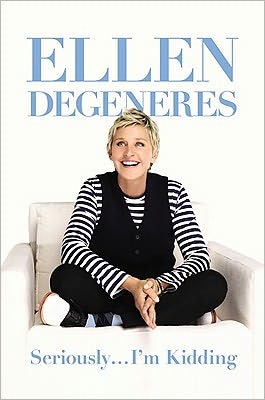
Review | Seriously… I’m Kidding, Ellen DeGeneres

Reading Ellen DeGeneres’ Seriously… I’m Kidding is like having a casual, one on one conversation with Ellen herself. The book is hilarious, rather sweet and oddball, with the wonderfully sunny outlook on life that has become Ellen’s trademark. It also often veers into the pointless, with sight gag chapters that probably would work well as minor sketches on her show, but are just worth skimming in a book. On the bright side, I’m Kidding is overall a feel good book, cheerful and optimistic without being preachy. It’s Ellen, on the page, and a fun way to spend your commute.

There are a few completely random chapters. One can almost imagine her Finding Nemo character Dory narrating some of the passages, with their pointless digressions and wide-eyed punchlines. In one chapter entitled “Ideas,” for example, Ellen rambles about everything from smiling to astronauts. Presumably, she means to mimic the brainstorming process, how each idea leads on to another with the barest minimum of connections, and so on. Except it plays out like a comedy routine that seemed funnier than it really is, and the punchline, “I’m sorry, maybe I shouldn’t have written this chapter,” backfires when the reader reluctantly agrees.

Others, like “For the Teenagers” and “Magic,” are sight gags, possibly worth a chuckle when read, but nothing that will make you remember once the page is turned. These stand in sharp contrast to some genuinely great bits of comedy in the book. Take for example “How to Be a Supermodel,” a how-to guide based on Ellen’s experience as a Cover Girl model. The tips in this chapter are sharp and insightful, comedic gems. Take for example:

One: The Look
Always look like you’re angry at the universe for making you too pretty. [p. 11]

Ellen is at her best however in the somewhat more serious chapters. She never allows herself to become Oprah-esque, pulling back with a wisecrack just when she’s dispensed some bit of wisdom. The overall effect is that of a woman who is afraid to let the mood get too sombre, and who therefore undercuts her own advice with humour. That being said, in many of these instances, the humour actually enhances the impact of the advice, and at times reveals further insight.

Take for example a thoughtful chapter on the meaning of life. Ellen observes that people disagree about the nature of happiness — some say we should live each day as if it were our first, and others say we should live each day as if it were our last. It’s confusing, Ellen admits, then immediately quips, “Either way you should probably have a diaper on.” Good point, a quick joke, and a good reminder that prescribed methods of finding happiness aren’t foolproof.

Ellen’s chapter on “Labels” stands out as possibly the most serious. Apart from an offhand joke about her Cover Girl endorsement and a gentle scoff at musical theatre, Ellen reflects on how much she’s been labelled. In a particularly striking line, she admits,

It didn’t occur to me that when I announced I was gay I would have to clarify just how gay I am. What does it matter? What does it mean? All I can say is I’m gay enough for me. [p. 93]

In one of my favourite chapters, “What Would Jesus Do?” Ellen talks about magazine polls and the culture of judgement. Much like the chapter on the meaning of life, Ellen switches from thoughtful observation to quick quip and back again throughout this chapter. Giving the example of a poll that asks “Hot pink dress — is it a do or a don’t?” Ellen demands:

Who cares? If you want to wear a pink dress, wear a pink dress. It doesn’t matter what other people think. One hundred percent of the people polled could say a pink dress is a “do” and guess what? I still ain’t wearing one. [p. 54]

Ellen’s independence and self-confidence are among the many things that make her such a great role model. That passage just about made me applaud. Ellen continues:

All these polls do is make everyone so judgmental. And I don’t believe in judgment. Unless is judgment of judgment. I don’t think someone has to “wear something better” or have a better hairstyle. That’s why the word “different” exists in our language. [p. 55]

Hear hear, Ellen DeGeneres, hear hear!

She immediately undercuts that inspiring passage with a joke, but then switches right back into incisive observation so seamlessly that the interjection of jokes feels natural.

Seriously… I’m Kidding is very much hit or miss, on a chapter by chapter basis. Overall, however, it’s a fun read that just has Ellen’s wonderful personality shine through. You’ll feel good while reading it. The flapjacket copy that promises

If you buy it, you will feel better, look better, be happier, grow taller, lose weight, get a promotion at work, have shinier hair, and fall madly, deeply in love.

is a joke, but like many chapters in the book, holds a grain of truth. Ellen’s humour is so infectious that this book will most likely cheer you up, and if you haven’t fallen in love with Ellen yet, some chapters in this book might make you do just that.

+

Thank you to Hachette Book Group for a finished copy of this book in exchange for an honest review.