
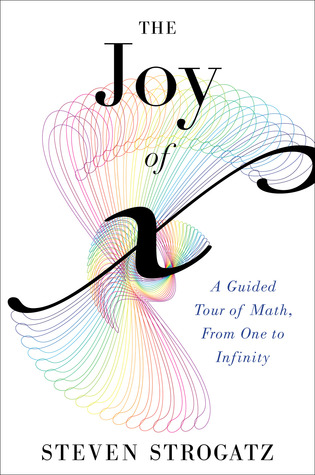
Review | The Joy of X, Steven Strogatz

13356649I’m a nerd. The idea that math can be used to explain everything, including (from the book jacket) whether or not O.J. Simpson did it, or how many people it is optimal to date before settling down, appeals to me. I love patterns, and I love the idea that numbers can be applied in the most esoteric situations in real life.

So Steven Strogatz’s The Joy of X instantly appealed to me. Life, the universe and everything… How can math play a role in understanding all that? And while I’m sure mathematicians can give me various answers, I looked forward to reading about it as written for a layperson’s perspective, and to understanding just a bit of the wonder that math can present.

Unfortunately, this book made the joy of X even more of a mystery to me. Strogatz begins with fairly basic arithmetic, and uses images like rocks and dots to explain addition and subtraction. He writes: “This side of arithmetic is important, practical, and–for many people–joyless. The playful side of arithmetic is a lot less familiar, unless you were trained in the ways of advanced mathematics.” I presume then, that the Tetris-style patterns with rocks represents this more playful side, which appears to be minor tricks with basic functions.

On one hand, I see what he’s trying to do — by presenting even the most basic arithmetic functions in new ways, he’s prepping us for the way he’ll present the (presumably) more fun, more advanced mathematics, such as how to calculate O.J.’s guilt, later on. The problem is, even the first few chapters gave me a headache. The four basic functions are math we as adults are already familiar with, and quite frankly, the struggle to see it from Strogatz’s new, supposedly more playful, perspective, just doesn’t seem worth it.

The book began as a series of columns, and possibly because of this, each chapter is a minor topic in itself, barely leading on to the next one. The result is a fairly shallow overview of various math concepts, and Strogatz seems to try too hard to make the math interesting. He explains the concepts well enough, though I personally think he either overcomplicates or underexplains his topics, yet never quite answers the question: so what? And when each chapter is its own topic, and each chapter begins a new attempt to present an aspect of math in a new light, the repeated sense of “so what?” becomes frustrating.

I remember starting Brian Greene’s The Hidden Realityabout parallel universes. I still haven’t finished it, mostly because it started getting really complicated, and honestly I think I need to start from the beginning to make sense of it all again. But unlike Strogatz’s book, Hidden Reality shows a progression — Greene begins with a really simple, accessible example of parallel universes, then slowly delves deeper into the subject, and explores further into scientific concepts. It’s not an easy read, but the payoff will be worth it — Greene tackles a complex subject and gently takes the reader deeper and deeper into it.

In contrast, Strogatz sounds like the high school teacher desperately trying to convince his bored students that math is fun (cue big grin and exclamation point). I’m not saying that the math he covers is simple — on the contrary, I’m sure most of it, particularly in the later part of the book, is over my head. But I do want to understand, and I feel Strogatz’s approach keeps one firmly in the elementary level of understanding. I’m sure this wasn’t the author’s intention, but I generally found his tone condescending — no way we readers could understand these concepts, so here’s a funny little story to convince you that it’s F-U-N!

I didn’t finish the book, so I don’t know whether or not math says O.J. did it. I did see the chapter about how many people one should date before settling down. It all boils down to a formula, and despite Strogatz beginning with a concrete example, it still ends up being really abstract. By the end of the chapter, I have a general idea of the solution (spoiler alert: it’s nothing you couldn’t have guessed without math), and still no idea of how to calculate it or why I should even bother.

A mostly joyless, shallow exercise, this book is hardly worth the effort.

+

Thank you to Thomas Allen Ltd for a copy of this book in exchange for an honest review.
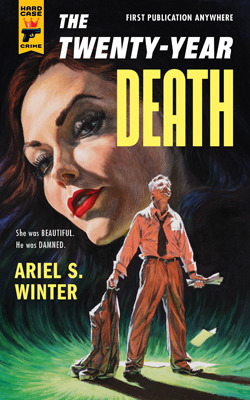
Review | The Twenty-Year Death, Ariel S. Winter

13089521I really, really wanted to like this book. When I first heard about it, I immediately begged Random House for a review copy. As a lifelong mystery fan, I was immediately hooked by Ariel S. Winter’s concept: three complete mystery novels, each set in a different decade, each told in the style of a famous mystery writer from that decade, and yet all part of a single 700-page story. Seriously. A daring idea, an amazing hook, and I applaud the author for coming up with it.

Unfortunately,  The Twenty-Year Death failed to live up to its (admittedly ambitious) promise. To be fair to Winter, noir/hard-boiled isn’t a mystery genre I’m very familiar with, so it’s possible this book is just not my cup of tea. Also to be fair, while I am familiar with Raymond Chandler (one of the authors Winter mimics), I’ve never read Georges Simenon and Jim Thompson, the other two authors Winter imitates. So I am unable to say how successful Winter was in either paying homage to or re-interpreting the genre, and these writers’ works in particular. Rather, I read it as a standalone book, hoping to discover a new and exciting mystery writer.

The three books within Twenty-Year Death tell the story of Clotilde and Shem Rosenkratz. In the Simenon-style Malniveau Prison (Book 1), the year is 1931 and Clotilde’s father has been murdered in a gutter, but he was supposed to have been locked up in a prison and no escapes had been reported. Chandler-esque Book 2, The Falling Star, takes place in 1941 — Clotilde, stage name Chloe Rose, is in a Hollywood movie and fears for her life, and a PI steps in to investigate. Book 3, Police at a Funeral, mimicking Thompson, turns the spotlight on Shem, an alcoholic writer whose life is basically falling apart.

Despite the overarching storyline, it’s difficult to review this book as a whole, because each story within is so different from the others. While Clotilde and Shem appear in all three novels, they are minor characters until the last book — the action is somewhat driven by them, but we never really get invested enough in either of them to really care about them as characters. The three plots are disjointed, and having Clotilde and Shem in all three books just gives the impression that they are the unluckiest couple ever.

I’m generally a fan of police procedurals, so the introspective Malniveau Prison is probably most to my taste. However, while the puzzle was intriguing enough, the story just didn’t hook me. I was bored, and after several tries, gave up on finishing this story. The Falling Star, with its Hollywood glamour and soap opera subplots, actually turned out to be my favourite of the three. The story was intriguing, but ultimately unmemorable. Police at a Funeral may have suffered from being the last story in a largely underwhelming but lengthy book. I admit: if it hadn’t been a separate story, but just the end of a single long novel, I wouldn’t have read that far. So I did decide to give it a chance, but, in all honesty, didn’t have much patience for it. The main character was Shem, who I really didn’t like, even when he appeared in the first two books. And while I don’t believe that all protagonists should be likeable, I also didn’t care enough about this man’s story to read beyond the hundreds of pages I’d already read about it. I gave up on this third novel fairly early.

Part of it may be the writing style. Winter had set out to mimic three classic writers, and while I am unable to tell if he succeeded in that, I thought that by the third book, his writing style was fairly standard throughout. I figure that even with the homage to various writers, a distinct Ariel S. Winter style still came through. Unfortunately, while his writing is solid enough, it just isn’t compelling. It’s okay, but that’s it. I do wonder how it would be if he didn’t bother with the homage at all, and simply wrote an original mystery. It’s possible I might have enjoyed that better.

Overall, a disappointment. Again, in fairness, it may just not be my type of mystery, or perhaps Winter was constrained by certain stylistic conventions to which he was paying homage. Still, the overarching story just wasn’t compelling enough to merit three separate novels within a novel. As well, and this is an unfortunate yet perhaps expected reaction to Winter’s project no matter how well or poorly executed: I couldn’t help thinking, if all this is is an imitation of three classic writers, why not just read the originals?

+

Thank you to Random House Canada for a copy of this book in exchange for an honest review.

The British Invasion

Fans of British chick lit & romantic comedy: Win a haul of books just in time for your summer holidays from some of the UK’s best-loved and best-selling authors! 

5 winners + 25 books = a Summer of Love

Bookshelf

To celebrate the launch of Notting Hill Press, five lucky winners will each choose five personally inscribed and signed eBooks from the Notting Hill Press authors – there are 50 best-selling and award-winning books to choose from. To enter, go to Amazon (the giveaway is open to US or UK residents)* and:

  • Kick off your summer reading by buying any TWO eBooks listed below between now and June 13th.
  • Click the “Share This Item” button on the Amazon Thank You page after purchase to tweet/facebook about each book (if you use Facebook and/or twitter).
  • Enter to win by posting a comment over on the Notting Hill Press Facebook page telling us which two eBooks you bought. If you don’t use Facebook, you can enter the competition by adding your comment here instead. Winners will be chosen randomly from all the comments on June 14th and posted in both places.
  • “Like” the Notting Hill Press Facebook page to get freebies, discounts and sneak peeks at the authors’ books before they’re published! And if you’re on twitter, follow @nottinghillPR

Best of luck from all the Notting Hill Press authors, and don’t forget to check back on the Notting Hill Press Facebook page or the blog on June 14th to see if you’ve won!

Much love and happy reading,

Talli Roland, Belinda Jones, Michele Gorman, Matt Dunn, Nicola May, Scarlett Bailey, Nick Spalding, Sue Welfare, Chrissie Manby, Victoria Connelly and Lucy Robinson xoxo
*This is an Amazon eBook giveaway, open to US and UK entries. It will run from June 3rd through June 13th. The five winners will be randomly selected and announced on June 14th on the facebook page and Notting Hill Press blog. Winners can choose any 5 books from the participating authors – here’s the list.