Unknown's avatar

About Jaclyn

Reader, writer, bookaholic for life!

Review | The Next Best Thing, Jennifer Weiner

I like Jennifer Weiner. I like her Bachelorette tweets, and I applaud her for calling attention to the gender imbalance in mainstream book reviews. I loved In Her Shoes  — that scene where Cameron Diaz’s character (who has difficulty reading) reads a poem for her sister’s wedding makes me cry every time. And yes, when I read it in the book, that scene made me cry as well.

So, when in the mood for a fun, lighthearted read, I decided to pick up Weiner’s new book The Next Best Thing. The book is about Ruth Saunders, a young writer who moves to Hollywood with her feisty grandmother and gets the green light for her sitcom, the eponymous Next Best Thing, about a young chef who moves to the big city with her feisty grandmother. Fine. A lot of writing is autobiographical, and even with the additional meta layer (meta meta?) of Weiner herself having been a screenwriter, I could deal with it. After all, I started the book looking for a fun, lighthearted read, not an earth shattering emotional tale.

Weiner adds gravitas to her character by giving her physical scars. Ruth’s parents died in a car crash when she was a child; she’d been in the car with them and her scars had never healed. In one of the few truly poignant scenes in the book, eight year old Ruth writes in her diary, “I will never be beautiful.” Personally, I thought it was a bit much — physically scarred Ruth writes about an overweight chef, hoping to inspire other girls who don’t fit the traditional idea of physical beauty. Ruth also falls in love with a man who is paralyzed from the waist down. It’s a bit heavy handed with all the physical and emotional scarring, though to Weiner’s credit, she never gets maudlin about them.

Here’s the thing though: I really didn’t like Next Best Thing. It read like a mediocre sitcom meandering from plot point to plot point yet never hitting its stride. My overall reaction: meh. And in my view, such indifference may be an even worse reaction than utter disgust. 50 Shades of Grey at least, while much, much more horribly written, at times fell into the “so bad it’s funny” category. Weiner had some funny lines — I especially love the description of one man as looking like a favourite uncle who’d bring you the latest Baby Sitters Club book, and one woman whose cleavage was big enough to hide an iPad. Overall, however, I was reminded of something a character said about the process of a screenplay being turned into a TV show: it’s a lot of waiting. Reading this felt like that, checking off plot point boxes one by one while still waiting for something to happen that’ll make you care.

The crux of the plot is that Ruth had written a screenplay that would inspire the everywoman. Her character was plus size, insecure, yet witty, and that character’s success will inspire the viewers to go for their own dreams. Hollywood takes over Ruth’s show and begin to turn it into a standard sitcom, with a size zero heroine, crazy sex-crazed elderly lady and stupid, sexist jokes.

This story could work only if we believed that Ruth’s original screenplay was worth fighting for. It’s not. We are given scenes with Ruth’s unadulterated vision, and later see her dismay at the studio’s interference, and all I could think of was that while the edits did make the show more stupid and offensive, they weren’t much worse than the original. The scene that Ruth was so proud of, an emotional, rah rah scene between the heroine and her grandmother, just sounded trite. I admit, a confrontation scene between the heroine and an ex-boyfriend did make me cheer, but that was one good moment in a TV show pilot that we’re supposed to believe would have been the next Golden Girls, if only Hollywood hadn’t interfered. It’s not. Even Ruth’s original is blah, and because of that, the stakes for the entire story are depressingly low.

As for the subplots — Ruth’s relationship with her grandmother and her crush on her boss (the aforementioned paralyzed man in a wheelchair) — again, the stakes just aren’t high enough to care. The grandmother is the most colourful, most interesting character in the book. I love the description of her waltzing into a restaurant like a movie star and the maitre’d wondering  who she was. Unfortunately, she isn’t given many interesting things to do, and serves mostly to provide rah rah support to her granddaughter. Even the big conflict that put Ruth and her grandmother’s relationship at risk — while it did have the potential to be big and emotional — barely fizzles. The romance is sweet, and the sex scenes endearing, but again the conflict feels contrived and the outcome easy.

I wasn’t expecting to be blown away, but I was expecting to be entertained. Unfunny and lacklustre, The Next Best Thing failed to deliver.

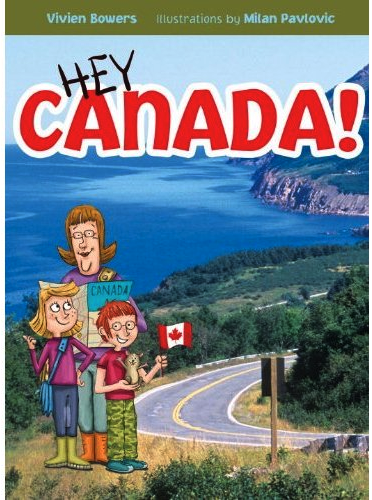
Blog Tour Review | Hey Canada! Vivien Bowers, illus. by Milan Pavlovic

Remember encyclopedias? Hardcover books with glossy, colourful pages. In my nerdiest moments, I had a great time flipping through them and learning random factoids about Elizabethan drama, far away places and whatever other topic catches my attention. Wikipedia is a much more efficient way to research, but there’s a certain charm in an encyclopedia’s glossy presentation of information.

Reading Vivien Bowers’ Hey Canada! reminded me of that experience. The story is simple: Gran takes nine-year-old Alice and eight-year-old Cal on a road trip across Canada. They visit all the provincial capitals, and learn about each one’s history and points of interests. It’s a fun, informative introduction to Canada for 7 – 10 year olds, a wonderful book for parents to read with their children to teach them about this country. As a recent immigrant myself, I would recommend this book to other immigrants, particularly those with children. Written in clear, easily accessible language and filled with photos of Canadian landmarks, Hey Canada! is a great way for a family to learn about the country together.

I enjoyed reading the facts and looking at the photos. I remember being in elementary school, and studying the dialects, cultural traditions and top industries of various regions in the Philippines. I imagine Canadian school children have studied the same about the various provinces. Hey Canada! is a great resource for this. I assume the plant and bird at each province’s chapter heading is the official plant or bird of the province (i.e. the osprey is the official bird of Nova Scotia and the mayflower the official plant), and I like that this was taught via a simple illustration in the chapter heading.

I liked the historical comic strips for a similar reason. Having not grown up studying Canadian history, it was fascinating to see small glimpses of each province’s history. For example in the chapter on Quebec, we see the British attack Quebec City in 1759, and the final panel shows the present-day Plains of Abraham as an idyllic park. I now want to visit the area, and perhaps read a bit more about this history.

The Find It! boxes are also particularly interesting as a teaching tool. It lists highlights in the chapter, and so, especially for parents reading with their children, it helps make the reading experience a bit more interactive. The only thing I didn’t like was that the list items sometimes referred to illustrations or text. Since they referred to highlights of the province, I would have preferred them to have referred to actual photographs. As well, and this admittedly is partly because I’m lazy, but I would have also liked the images to have labels, just so if I’m flipping through the book, I can immediately see what an image is, without having to search the entry.

Cal’s Tweets seemed designed to make the book seem more contemporary. Unfortunately, other than being labelled a tweet and, I’m assuming, consisting of less than 140 characters, it looked and sounded just like a regular Cal factoid rather than a tweet. I think using @ mentions, hash tags, and perhaps even formatting it to look like a tweet (with photos being labelled Twitpic or Instagram, and the Reply, Retweet etc buttons) would have helped these be more tweet-like. That being said, the primary appeal of Hey Canada! is its classic format, and the tweets just stand out as incongruous with everything else.

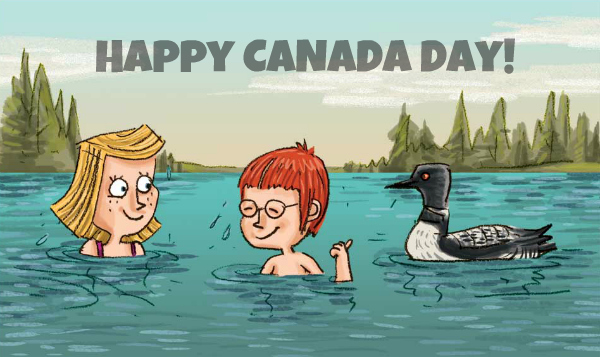
Hey Canada! is also very narrative in style, along with being informational. Gran and the kids joke around a lot, and there’s even a subplot about Cal’s hamster. The humour is very gentle, geared towards younger children and mostly about Gran’s singing and Alice’s snoring. It’s light family entertainment, and again, good for children or families reading together. With Canada Day coming up soon, it’s a great time to take an imaginary trip across the country with your whole family, and Hey Canada! is a fun way to do just that.

***

Thank you to Tundra Books for providing me with a copy of this book.

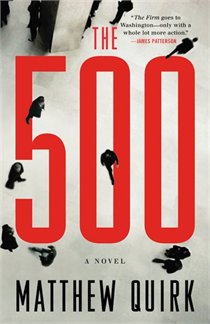
Review | The 500, Matthew Quirk

James Patterson compares Matthew Quirk’s The 500 to John Grisham’s The Firm and it’s easy to see why. Just like Grisham’s protagonist, Mike Ford is a fresh-faced hot talent who gets in way over his head in a high-powered career. Quirk takes the premise to Washington — “The 500” refers to the 500 most powerful people in Washington, usually those pulling the strings from the sidelines. Mike Ford has been hired straight out of Harvard Law School to join the Davies Group, Washington’s most powerful consulting firm. The Davies Group mandate is to make things happen for their clients, and that usually entails convincing one or more of the 500 to agree to something. As an ambitious young man raised in poverty and with a con man for a father, Mike’s street smarts provide fresh perspective for the Davies Group, otherwise staffed with privileged intellectuals.

The 500 is more action-packed than I remember The Firm to be. While The Firm, from what I remember, dealt a lot with the protagonist’s loss of innocence and the development of his relationship with his wife, The 500 focuses on the mystery — what are Mike’s bosses hiding? What do they want with an alleged war criminal? Why are they shutting Mike out and can Mike trust them? Unlike Grisham’s protagonist, Mike begins this story no longer an innocent. He has been trained by his father to be a con man, and has since struggled to live on the right side of the law. Unfortunately, his employment at the Davies Group forces him to use his long-suppressed con man skills, first to succeed, then later on, to survive.

Davies Group founder Henry Davies has built his empire on the tenet that everyone is corruptible. There’s an interesting reversal here — the law-abiding “good guys” manipulate people into corruption, and Mike’s old law-breaking “bad guy” acquaintances may be the only ones he can trust. It’s an old notion, and one that I think Quirk hammered home far too much. At one point near the end, just in case we hadn’t gotten the point yet, the narrator makes just that observation. It turns an otherwise fascinating story into a morality tale, and I wish it had been handled more subtly.

I do love the relationship between Mike and his father. Mike has tried his whole life not to become like his father, yet we see early on how much his father has influenced his life. I love the way Mike’s understanding of his father develops — it felt more genuine than Mike’s romance with a co-worker, and added a nice touch of emotion to this thriller. The romantic subplot was okay. At times the love interest felt more like a kick-ass Angelina Jolie fantasy figure — the perfect partner for a con man, who may or may not be trustworthy — than an actual woman.

Overall, the best part of The 500 is the mystery. I love that I couldn’t figure out what the Davies Group was up to, nor could I tell who Mike could trust. More than the Davies Group tenet that everyone’s corruptible, the House M.D. idea that everyone lies holds true in this book. The mystery was fast-paced and exciting, with unexpected twists. A lot of the action scenes and coincidental twists were a bit far-fetched, and would probably work out better on a TV or movie screen than a book. As well, despite the Washington D.C. setting, I would not consider The 500 to be a political thriller — I know there are major political consequences to the actions of the Davies Group, but the narrative was too focused on Mike’s experiences within the company to explore the bigger political picture. That being said, The 500 is a fun read and hard to put down.

+

Thank you to Hachette Book Group Canada for a finished copy of this book in exchange for an honest review.