
Review | Project Superhero, E. Paul Zehr and Kris Pearn (illus.)

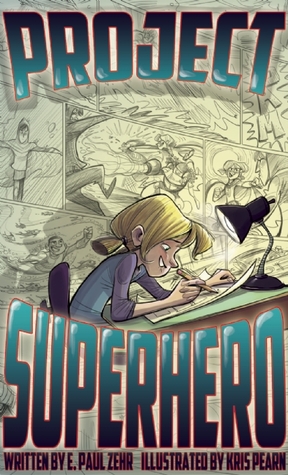
20578719I have to admit, the minute I saw this cover, Project Superhero went right to the top of my TBR pile. I also have to admit that I mistakenly thought it was a graphic novel about a young girl who creates actual superhero powers for herself. The actual premise of the story is somewhat similar, though much more grounded in reality and real-life heroes than the caped crusader teen my mind had conjured up from this cover.

13 year old Jessie and her classmates are given a year-long research project on superheroes, which culminates in the Superhero Slam, a head-to-head debate about which superhero reigns supreme, given a set of characteristics like agility, recovery and teamwork. A shy comic book nerd, Jessie is both thrilled by the subject of the assignment and terrified at the need for public speaking at the end of the project. She decides to champion Batgirl, who doesn’t have superpowers but rather relies on training and hard work to achieve great things. Through the year, Jessie documents her work on the project, which involves training in karate to become as strong as Batgirl, and which also connects her with real life heroes such as Olympian Hayley Wickenheiser, NASA astronaut Nicole Stott and Batgirl writer Brian Q. Miller, among others.

According to the advance reading copy I received, author E. Paul Zehr is known for using superheroes as a metaphor to communicate science. The book does a good job of teaching scientific principles, using both Jessie’s research on superheroes and her karate lessons. For example, an observation about how karate lessons are affecting her mentally as well as physically leads to a brief description of the cerebellum and the 100 billion neurons in the brain. Because the science is presented in line with something tangible like karate training or Batgirl powers, it’s a fun, easy way to learn. Heck, I learned things I don’t even remember taking up in school.

I love the premise behind this book, particularly the question on what makes a hero, and the vibe that girls can do anything, because science! Even a shy comic book nerd like Jessie can become a physically strong karateka with the confidence to debate her classmate in front of the entire school. I love that real-life heroes took the time to contribute to this project, and practically every other chapter is a brief interview or note from a notable name that inspires Jessie (and therefore the reader) to have confidence in her ability to achieve her goals.

The book is most valuable as an educational resource and a source of inspiration from these real life individuals, rather than for the story itself. The idea of the Superhero Slam held promise, but the debate itself wasn’t exciting. Part of me wishes Jessie’s class had been allowed to create their own superheroes rather than use ready-made DC and Marvel characters. If you could be any kind of superhero, what would you be and why? I believe those answers will be much more interesting, and much more revealing, than a canned debate on why Ironman isn’t as agile as Captain America. As well, due to the format of the story, superheroes other than Batgirl herself are given fairly short shrift — we learn next to nothing about the actual superhero characters, and so Jessie’s nervousness about some of her match ups fail to register any actual impact. And the way the debate ended made no sense to me. The framing device helps target the message towards its readers, but almost feels superfluous by the end.

Jessie is 13, but the book itself seems to skew more towards a younger demographic. The illustrations are absolutely awesome, and will definitely keep readers turning the page. The premise is inspiring, and I hope the letters from familiar names will inspire young readers to become real-life heroes themselves.

+

Thank you to ECW Press for an advance reading copy of this book in exchange for an honest review.


Review | Depth of Field, Chantel Guertin

20344869At the end of the first Pippa Green novel, Pippa had just won admission to the prestigious two week Tisch Photography Camp. Depth of Field picks up pretty much where the last left off, and some of the threads left hanging in the first book are resolved here.

The Tisch Photography Camp is Pippa’s dream come true, mostly because it’s in the same school her father graduated from. Unfortunately, while her boyfriend Dylan and best friend Dace were originally going to come to New York with her, both had to back out at the last minute. Instead of the fun NYC trip she’d planned, Pippa was stuck with the annoying Ben Baxter, who used her work to cheat his way into the programme.

Part of it may that I’m just too old for this kind of drama, but the entire time Pippa complained about her boyfriend and best friend being out of reach for the two week camp, all I could think of is that it’s just two weeks. You can survive two weeks — grow up.

Depth of Field is better than the first book — we learn a bit more about Pippa’s relationship with her father, and why photography is so important to her. The photography projects in this book were also more interesting, and I especially love the group of students who did a pigeon’s eye view series of the city. I wish the photography angle had been explored more. For an experience that had been such a dream for Pippa, we learn a lot more about her life outside the camp than about photography lessons she’d learned.

The book is written well, and a quick entertaining read. I only wish the story had been a little less predictable. For example, Pippa gets to know Ben a bit better in this book, and realizes he’s much more complex than she’d originally thought. Personally, I think his reason still doesn’t excuse his actions in the first book, and I much prefer Dylan’s witty flirtation to Ben’s complete 180 into a sensitive guy. But Dylan isn’t answering Pippa’s calls, and Ben’s turning out to be a tortured soul, so you do the math. With Pippa so adamant that Ben would ruin her Tisch experience and with Ben so bafflingly nice to her from the beginning, it seemed pretty obvious where this was headed. And normally, I may not mind, except Pippa’s cluelessness throughout just got annoying.

Beyond Ben, Pippa’s also dealing with David, her Tisch mentor and a renowned photographer with unexpected ties to her parents’ past. The truth is a bit of a surprise, though to be honest, he seemed so sleazy that I was expecting something much more sinister — a sign, clearly, that I need to stop reading/watching all those creepy psychological thrillers.

To Pippa’s disappointment, one of the most important things she learns from her mentor is that he’s unprofessional and a flake. This leads to one of the most unbelievable twists in the series yet, which, I’m sorry to say, is pure wish fulfillment. I wouldn’t necessarily say it’s impossible that such a thing would happen, but it’s highly unlikely and sets Pippa up as a special snowflake type of heroine.

This is unfortunate, because when it comes to realism, Guertin is amazing at capturing depth of emotion. When Pippa wears a Tisch sweatshirt in memory of her father for her first day at Camp, for example, or when she has a breakthrough for her final Tisch project — these are all beautifully written moments, and they ground the story. Even when Pippa has a series of misadventures in various projects for Camp, it’s fun to read, and the reader can relate to the feeling of being out of your depth in a big city. And while I didn’t like the predictability of Ben’s storyline, there’s a moment when he pursues his own reasons for going to New York, and it’s sad, and I wish more had been done with it.

With both the books in the series, there’s a lot going on and a lot of real emotion being explored, and yet there’s always at least one big scene that feels completely false and takes me right out of Pippa’s world. The photography aspect is great, and I think girls who dream of becoming professional photographers themselves will enjoy reading about Pippa Greene. The ending of this book sets up for a sequel, and I’d be curious to see where Guertin takes Pippa’s story next.

+

Thank you to ECW Press for an advance reading copy of this book in exchange for an honest review.

Review | The Shadow’s Curse, Amy McCulloch

18240215I loved The Oathbreaker’s Shadow and was eagerly anticipating this sequel. In The Shadow’s Curse, Raim sets off on a journey to learn about the vow he’d unknowingly broken and to rescue Wadi, the girl he loves, from his former best friend turned tyrannical khan Khareh. He develops his own powers as a sage and learns that he may be destined for a future greater than he’d ever dreamed.

There are a lot of things I like about this story, but overall, it wasn’t as compelling as the first book. Having built such a rich mythology in Oathbreaker’s Shadow, McCulloch’s sequel simply gets to work taking the characters closer to their respective destinies. We learn more about Raim’s vow, see his powers develop in an interesting way, and catch a fascinating glimpse into society in the South (a much different culture from Raim and Khareh’s, though perhaps more familiar to readers), but, particularly in the first half, the narrative feels workmanlike rather than magical.

Part of it may be that I hadn’t read Oathbreaker’s Shadow in a while, and so took a while to re-establish a connection with the characters. Early in the book, a prisoner is rescued and it took me a while to figure out who he was or why he was important. The story, and Raim’s motivation, also seemed to focus more on the love between Raim and Wadi rather than the larger scale political situation or promise knot mythology — even Raim’s quest to rid himself of his oathbreaker mark is fuelled by his desire to become strong enough to rescue Wadi. The love story was never too gushy, but the shift to this standard trope still seemed a waste of the vast potential set up in the first book.

As well, Wadi never seemed to be in danger from Khareh in the first place. She openly challenged him and attempted escape multiple times, and yet, despite his reputation as a tyrant, he never harms her and in fact often does things to protect her. She is treated better than other prisoners because she can read and write, a valuable skill for Khareh since most of his team cannot. Yet we rarely see her using this skill to help Khareh, making her preferential treatment baffling. Khareh also explains his behaviour by saying that his oathbreaker’s shadow — a piece of Raim haunting him — is drawn to her. This doesn’t completely make sense, and worse, negates any sense of urgency for Wadi’s rescue.

The story hits its stride around the halfway point, and again, I am swept up in the storytelling. Once the story shifts away from Raim’s desire to rescue Wadi and back towards his need to remove his oathbreaker’s scar and fulfill his destiny, McCulloch returns to the more epic scale narrative that made the first book so strong in the first place.

Still, it never quite lives up to the promise of Oathbreaker’s Shadow, which admittedly set a very high standard to follow. So much more could have been made of Raim’s training to become a true sage, with powers unencumbered by reliance on a shadow. What other powers could he have developed? How did he learn to do some of the things he did? There are descriptions of some pretty impressive feats, but the journey towards those feats seemed underdeveloped.

Khareh as well seemed woefully underdeveloped as a character. We see multiple facets of his personality through Wadi’s observations, but he is such a complex figure that I would have loved to hear him tell his own story. How can we reconcile the image of a man who would order another to be trampled by elephants (the scene made chilling by a party atmosphere and almost throwaway reminder of the victim) with the same man desperately desiring to be reunited with his former best friend? Wadi is never sure if Khareh can be trusted, particularly in intentions towards Raim, and so neither are we, yet I would love to see that struggle from the perspective of the man himself.

The ending was satisfying, but also felt somewhat anticlimactic. The big battle scene was impressive, but the resolution felt too neat. A character makes a surprising decision near the end that felt absolutely right, and would have ended the story on a strong note. Yet pages later, another character also makes a decision that does make sense, but it also feels like a Twilight-type satisfying ending for all. There were so many reveals and reversals in the last few chapters and because it was the first couple that held more emotional resonance, the final one just felt extraneous.

Shadow’s Curse is a good book. I enjoyed reading it and from the halfway point onwards, couldn’t put it down. I like the characters and I love the world that McCulloch created. Oathbreaker’s Shadow is still one of my favourite YA books, and to be fair, nothing short of epic would have met my expectations in a sequel. This sequel is good, and an exciting read. It just wasn’t epic.

+

Thank you to Random House Canada for a copy of this book in exchange for an honest review.