
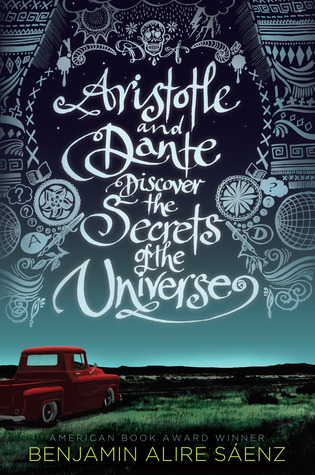
Review | Aristotle and Dante Discover the Secrets of the Universe, Benjamin Alire Saenz

12000020This is by far one of the best books I’ve read all year. It’s a story about friendship and family and all the things people don’t say. It’s about silence, and the consequences of that silence, and it’s told in lovely, heartfelt prose. Saenz’s gift is subtlety — beneath a story ostensibly about a friendship between two Mexican American boys is so, so much more. The prose invites the reader to reach deeper, to attempt to grasp what lies between the lines, and yet the story works because there is so much more than what is within our grasp. Like Aristotle and Dante, we sense the depth of secrets the universe has to offer, and as they eventually realize, we find the answers much closer than we might expect.

One late afternoon, Dante came over to my house and introduced himself to my parents. Who did stuff like that?

“I’m Dante Quintana,” he said.

“He taught me how to swim,” I said. [p. 32]

Ari is a bit of a misfit. He has no friends, literally, and always feels out of place when talking to boys his age. His older brother is in jail, for a crime Ari has never been told; his parents never want to speak of the brother, and his father, a stoic, distant man, is struggling with PTSD from the Vietnam War. So when Ari meets Dante, a friendly, open book of a boy who is casually affectionate with his parents, it almost makes no sense for them to get along, and yet they click immediately.

In both family and friendship, while the connections that form may be easy, the relationships are never quite that simple. The contrast between the boys’ families is sharp, and Ari understandably finds it difficult to trust that Dante’s family’s warmth toward him is genuine. Then an accident alters Ari and Dante’s friendship, and forces both to face things they may have been much more comfortable keeping hidden.

And yet there are consequences to keeping silent, and the characters understand that all too well. The refusal of Ari’s parents to talk about his brother causes Ari to have nightmares, all these memories struggling to surface and yet being held back. Similarly, when Dante gives Ari his sketchbook, which he has never shown anyone else, and Ari refuses to look at it, it’s because of what Ari fears — and knows — he’ll find inside. Each time, not talking about something is the easy choice, and each time, it also turns out to be the more problematic one.

I discovered Aristotle and Dante Discover the Secrets of the Universe at Glad Day Bookshop. I asked the bookseller for the best novel he’d read recently. Without hesitation, he handed me this book. Turns out I’d bought the last copy he had in stock, and I discovered on Twitter the next day that there was someone after me who also wanted to buy it. I read it, absolutely loved it, and recommended it to my sister. Upon reading it, she marked it as a favourite in Goodreads and did a Google search for other books by this author. That’s just the kind of book this is. So read it. I hope you like it, and if you do, pass it on.

Review | Revenge Wears Prada, Lauren Weisberger

DevilWearsPradaMerylStreep2I have a confession to make. When I say I love The Devil Wears Prada, I’m really talking about the movie. I did read the book, and I do remember liking it. But when I squee in delight at the idea of a sequel, and beg the publisher for a review copy, well, it’s the elegant, formidable Meryl Streep that’s in my mind. Seriously: an icon. And while I can barely remember the book apart from the movie, this sequel makes me think the author has a lot to thank the filmmakers for.

I had high expectations for Revenge Wears Prada, and the book was a disappointment. Biggest problem: too much Andy, not enough Miranda. My mom originally bought me the first book because she thought that as an aspiring writer myself, I would relate to Andy. I did see myself in Andy, the wide-eyed fashion don’t who dreamed of a byline in the New York Times, but it was Miranda who made the story such a cultural icon. When I heard of the sequel, set ten years after the events of Devil Wears Prada, and the book blurb hinted that Miranda may be plotting something diabolical for Andy, my first thought was disbelief that someone like Miranda would waste her time on someone so insignificant. (To the Miranda in my mind, no one really was worth wasting her time on.) Still, I figured if anyone can come up with an epic revenge plot, it would be Miranda Priestly. Unfortunately, and this may be more the marketing department’s fault than the author’s, there was no epic revenge plot and Miranda was barely even in the book. The few scenes she was in, she dominated, and each time I kept wanting to delve more into her story. Each time, however, the story shifts away back to Andy’s life now, and I keep wondering where Miranda went.

cvr9781439136638_9781439136638_lgAgain, part of that might be because I have Meryl Streep’s Miranda Priestly in mind rather than the character Lauren Weisberger originally wrote. As one of the interviewees in the Devil Wears Prada DVD extras points out, Meryl Streep has a natural seductiveness to her — even when being the boss from hell, she still manages to draw people in. So, when in Revenge Wears Prada, Andy suffers from PTSD-type symptoms from her experience, I felt like telling her to get over it. At one point, Emily tells her Miranda was a horrible boss, but hardly “the devil incarnate” and Andy scoffs at that, as presumably should the reader, but this reader at least agrees with Emily. Sure, Miranda’s demands were unreasonable (the unpublished Harry Potter manuscript!), but really, after a decade, to still be having nightmares and to still go into panic attacks at the thought of encountering Miranda again? Andy: seek help.

In Revenge Wears Prada, Andy and Emily have teamed up to create The Plunge, a high end, aspirational wedding magazine. It is so successful that Miranda Priestly wants to acquire it for her own publishing company. Emily is thrilled at the opportunity and the sales price, but Andy can’t deal with the thought of working for Miranda again. It’s a fairly straightforward business proposal, where Andy and Emily deal more with Miranda’s lawyers than with her directly, and calling it “revenge” just raises expectations for something juicier. Instead, the story focuses more on the character of Andy, who is married now and expecting a child. She is also dealing with a (mostly absent from the story) mother in law who doesn’t like her, a fear that her husband may have been unfaithful, and a strong attraction to an ex-boyfriend. All this is an okay story, but Andy just isn’t a compelling enough character to propel it to greatness.

There are also some niggling plot holes and inconsistencies. I can accept Andy being unable to break into the field of investigative journalism, but a high end wedding magazine requires a completely different skill set (more visual, highly tuned to designers and all the artistic touches), and it’s quite a stretch to imagine Andy having developed that skill.

Revenge also includes a cameo by Rafael Nadal, a thinly veiled reference to Anna Wintour’s friendship with Roger Federer. The problem is, anyone who’s heard even a single Nadal interview knows he would never be that smarmy. He sounded more like a sleazy salesperson than anything, and I doubt Weisberger was able to capture even the more polished Federer’s cadence.

Still, Revenge Wears Prada is an enjoyable enough book. It’s a quick read, a fun way to spend a lazy afternoon. It just really, really needed more Miranda Priestly. That’s all.

+

Thank you to Simon and Schuster Canada for a copy of this book in exchange for an honest review.

Review | The Next Best Thing, Jennifer Weiner

I like Jennifer Weiner. I like her Bachelorette tweets, and I applaud her for calling attention to the gender imbalance in mainstream book reviews. I loved In Her Shoes  — that scene where Cameron Diaz’s character (who has difficulty reading) reads a poem for her sister’s wedding makes me cry every time. And yes, when I read it in the book, that scene made me cry as well.

So, when in the mood for a fun, lighthearted read, I decided to pick up Weiner’s new book The Next Best Thing. The book is about Ruth Saunders, a young writer who moves to Hollywood with her feisty grandmother and gets the green light for her sitcom, the eponymous Next Best Thing, about a young chef who moves to the big city with her feisty grandmother. Fine. A lot of writing is autobiographical, and even with the additional meta layer (meta meta?) of Weiner herself having been a screenwriter, I could deal with it. After all, I started the book looking for a fun, lighthearted read, not an earth shattering emotional tale.

Weiner adds gravitas to her character by giving her physical scars. Ruth’s parents died in a car crash when she was a child; she’d been in the car with them and her scars had never healed. In one of the few truly poignant scenes in the book, eight year old Ruth writes in her diary, “I will never be beautiful.” Personally, I thought it was a bit much — physically scarred Ruth writes about an overweight chef, hoping to inspire other girls who don’t fit the traditional idea of physical beauty. Ruth also falls in love with a man who is paralyzed from the waist down. It’s a bit heavy handed with all the physical and emotional scarring, though to Weiner’s credit, she never gets maudlin about them.

Here’s the thing though: I really didn’t like Next Best Thing. It read like a mediocre sitcom meandering from plot point to plot point yet never hitting its stride. My overall reaction: meh. And in my view, such indifference may be an even worse reaction than utter disgust. 50 Shades of Grey at least, while much, much more horribly written, at times fell into the “so bad it’s funny” category. Weiner had some funny lines — I especially love the description of one man as looking like a favourite uncle who’d bring you the latest Baby Sitters Club book, and one woman whose cleavage was big enough to hide an iPad. Overall, however, I was reminded of something a character said about the process of a screenplay being turned into a TV show: it’s a lot of waiting. Reading this felt like that, checking off plot point boxes one by one while still waiting for something to happen that’ll make you care.

The crux of the plot is that Ruth had written a screenplay that would inspire the everywoman. Her character was plus size, insecure, yet witty, and that character’s success will inspire the viewers to go for their own dreams. Hollywood takes over Ruth’s show and begin to turn it into a standard sitcom, with a size zero heroine, crazy sex-crazed elderly lady and stupid, sexist jokes.

This story could work only if we believed that Ruth’s original screenplay was worth fighting for. It’s not. We are given scenes with Ruth’s unadulterated vision, and later see her dismay at the studio’s interference, and all I could think of was that while the edits did make the show more stupid and offensive, they weren’t much worse than the original. The scene that Ruth was so proud of, an emotional, rah rah scene between the heroine and her grandmother, just sounded trite. I admit, a confrontation scene between the heroine and an ex-boyfriend did make me cheer, but that was one good moment in a TV show pilot that we’re supposed to believe would have been the next Golden Girls, if only Hollywood hadn’t interfered. It’s not. Even Ruth’s original is blah, and because of that, the stakes for the entire story are depressingly low.

As for the subplots — Ruth’s relationship with her grandmother and her crush on her boss (the aforementioned paralyzed man in a wheelchair) — again, the stakes just aren’t high enough to care. The grandmother is the most colourful, most interesting character in the book. I love the description of her waltzing into a restaurant like a movie star and the maitre’d wondering  who she was. Unfortunately, she isn’t given many interesting things to do, and serves mostly to provide rah rah support to her granddaughter. Even the big conflict that put Ruth and her grandmother’s relationship at risk — while it did have the potential to be big and emotional — barely fizzles. The romance is sweet, and the sex scenes endearing, but again the conflict feels contrived and the outcome easy.

I wasn’t expecting to be blown away, but I was expecting to be entertained. Unfunny and lacklustre, The Next Best Thing failed to deliver.