
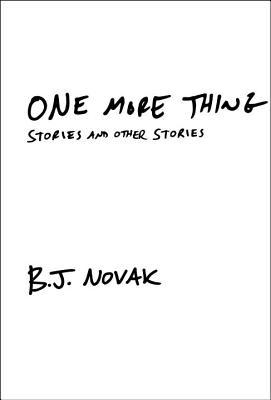
 B.J. Novak’s short story collection One More Thing is uneven in quality. The stories are comedic, not necessarily all laugh out loud funny, but more the kind of comedy where you end up with a knowing, somewhat bemused, smile at the end. The punchlines in these stories are shared knowledge, insight from an experience that seems fantastical at first, yet is revealed to be familiar by the punchline. I like B.J. Novak in The Office, and from his bio, I know that he is a writer as well as an actor, so this isn’t just one of those ghost-written Hollywood celebrity titles. I love the cover of the book, the casual, confidential tone of the title echoed in the scribbled intimacy on the jacket. I also like the conceit of the first story — a rematch between the tortoise and the hare, this time with the hare determined to win. Despite the adage at the end, it is the hollowness of victory that resonates long after reading the tale. So when I began this book, I was very much predisposed to loving it.
At his best, Novak is very, very good. Particularly in some of his longer stories, he turns a lens towards an aspect of life that is right on point, though his approach is so sly that it takes a while to get the point, if indeed we ever do. In one of my favourite stories, a man seeks out his grandmother in heaven because of a childhood promise to meet up after death, except the grandmother keeps putting him off, and it turns out, she’s too busy partying with Frank Sinatra, Elvis Presley and the like to hang out with him. The punchline is in the big reveal, and there’s the comedic moment of surprise and reversal. But like any good comedy, the power is in the emotion beneath the surprise. There’s something bittersweet about the ending — when the grandmother explains to the man that they’ve both changed since that childhood promise was made, it reminds us of how much we do change and lose our childhood selves. But there’s also something satisfying about it — both grandmother and grandson end up happy, living separate lives in heaven. I’m not quite sure what the story means, but there’s that sense at the end of it, as in all good stories, that there is something indefinable beyond the page.
In yet another favourite, a man purchases a made-to-order girlfriend, who is perfect in every way, until she starts becoming emotionally needy and he is ill-equipped to cope. A somewhat less restrained version of the movie Her, except unlike Scarlett Johansson’s character, the one in this story is stuck in a particular body and unable to explore the world beyond being the protagonist’s girlfriend. The story is thoughtful and smart, and while I wish Novak had added more complexity to his characterizations, the story still packed a punch.
Despite some strong works, many of the stories are simply okay. There’s the slightest touch of insight at the end, yet the impact fails to linger barely a page after. It’s possible to make a really short story (less than a page long) powerful, yet many of Novak’s shorter works are more likely to elicit a shrug and turn of the page than anything else. You’d think, “Uh huh, so what?” then realize Novak’s left you nothing to work with and you just need to move on to the next story. Worse are some stories that seem too self-consciously funny or clever. You can just hear the suspense building up and the comic letting loose with a punchline and waiting for the audience to laugh. It doesn’t work on the page — the buildup is too brief and the punchline not enough of a surprise to elicit the desired response. And the obviousness of what that desired response should be just makes it annoying.
One More Thing is worth checking out at a library for a few gems. It’s best read by dipping into a story at a time, in between other tasks in the day, rather than read cover to cover, particularly in one sitting. I’ve heard good things about the audio book, which was narrated by Novak himself and some other well known actors, and perhaps that’s a much better medium for this.
+
Thank you to Random House Canada for a copy of this book in exchange for an honest review.

 Literary Treats