
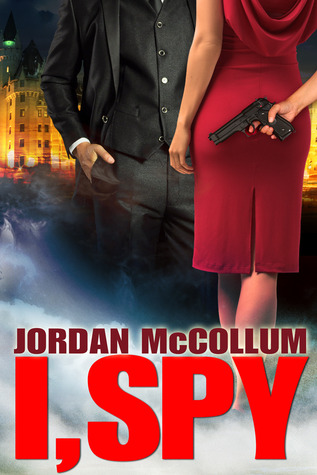
Review | I, Spy, Jordan McCollum

17852668Jordan McCollum’s I, Spy, the first in a series starring CIA operative Talia Reynolds, is an entertaining spy thriller. One doesn’t traditionally associate Canada with high-stakes espionage, so I love that Talia is stationed in Ottawa, and that her department has to coordinate with CSIS. Even more interesting, Talia is a Mormon, yet another detail not traditionally associated with contemporary fiction in general, never mind the spy thriller genre.

In this book, Talia is asked to investigate Russian aerospace executive Fyodor Timofeyev, whom CSIS and the CIA suspect of being a spy. Unfortunately for Talia’s personal life, her investigation requires her to pretend to date Fyodor, both to pump him for information and also to distract him while other agents search his room. This comes at a time when her relationship with her boyfriend Danny is on the rocks, mostly because she has been breaking a lot of dates with him lately for work-related matters. Worse, she’s spending even more time with her co-worker and best friend Elliott, and while the relationship is completely platonic, Danny is starting to get jealous.

I, Spy is a fun, action-packed read. I love the references to Ottawa landmarks, although I do think the author went too far in explaining all the minor Canadian-isms. This may just be because I’m Canadian myself, but when a couple of characters buy coffee and donuts at a Tim Horton’s, I didn’t think it necessary for the narrator to explain that a Tim Horton’s is like a Dunkin Donuts.

McCollum has a breezy writing style, and a talent for describing action scenes. At times, Talia and Elliott almost appear superhero-like in their uncanny ability to dispose of bad guys and get out of bad situations, and at times I wished for more realism, but even glossed up, this remains an exciting read. McCollum saves her realism for the personal subplots — Elliott’s fears about his wife’s pregnancy distracting him from performing his CIA duties, Talia and Danny’s repeated miscommunication and resulting strain on their relationship, and, in the most striking passage in the book, Talia’s raw emotions after being sexually assaulted. While most of the plot features the high-stakes espionage operation, the heart of the story lies in the characters’ personal lives, and McCollum reveals the human side of the operation.

+

Thank you to the author for a copy of this book in exchange for an honest review.


Review | Compound Fractures, Stephen White

17415169As he proved with the shocking ending of Line of Fire, Stephen White is not afraid to blow his characters’ world to smithereens. In Compound Fracturesthe final book of the Alan Gregory series, White holds nothing back. Secrets are revealed, long-held beliefs are shattered, and poor Alan Gregory’s life just spins faster and further out of control.

I’ve followed the Alan Gregory series from the beginning, and love the psychological insights into criminal behaviour. Unlike Jonathan Kellerman’s Alex Delaware series, White has no compulsion about killing off major characters or destroying illusions. Fairly rare for a series, nothing in Alan Gregory’s world is sacred, and while I still can’t forgive what White did to poor Adrienne, I have to admire his take-no-prisoners stance. From Line of Fire, I knew I could expect Compound Fractures to be epic, and indeed, far from winding down, White ratchets it up all the way to the final few pages.

Personally, I think he took it too far. There was a lot going on in this book, and a lot of major revelations made. White’s strength is in psychological realism, and the intimate, personal moments between characters that hit hard. There’s some of that in here but because there was so much of it, White squanders many an opportunity to explore these characters’ psyches. The result is a bit of a soap opera take on events – we are told certain things, we are shocked by certain revelations, and we wish we could delve deeper, but alas, the series is at an end.

For example, we learn why Diane acted the way she did in Line of Fire, but unfortunately, she is mostly absent in this book and so we barely get a chance to understand her motivation. Considering how anomalous her behaviour was, I did want to hear more from her, and at least get a taste of what was running through her head at the time.

Lauren as well is revealed to have a secret that incredibly impacts upon Alan. I love the psychological realism of Alan’s response, and I particularly like how the use of Christian Louboutin shoes reveals the complexity of Lauren’s feelings about her multiple sclerosis, but again I wish the other characters privy to this secret reacted in a less caricature-like manner.

An incident from Sam and Alan’s past comes to a head in this book, and while that forms the bulk of the mystery component of this book, and while it certainly ratchets up the tension, it mostly felt tacked on. I didn’t really understand Alan’s distrust of Sam, considering how long they’d been working together, and with regard to this plot thread, I mostly found Alan annoying.

Finally, the Elliott Bellhaven subplot started out utterly fascinating, but the big reveal at the end felt contrived. Again, White is at his best when dealing with the personal, so adding the large-scale political angle to Elliott’s story when there was already so much going on with him, seemed jarring.

That being said, it’s a fantastic series, and while I think White could have done more with the book, I was mostly satisfied with the ending. I loved seeing these characters grow, and I especially loved how deeply personal this story felt with regard to Alan Gregory’s character. He’s changed a lot from the beginning of the series, and by the end of the book, you can’t help but feel wistful at letting him go, but at the same time also feeling like it’s time to let him rest, and to give him privacy to deal.

+

Thank you to the author’s manager for a copy of the book in exchange for an honest review.
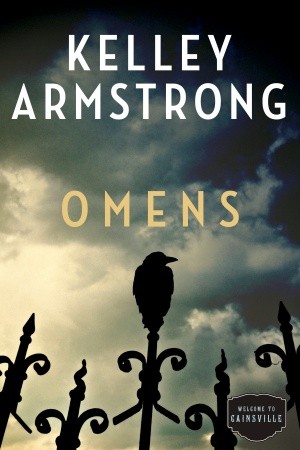
Review | Omens, Kelley Armstrong

cover-2Imagine being the only child of a multimillionaire. You volunteer at a drop in shelter, helping young women put their lives back together, and you’re engaged to a handsome young CEO with political ambitions. Then imagine finding out that you were adopted as a child and that your biological parents are notorious serial killers and are now serving life sentences.

I’m a huge fan of Kelley Armstrong’s books, and to be honest, I think the serial killer parents angle is a potent enough hook to launch a hell of a series. As the book cover suggests, however, the story has a supernatural twist to it. The first in Armstrong’s new Cainsville series, Omens has almost a Stephen King feel to it, with eerie, inexplicable things happening in a strange small town. 

When heiress Olivia Taylor Jones learns her birth parents are serial killers, she runs away from the media circus and hides in sleepy Cainsville, Illinois. Small towns are notorious for not being welcoming to outsiders, but Cainsville takes this to a whole other level, and Armstrong immediately builds a sense of everything hinging upon the town’s supernatural aura. Olivia’s arrival in Cainsville is hinted to be destiny, somewhat because of her birth parents’ mysterious link to the town.

There’s a lot going on in this novel, and Armstrong masterfully weaves all the plot threads into an atmospheric page turner. A visit to her birth mother leads Olivia to investigate her parents’ crimes with the help of her mother’s former lawyer Gabriel Walsh. Is it possible that her parents are innocent after all? At the same time, Olivia is beginning to develop strange abilities — nothing too superhero-ish but rather something so subtle one would even wonder if incidents were in fact supernatural or mere coincidences. Olivia can read signs — a black cat or a certain flower catches her eye and an old rhyme pops to her head, a rhyme that uncannily turns out to be accurate. We know that it’s supernatural because of everything else that’s happening in the book, but I can just imagine something similar happening to myself in real life and dismissing it as mere coincidence. With the popularity of much more kickass super powers, I love the subtlety of Olivia’s, and I love the sense of unease Armstrong cultivates by hinting at but never quite fully revealing the reasons behind Cainsville residents’ odd behaviour.

The mystery behind Olivia’s parents’ innocence leads to a rather elaborate plot that reaches far back into the past. As with the supernatural angle, Armstrong reveals enough to make this book end on a sort of resolution, yet with enough left to still be investigated in future volumes. 

It took me a while to warm to this book. Olivia seemed rather spoiled and naive, particularly in the first part of the book. I love that Armstrong made her twenty-four, as similar books are more often found in the YA market, with teen protagonists. At the same time however, there are times when Olivia seemed immature — when her boyfriend fails to run after her after an argument, she is devastated and thinks that proves they shouldn’t be together. She may have been right, but her reaction struck me as petulant and overly romantic, a naive young woman longing for the swelling music and dramatic embrace from the movies. Yet at other times, Olivia seems far too self-assured for twenty four. The way she negotiates with Gabriel and the confidence with which she deals with her situation are remarkable, and rather questionable considering how sheltered her life has been so far. 

Still, by the last few chapters, I was devouring the pages and postponing dinner plans as because I couldn’t wait to see what happened next. Once Armstrong delves fully into the Cainsville setting, the reader gets sucked right into an exhilarating ride. By the end of the book, I just wanted more, and I can barely wait till the next book in the series.

+

Thank you to Random House of Canada for a copy of this book in exchange for an honest review.