
Review | The Dead in Their Vaulted Arches (Flavia de Luce #6), Alan Bradley

17834904The Dead in Their Vaulted Arches takes the Flavia de Luce series in a completely different direction, and while the writing is still great and the mystery enjoyable, I’m not quite sure how I feel about this shift in the series.

The book begins with the return of Flavia’s long-lost mother Harriet, and what that means for the de Luce family. Waiting on the platform for her mother’s train, Flavia receives a hurried, whispered message from a mysterious man, who shortly after gets killed on the train tracks. Winston Churchill makes a cameo, there is a mysterious reference to pheasants, and Flavia returns to Buckshaw with her family. All of this happens in the first chapter of the grandest Flavia de Luce adventure yet.

Previous Flavia mysteries have had a cozy feel, Nancy Drew meets Miss Marple in a small village setting. There have always been hints in the background at a larger mystery involving the de Luce family (much of which I admit I chalked up to Flavia’s rich imagination) and Vaulted Arches finally tackles this mystery head on. Bradley takes Flavia de Luce into Maisie Dobbs territory. There is espionage, matters of national importance, secret codes, and Flavia is caught up right in the thick of it. We still get the classic Flavia elements — bickering older sisters, Dogger, Buckshaw — but the stakes are higher than ever before.

Vaulted Arches also introduces a more mature Flavia. Much more thoughtful than in previous instalments, Flavia appears very conscious of being twelve and on the verge of growing up. She still has her delightfully childish moments, most often when dealing with unlikeable cousin and new character Undine, but overall, this is Flavia growing up, and kudos to Bradley for keeping it real and allowing us to see the character develop. We also get to see a classic Flavia de Luce science experiment, Flavia’s darkest and most disturbing attempt in the whole series, yet also the most fraught with emotional heft. Also a nice counterpoint to Flavia’s growing up, the experiment reveals an almost desperate need to cling to childlike belief, because the potential payoff is so very high.

It’s difficult to keep such a long running series fresh, particularly when there is such a significant thread of a backstory tying everything together and preventing the series from being purely episodic. So in a way, I’m glad Bradley took the series in this direction — it’s a natural progression for Flavia as a sleuth and a way to take the mysteries to another level. Future Flavia mysteries will likely continue on in this vein, and the very next one (minor spoiler alert) will be set away from Buckshaw, a clear signal that this is a whole new type of Flavia de Luce mystery. Personally though, I’ll miss the cozy, small scale feel of the first few mysteries. I’ll certainly keep following the Flavia mysteries, and am excited to see how Bradley takes this series forward, yet I’ll always have a special place on my shelf for the beginning of the series, and the irrepressible turn of the century Nancy Drew racing around the dark passages of her family estate.

+

Thank you to Random House Canada for a copy of this book in exchange for an honest review.
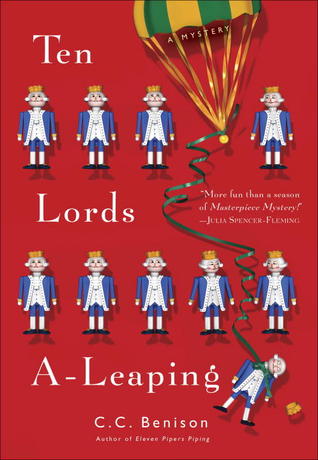
Review | Ten Lords A-Leaping (Father Christmas Mystery # 3), C.C. Benison

17568763Father Tom Christmas sprains his ankle during a charity event and is forced to convalesce in an estate in town, where a large number of relatives are in the area for that same charity event. One of the family members is murdered, and Father Christmas is pulled into the investigation. Benison has set up a classic Agatha Christie style cozy mystery with Ten Lords A-Leaping, with the requisite large number of possible suspects, family secrets and scandals, and detached observer ticking away at the clues.

It’s exactly the type of mystery I usually love, yet I couldn’t get into this one. There is a long list of characters and possible suspects, which shouldn’t be a problem except none of them really stood out. I found it difficult to keep track of who people were and I often found myself flipping back several pages to try to remind myself who that person was. I hadn’t read the second book, and it’s been years since I’d read the first, so that may be why it took me a while to get to know even the series characters, and it definitely didn’t help that the new characters were so interchangeable.

The story felt pretty plodding, and while a slow pace is par for the course for this type of mystery, this one just felt bogged down. Interspersed throughout the mystery are letters by Father Christmas’ housekeeper Madrun to her mother, about the goings on in the estate, and perhaps this is a series signature, but it just felt unnecessary. The subplot with Father Christmas’ daughter and one of the teens in the estate trying to solve the mystery themselves was entertaining, and I liked the hint of romance between them.

The plot seems simple enough — there’s a fortune at stake and the victim was pretty universally disliked. Still, the plodding pace and confusion of characters harmed the clarity of the basic plot, and by the time of the big reveal, I hadn’t connected enough with the characters or the mystery to care whodunnit.

The Father Christmas books are fairly popular, and Benison’s writing is good enough that I’d certainly give this series another shot. As a series detective, Father Christmas strikes me as being unmemorable other than his unusual name, and there is only so far you can go with a pun. Still, there are nine books to go, and plenty of time for the series to find its legs. In the meantime, Miranda is the sleeper in this series, and it will be interesting to see how her character develops.

+

Thank you to Random House Canada for a copy of this book in exchange for an honest review.

Review | Murder Chez Proust, Estelle Monbrun

16284882Can Marcel Proust inspire one to murder? In Murder Chez Proust, Adeline Bertrand-Verdon, the unlikeable president of the Proust Association, is murdered just before a Proust convention. There is an assortment of suspects, including colleagues, lovers, and her assistant Gisele Dambert. Through a stroke of luck, Gisele owns a set of previously undiscovered notebooks used by Proust which proves the originality of a key scene in one of his most famous novels. It would have settled a debate in Proustian circles, and Adeline was going to steal Gisele’s research and publish a book.

Gisele is probably the most intriguing character in the book – an aspiring Proust scholar who lives with her cat and has a penchant for carelessness. She makes some idiotic decisions, such as letting Adeline know about her research, but overall, you root for her to succeed.

Murder Chez Proust is a solid, entertaining cozy, with an Agatha Christie-type list of suspects, and a genteel approach to murder. As someone unfamiliar with Proust’s work, I probably missed a lot of the significant little tidbits the author provided, but I did enjoy the description of how the interpretation of a single scene in one of his books can cause such heated scholarly debate. I wish the book had been more steeped in the academic world – the strongest scenes featured the politicking that goes on behind the publication of academic research, and I would have liked a bit more sense of that atmosphere.

There was a subplot mystery that I admit drew most of my attention — Gisele loses the Proust notebooks and tries to track down a hotel employee who had held them last. In some ways, it stole the spotlight from the main murder mystery, but it may just be because Gisele is a more interesting character than Adeline who, though villainous and potentially intriguing, was never quite fleshed out enough to go beyond a stereotype.

+

Thank you to Thomas Allen for a copy of this book in exchange for an honest review.