
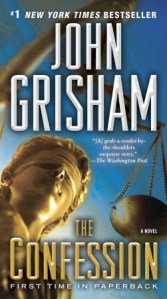
Review: The Confession, John Grisham

I grew up reading John Grisham. The Firm was the first adult novel I’d ever tried to read. I remember being fairly young, and trying to figure out how people ever kept so many characters and subplots straight. I’m still a fan of his earlier legal thrillers, but I haven’t read him in a while (Bleachers is pretty well-written, but I prefer his legal thrillers, and I haven’t really enjoyed any since The Partner). So when I saw The Confession, I decided to check it out, and see if I could recapture the excitement of the earlier thrillers.

I was absolutely disappointed. It started off interesting, with a man named Travis coming to a church in Kansas and confessing that he raped and murdered a girl in Slone, Texas about a decade ago. The pastor, Keith, is unsure whether or not to believe him, but some online research reveals that Travis has a long record of sexual crime. The veracity of Travis’ confession is especially important because Donte, a classmate of the victim, had already confessed to the crime and convicted nine years ago, and will be executed in Slone in a couple of days. Travis isn’t allowed to leave the state, yet Keith can’t let an innocent man die either. So far, a promising premise.

Unfortunately, The Confession quickly becomes an anti-death penalty manifesto rather than an actual story. We know within the first few chapters that Travis is telling the truth; we can also predict fairly early on how Keith will decide to try to save Donte. The main conflict then is a race against time to save Donte. Grisham focuses mostly on people and events in Slone — Donte’s lawyers and family, the victim’s family and the media. Because Donte is black, Slone mostly divides along racial lines, with the black community protesting Donte’s innocence and the white community calling for his blood, and race riots threatening to erupt. Still potentially exciting, but Grisham reduces his characters to stock figures. Donte’s lawyer is idealistic, and his family is just after justice. The victim’s mother is mostly after fame; the prosecutor and governor are concerned only about looking good on camera. Worse, it turns out Donte was completely screwed by the system for nine years — his confession was coerced, the prosecution’s star witness was clearly jealous of Donte, all his appeals failed despite having merit because of politics, the original trial judge was even shown to have been sleeping with the prosecutor. Such a corrupt system, such a victimized young man. We get it. Enough. And yet Grisham continues revealing injustice after injustice after injustice. It began to feel like a soap opera, where some villain was manipulating the strings to make life as difficult as possible for the poor hero.

Grisham has always advocated a clear side on issues (mostly: rich corporations = bad, pro bono lawyers = good), but it hasn’t bothered me as much as in The Confession. It’s not even that I disagree with him about the death penalty (to be honest, I haven’t really made up my mind on the issue yet). But Grisham’s other novels at least had an interesting story and likable characters to go with the soap box. By completely removing the ambiguity from the characters, Grisham presents The Confession as an argument on why the death penalty should be abolished. It can’t even be called a debate, because he refuses to make any of the pro-death penalty characters sympathetic, nor does he explain their reasons for advocating the death penalty, beyond their need to pander for votes (the governor) or the desire to be on camera (the victim’s mother).

Because the characters are so one-dimensional, and the conflict so straightforward, The Confession was boring. Certainly, Donte’s situation was unjust, but Grisham makes him into such a martyr that I almost wanted it to turn out that Donte really did kill the girl after all. Unfortunately, the story unfolds pretty much as expected. I can understand why Grisham would be against the death penalty; I can even understand why he’d be so angry he wanted to tell us why the death penalty should be abolished. It’s just, in a novel, I prefer to have a story as well.

Review: Sing You Home, Jodi Picoult

In Sing YoHome, Jodi Picoult explores the issue of gay parenting. Music therapist Zoe and her partner Vanessa want to have a baby, using frozen embryos from the time Zoe and her ex-husband Max tried to have their own baby. Unfortunately, since the divorce, Max has become a member of a conservative Christian church. He believes homosexuality is a sin, and would rather his and Zoe’s embryos be implanted in his sister-in-law’s womb, for her and Max’s brother to raise in a Christian household.

Picoult handles the issue well, presenting both sides fairly. Even Max, the “bad guy,” is a sympathetic character, a recovering alcoholic who has found solace and a community in church, and is genuinely trying to reconcile his newfound beliefs about morality with his knowledge that Zoe is really a good person and would become a good mother. While I can’t personally understand Max’s pastor’s position, I think Picoult shows well how thoroughly he believes what he says, and so his motivation, however misguided I think it, is primarily to provide for the spiritual welfare of the people at his church. Picoult clearly shows her belief that gay couples should be allowed as much right to parent as straight couples, and while I completely agree with her, I’m also glad she made Zoe’s lawyer as arrogant and focused on political agenda as Max’s lawyer is. Zoe and Vanessa are wonderfully developed, flawed characters, and I’m glad that Picoult chose to show characters rather than just present her take on the issue.

It was near the beginning of the book, however, where Zoe and Max were dealing with their most devastating failed pregnancy yet, that really hit home for me. Zoe recalls being called into a dying pediatric patient’s room to provide some music therapy. She starts playing a melancholy melody, to fit in with the mood of the family, but they ask her to play instead the dying child’s favourite songs, mostly upbeat nursery rhymes. She does, and the family sings along, until the child passes. Zoe remembers that, and realizes that she is incapable of playing anything for her own child, that all she can do is hold his body and while she wants to give him some music, she can’t.

My mom passed away a couple of months ago, and at her wake the night before the funeral, we had a band play her favourite songs. I remember a cousin looking at me, brows furrowed, a few moments after the band began: “Is that Barry Manilow?” Not exactly in line with the solemn, sombre mood, but it was the most we could do for Mom. The worst part is knowing how inadequate it is, and how no matter what we did, there was no way we could give Mom any more. So, reading that scene in Sing You Home took me back to that evening. Since my mom’s passing, I’ve found it difficult to read scenes of characters dealing with the death of loved ones (mostly their children, at least in the last couple of books I’ve read). That scene, in Sing You Home, was just absolutely raw, and real, and I ached with Zoe at her inability to sing to her own child.

Possibly because the beginning, with Zoe and Max dealing with death together, affected me so much, I found the transition to Max’s conversion to Christianity and Zoe’s finding a new soul mate in Vanessa abrupt, and much too convenient. It was just too obviously orchestrated; when Max, after chapters of hating it when his brother tried to convert him, suddenly has a big experience and decides to join a church earlier shown picketing against homosexuality, I just knew that Zoe, who throughout showed no inkling of ever being attracted to women, would suddenly realize she was gay. In fairness to Picoult, she builds up the Zoe/Vanessa romance gradually, but after the emotional impact of the beginning, I felt cheated when I realized the book wasn’t about the relationship (Zoe/Max, who really did seem an intriguing couple) and the issue (Zoe’s desire to be a mother) that I’ve already become so invested in. In a way, it still is about Zoe’s desire to be a mother, but that felt like a minor thread in the main plot about gay rights. While the Zoe/Vanessa romance was certainly believable, there were portions where I felt like I was reading a primer on homosexuality. Vanessa and Zoe reflect a lot on what makes homosexual relationships different from heterosexual ones, which is fine, but I felt more like Picoult was educating us rather than showing the romance develop.

The ending is disappointing, with convenient plot twists that tie everything up neatly, but I’ve come to expect this from Picoult’s books (ever since I was horribly disappointed by the neat, convenient ending of My Sister’s Keeper). So the only thing that really disappointed me here was that I thought Lucy’s story (a troubled teen undergoing music therapy with Zoe) was just left hanging. I definitely wanted to find out more about what happened to her.

Still, overall a pretty good book. Worth checking out.

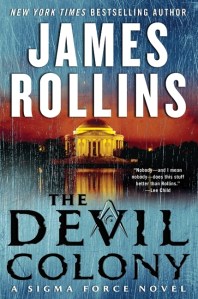
Review: The Devil Colony, James Rollins

Two things you can expect from any James Rollins book: non-stop thrills and really cool science that sounds like science fiction, but is really based on fact. The Devil Colony is no exception, and after two whole years, I’m just happy to spend a few hours again with the Sigma Force team. I love Sigma Force — secret agents with Sheldon Cooper IQs, they’re literally kick-ass nerds. That means that while they’re racing after bad guys action movie style, the problems they try to solve are just as much intellectual challenges as physical ones. It’s Michael Crichton on steroids, and a nerdy adrenaline rush all the way through.

The main plot of Devil Colony is one that, I admit, didn’t really draw me at first: the history of America is based on a lie perpetuated by the Founding Fathers and involving Mormonism. Rollins writes it well, with lots of clues to keep you guessing, and Da Vinci Code-style revelations that call into question commonly accepted beliefs about the history of America. Perhaps it’s just that I’m not American, nor am I that familiar with American history regarding the Founding Fathers. So the revelations didn’t really make gasp the way Dan Brown’s did in Da Vinci Code, where I contrasted it to everything I’d learned in Catholic school. Thankfully, however, Rollins isn’t as wordy as Brown was when discussing all the historical details. Plus, the action is vintage Rollins, and even I was swept along by the mystery and the action.

Call me a nerd, but the part that really interested me in Devil Colony was the bit about nanotechnology. I love how Rollins integrated such contemporary technology, and one I usually associate with futuristic thrillers, with the historical mystery. My main disappointment was that the scientists who were working with Sigma in exploring the impact of this nanotechnology weren’t given more scenes; I would’ve loved to read more about them, and perhaps find out what, if anything, the Founding Fathers thought of nanotechnology.

I also love how Rollins explored more of the Sigma members’ personal lives in Devil Colony. Monk is definitely one of my favourite characters, and I love seeing him in expectant father mode. Gray’s parent issues felt very real, and I love seeing Seichan’s softer, sympathetic side in dealing with him. The book ends with a bit of a surprise twist promising a future plot thread regarding Sigma and the Guild, which is exciting in itself, but honestly, I’m even more excited to see how Gray deals with what has happened in this book and what happens to Monk as a father.

Devil Colony isn’t my favourite Rollins book, but it’s definitely an exciting read. I love it, and I already can’t wait for the next Sigma adventure!