
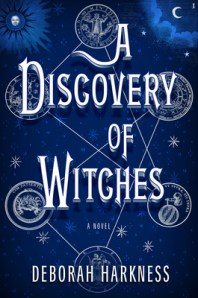
Review: A Discovery of Witches, Deborah Harkness

Deborah Harkness’ A Discovery of Witches begins with an interesting premise: reluctant witch Diana Bishop discovers an ancient book of great power in a library and sends it back. It turns out witches, vampires and daemons have been after that book for centuries, each with their own ideas about what the book contains. Together with tall, handsome vampire Matthew Clairmont, Diana tries to escape all the baddies after her (and the book) and find out more about this book. They fall in love, which unfortunately violates a centuries old treaty that vampires, witches and daemons must not mingle. Forbidden love, a mysterious ancient text and a reluctant witch who, it turns out, has the potential to be the most powerful witch in history — sounds exciting, eh? The beginning certainly was.

Unfortunately, the rest the book felt like the first six hundred pages of a three thousand page novel — full of minor threads that either get resolved or not yet, with no major story arc for the book itself. As a result, a lot of the major dramatic scenes didn’t have the impact it could have. Once, Diana is tortured by a baddie wanting to force her to reveal her powers. She survives and is praised for her bravery. Unfortunately, it comes too early in the novel to feel climactic, and as Diana herself didn’t know what her powers were at this point, her resistance seemed more unavoidable than heroic.

Several major baddies show up, all of whom are given only a few chapters before disappearing, ostensibly to reappear in a later book. The major baddie, who provided what I assumed was the climax, came almost literally out of nowhere. This could’ve been a wonderful surprise twist, if only this particular baddie had been present, even as a shadowy, unknown behind the scenes puppeteer, throughout, but that wasn’t the case. I can only assume Harkness is saving the actual climax for a later book.

Discovery is bogged down by minutiae. Harkness may have been so fascinated about vampire eating habits (they eat nuts!) that she wanted to devote practically an entire chapter to Diana serving Matthew a meal. Halfway through, when I realized the conversation was never going to move beyond Matthew praising Diana’s attention to detail and Diana’s fascination that Matthew can eat solid food, I stopped caring completely. So imagine my horror when only a few pages after this meal, Matthew decides it’s his turn to feed Diana, and to educate her about all the wines he serves. While it must be amazing to taste centuries old wine, by what felt like the tenth bottle described in loving detail, I wanted to swear off wine forever.

Minor quibble, but while I love having a heroine with a great appetite (finally!), Diana eats more toast in one book than Miss Marple drinks tea in all of Christie. That’s how it seemed anyway, from Matthew serving her tea and toast to Diana wondering if they had any more butter. I love foodie lit (Goldy Schulz! Guido Brunetti! Hannah Gruen!), but there’s a reason none of those authors spent this many pages on toast.

Diana spends a huge chunk of the novel in Matthew’s mother’s castle, where she waits around for Matthew and finds out lots about the vampires’ back stories. Way too many pages of nothing exciting happening, and way too much boring information, to the point when, after a few chapters of action, when a vampire I actually liked said “This is my tale to tell,” I had to turn off my Kindle (much less satisfying than slamming a book shut).

This book does have one of the most unintentionally hilarious scenes I’ve read in a while. When Matthew leaves Diana in the castle to go pursue baddies, Diana cries so hard she starts leaking water everywhere and creates a literal flood. Maybe it’s just because it’s such a lame reason to be that devastated, but that made me laugh. It was only afterward, when Matthew’s mother said Diana was the first witch in centuries powerful enough to command witchwater that way (Diana actually became water) and Diana admitted her fear that she’d disappear completely (think Wicked Witch of the West) that I realized the scene was meant to be solemn.

So why did I finish the book? Like I said, the premise was promising, and the parts where the characters talk about the book are interesting. There is also the possibility of a revolution and a war among the witches, vampires and daemons, which sounds exciting. So I do want to find out how this whole story ends.

The next book promises to be about Diana training to use her powers properly. Personally, I’d like to find out how many books Harkness plans to have in this series, so I can wait for the final one and read the last few chapters to see how the war turns out and what the ancient book actually contains. Till then, I leave the toast eating and vampire reminiscing to other readers.
Review: The Beasts of New York, Jon Evans

My initial reaction when I received Jon Evans’ Beasts of New York in the mail was, what a beautiful book! With the rise of e-reading, I’ve long believed that the future of print publishing is in books that are practically works of art. The Madame Bovary translation by Lydia Davis released last year, for example, had such a beautiful cover that I decided against getting the cheaper Kindle ed or waiting for the paperback. I’ve also made no secret at work of my love for the Penguin Essentials series released recently, which prompted me to buy myself another copy of The Great Gatsby.

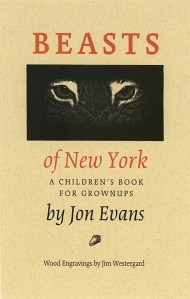
So, when I saw the absolutely beautiful way Porcupine’s Quill printed Beasts of New York, I fell in love with the textured, cream-coloured pages and the ornate letters that opened each section. I also love the wood engravings by Jim Westergard. I was totally grossed out by the one of the rats, but overall, they’re beautiful. I love how realistic the fur looks, and am amazed whenever I remember that these images were originally created on wood. This book is a work of art, an example of the kind of reading experience e-books can’t offer (an image of a wood engraving on a screen will also be beautiful, but not quite as beautiful as on this type of paper, I think).

I was also intrigued by the plot: a squirrel named Patch travels to New York City to search for food and finds out about a war in the animal kingdom. Growing up, one of my favourite books was The Secret of NIMH, and one of my favourite movies was Homeward Bound.. To be honest, the Beasts’ first chapter excerpt on the publisher’s website didn’t really grab me. With details like a squirrel’s home being called a drey, I was afraid the book would end up being like a nature documentary. Luckily, however, the story becomes much more involved than that. I quickly became intrigued by Patch’s adventures, and loved seeing New York City through his eyes. Cars become “death machines” and apartment buildings are “mountains.” In the hands of a lesser writer, I can imagine such descriptions being cutesy, but Evans pulls it off. At times, even I felt like I was traveling in a hostile, utterly alien environment, and I grew up in a city!

Politics — alliances, betrayals, war councils — in this story is wonderfully intricate. What I loved most, however, was that Evans never lets us forget that these are animals. In a particularly chilling scene, when trapped with a group of other animals, Patch sets a fox free from his cage on the condition that the fox swear on the moon (an oath deeper than blood, so powerful Patch literally feels a shudder when he does it) never to eat squirrels again. Other creatures then beg to be set free, so the fox frees a rabbit, then promptly devours it, saying, quite reasonably, that he’d never promised the same for rabbits.

The battle scenes are gory, filled with characters biting each other, and bleeding to death. The ultimate villain, the King Beneath, is an absolutely frightening, mysterious creature. He might not have been as scary if we could just label him a certain type of animal, but because we’re seeing the story through Patch’s eyes and Patch himself doesn’t know what the King is, or indeed if the King is anything more than a legend being used by the power-mad rat Snout, the King is mostly an eerie, shadowy presence to us as well.

The one thing I didn’t like was inclusion of the coyote and the turtle, especially in the last  chapter. For a book with such power in the realism of its details and dialogue, I found the attempt at mythology to be unnecessary. It was like Evans was trying to add gravitas to the story by making it part of a much larger tradition, when I was most moved by the focus of the story on one squirrel, for whom one city already seems too much for the world to contain.

Beasts of New York is a contemporary urban fable, geared for adults, but also a story that I think mature kids will appreciate. There aren’t a lot of adult books starring animals, and Evans’ animals seem less anthropomorphized than the books and movies I remember. Beasts is an exciting tale overall, and a beautiful, beautiful book.

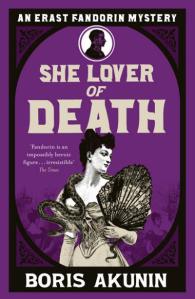
Review: She Lover of Death, Boris Akunin (Andrew Bromfield, trans.)

A huge thank you to my sister Jessica! She introduced me to John Rebus and Guido Brunetti (both detectives and mysteries I adore!), and now she’s introduced me to turn-of-the-century Russian detective Erast Fandorin. Thin and debonair with piercing blue eyes and (quite honestly, the coup de grace) a slight stammer, Fandorin is my latest discovery in the world of gentlemen detectives I love.

She Lover of Death is the eighth book in Boris Akunin’s Erast Fandorin series. There are intriguing hints of Fandorin’s back story (a past romantic tragedy, incredible luck), but since the story is told from the perspective of a young woman who has only met him in this mystery (and in fact only knows him under an alias), I learned just enough to make me want to read the previous mysteries and find out more. Again, since the narrator doesn’t really know Fandorin, I don’t even know if he’s a private detective (he appears to have some problems with the police, so he can’t be a cop), or a Lord Peter Wimsey type character, who solves mysteries as a hobby. All I know of him is that he’s a brilliant detective, a gentleman with a protective streak who gets flustered when he interviews an artist and is faced with a nude female model, and a bit of an adventurer (near the end of the novel, he mentions going off to break a record). A charming man similar to Brunetti and Lynley, but with an air of mystery that makes him even more intriguing.

The mystery in She Lover is fascinating. In Moscow, 1900, a young woman joins the Lovers of Death, a suicide club composed of bohemians. The head of the club is a charismatic man with a romanticized view of Death. Members read poetry at club meetings, and whoever is chosen for suicide has to compose a final poem first. The mystery appeared straightforward at first — we know all about the club fairly early on — and it seemed a well-written, creepy mystery, with the main problem being how to stop the suicide club. However, Akunin introduces plot twists that hint at an actual murderer, and figuring out the identity and motives of this killer is an exciting, convoluted puzzle, and a classic detective story.

I love this book, and am looking forward to checking out the others in the series. Fandorin is a likable character, and I love learning about him from a complete stranger’s perspective. I’m used to reading detective stories from the perspective of the detective or a sidekick figure, so Akunin’s style in this book is an interesting change. The ending is one of those so-obvious-can’t-believe-I-was-fooled type revelations that I love in mysteries. The language is a bit formal, which adds to the atmosphere of the turn of the century Russia setting. The romanticization of Death and naivete of the narrator could so easily have been overdone, but Akunin handles it well. I’m so glad my sister introduced me to this series, and I’m excited to read more about Fandorin.