Review: The Borrower, Rebecca Makkai

Young librarian Lucy Hull wants to help ten-year-old book lover Ian Drake, who has a lively imagination, but whose mother wants him to read only books “with the breath of God in them.” Mrs. Drake also enrols Ian in gay rehab classes with Pastor Bob. So when Lucy discovers Ian hiding in the library after hours and intending to run away, she goes with him. Lucy pretends to believe Ian’s story that he’s really just running away to his grandmother’s house in another state, but the truth is, Lucy just wants to show Ian a world beyond his mother’s rigid boundaries. Rebecca Makkai’s The Borrower is a funny, entertaining book, about the love of reading and the transformative potential of stories.

I love so many things about this book. Both Lucy and Ian are obsessed with reading, which is something to which I can totally relate. While it appears to be only Ian running away, it soon becomes clear that Lucy is also trying to escape something. I love Lucy’s parents; the father especially is such a colourful character, a member of the Russian mafia with so many stories about his childhood. Lucy has always accepted these stories as true, albeit exaggerated. Her realization that her father’s stories may not have been as based on reality as she believed when she was younger is a beautiful, poignant portrayal of our own growing up. I grew up reading a lot, and it kinda sucked realizing high school wasn’t anything like Sweet Valley or finding out Carolyn Keene (who was one of my favourite authors growing up) isn’t even a real person.

The Borrower is a tribute to children’s literature, with lots of references to wonderful books. For example, Lucy’s father ran a chocolate factory in Russia. (What avid reader would not immediately remember his/her experience reading Roald Dahl?) There’s also a chapter written in the style of Choose Your Own Adventure, another of my childhood favourites, and one chapter begins in the style of “This is the house that Jack built.” The story of The Borrower is interesting enough to read, but it’s these little winks to beloved children’s books that I loved the most.

I also love that Ian himself challenges Lucy’s perceptions of him. For example, Lucy sees a scar and immediately assumes Ian is being physically abused, but it turns out not to be the case. Ian glumly borrows some Bobbsey Twins books because Lucy assures him they’ll meet his mother’s “breath of God” requirements even though they’re horrible (as a Bobbsey Twins fan myself, I have to say I’m offended by that). So Lucy assumes Ian only likes to read the kinds of books she does (admittedly also a good list, including The Hobbit), only to be shocked that Ian also enjoys reading a Christian YA series. Lucy can’t understand how Ian can “fall” for that, which I think also shows her own limitations. I liked this because it shows that, although Lucy appears to be the hero, wanting to break Ian free to be himself, she also imposes her own preconceived notions on what he should be.

Not sure how I like the ending. The Borrower ended with a whimper, which felt like a let down after such building up through most of the book. Yet at the same time, the ending also felt very fitting. Like, how else could their adventure have ended, and how else would a book extolling the virtues of reading close its story? The Borrower is a fun, breezy read, and a wonderful homage to the magic of children’s literature. Love reading? This is worth checking out.

Review: The Filipino Heroes League Book One: Sticks and Stones, Paolo Fabregas

I discovered The Filipino Heroes League by Paolo Fabregas on a recent trip to the Philippines, and absolutely love it. The Philippines has its own share of superheroes like Darna and Captain Barbell, but the “undermanned and under-funded” Filipino Heroes League, I think, really shows how superheroes would live in the Philippines if they did exist. As the back cover says, “It’s tough being a superhero but it’s even tougher being a third-world superhero.”

Fabregas got me from the first scene: a Filipino news anchor excitedly relates the exploits of a Filipino superhero who has migrated to America and now works as the sidekick to an American superhero. “A proud day indeed for Filipinos everywhere,” the announcer states. He then mentions in passing a local “raging inferno” with no casualties before moving on to the weather. “Putang ina,” Kidlat (Lightning) Kid says, “We saved 3,000 people in that fire and we don’t even get mentioned.” It’s funny because I can totally see it happening, and it’s sad for that same reason. I also love how the FHL has dwindled in number, because of all the superheroes who’ve become OFH’s (Overseas Filipino Heroes). Again, it’s both funny and sad because it’s true.

The Filipino Heroes League has a dilapidated government building instead of a high-tech fortress. Instead of a Batmobile, they also have a jeep that won’t start, so they end up chasing after bad guys in a pedicab. It’s absolutely, wonderfully Pinoy right up to Kidlat Kid’s crack that pedicab passenger Invisiboy should lay off the ensaimada (a Filipino pastry). I also love how one of the superheroes, who lives at the Payatas Dump Site, has the superpower of being able to create anything from trash (“But it has to be thrown away first”). It’s a third world superpower for a third world superhero, and I found it wonderfully apt.

Fabregas has some delightful tongue-in-cheek glimpses of Filipino culture, like the dozens of billboards along the road featuring the celebrity-of-the-moment and like Kidlat Kid and Invisiboy calling the FHL head “Sir Don” (I can only imagine my boss’ reaction if I call him Sir). In Filipino Heroes League: Sticks and Stones, the FHL has to fight corrupt government officials. Again, I love how Fabregas chose to keep his villains grounded, rather than have the FHL fight aliens. Indeed, if the FHL existed, it would be great if they could help eradicate corruption.

The characters are likeable (I especially love the potential for romance for the sweet Invisiboy), and the story kept me laughing the whole time. My only regret is that this series is only available in the Philippines, so I’ll have to wait for my next visit before checking if the next book is available. To Mr. Fabregas: any chance of an international release?

EDIT 7 November 2011

While I love this book, I wasn’t sure if the appeal would translate to non-Filipinos as well, because of all the pop culture references and (to my mind) inside jokes. To my delight, I discovered that Fabregas’ story does have cross-cultural appeal. I recently lent my copy to my co-worker’s husband, who isn’t Filipino, and he loved the book! He admitted he didn’t completely get some of the references, but he just kinda rolled with it and his enjoyment of Filipino Heroes League wasn’t at all affected. He found it a funny, enjoyable read, and he also liked the superhero who can create anything from trash. He even asked me if there were any more books in the series. So, Mr. Fabregas, if you ever decide to distribute this series internationally, you already have at least two fans in North America! 🙂

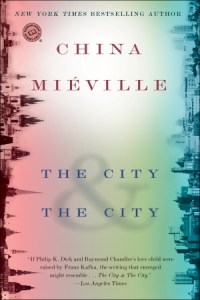
Review: The City & The City, China Mieville

I finished China Mieville’s The City & The City days ago, and to be honest, I’m still trying to wrap my head around it. The novel begins as an apparent classic crime noir: a woman is found murdered in Beszel, and Inspector Tyador Borlu is called in to investigate. Evidence links the woman to neighbouring city Ul Qoma. Thing is, Beszel and Ul Qoma aren’t geographical neighbours as we are used to. Best I can understand, they overlap somehow, and residents of each city train themselves to un-see people and places from the other city, lest they be charged of Breach and taken away. Borlu’s investigation therefore isn’t so much about a murder as it is about the two cities, and the mythical third city that is rumoured to be between them.

The City & The City isn’t a fun thriller to read on the subway or before bed. The murder mystery is certainly interesting, embroiling Borlu in politics, history and legends that may turn out to be true. But it’s far from an easy read, at least for me, and I had to set aside a few hours to sit, read and work things out. My sister and I then spent even more time discussing the relationship between Beszel and Ul Qoma, and trying to figure out the implications of this relationship. The resolution to the mystery itself turns out to be fairly simple — not simplistic, by any means, but certainly nothing as mind-blowing as the political landscape Mieville depicts — and certainly, it’s possible to read this as a straightforward crime novel.

But I think it’s worth quite a bit more thought than that, a bit more of a puzzle than who the murderer is. The more I got into the way Beszel and Ul Qoma work, the more the world in this novel became familiar. My sister suggested that physically/geographically, Beszel and Ul Qoma might actually be the same city, with the distinction between them only psychological, and, more importantly, willed. The further I read, the more that made sense to me, though Mieville certainly opens the nature of these cities up to debate.

City makes you think, in much the same way as Le Guin’s Left Hand of Darkness makes you think. It’s a world absolutely nothing like our own, yet it’s also strangely familiar. I’m not sure if I could say I enjoyed it, but it was definitely worth the read.