
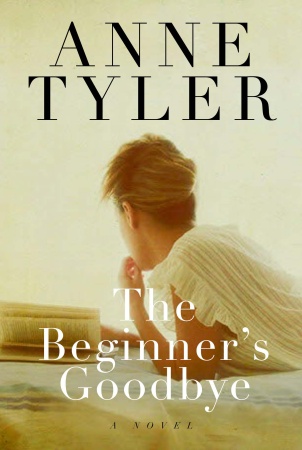
Review | The Beginner’s Goodbye, Anne Tyler

There is no such thing as the Beginner’s Guide to Grief. No such thing as Grief for Dummies. Sure, there are the five stages of grief, but really, they don’t help. Nothing can prepare you for the loss of a loved one, and while dealing with the loss might get easier over time, it will never become easy. Anne Tyler’s The Beginner’s Goodbye is a moving, beautifully written portrait of grief, a story of loss and the desire to put off the goodbye as long as possible.

When Aaron Woolcott loses his wife Dorothy in a freak accident, he finds peace only when she reappears. It’s not a ghostly encounter, nor has he forgotten that she’s died. It’s just, one moment she isn’t there, and the next moment, she is, and her presence gives him peace. Be honest: if someone you’ve loved and lost shows up again, can you imagine telling them to go away?

I originally thought The Beginner’s Goodbye was going to be about Dorothy showing up again, and about Aaron wondering if she’s real or not, but I’m glad that wasn’t the case. Rather, much like her reappearance in Aaron’s life, Dorothy remains mostly a presence in this story — she exists, but the story is really Aaron’s and those around him.

Tyler’s simple, straightforward narrative style keeps her story from ever becoming maudlin. Rather, it feels honest. So often while reading, I would nod and think, yes, I can relate. For example, Aaron hires a contractor to fix his house, but keeps making excuses about why he doesn’t have to be there to oversee the work. That house, after all, is a reminder of how Dorothy had died, and it’s only natural to want to stay away, even past the point of common sense — Aaron, now living with his sister, has to ask the contractor to bring over some of the clothes he’d left behind. A short dialogue, but very, very telling, and an example of how effectively Tyler uses the smallest details to show so much.

I also love this passage:

I realized that I had survived [the loss]… Even though I still felt a constant ache, I seemed unknowingly to have traveled a little distance  away from that first unbearable pain…

And yet, just two nights later, I had one of those dreamlike thoughts that drift past as you’re falling asleep. Why! I thought. Dorothy hasn’t phoned me lately!

…But then I came fully awake and I thought, Oh. She’s dead. And it wasn’t any easier than it had been at the very beginning.

Ever had that happen to you? It sucks.

Coming to terms with Dorothy’s death also means coming to terms with her life, and with their life together. Right after her death is Aaron’s realization that all the idiosyncrasies that had bothered him actually aren’t a big deal after all, and it takes time before he can step back enough to get a more realistic, balanced view of their life together. We meet Dorothy through Aaron’s memories, and through his perception of her after death, and it is through meeting both versions of Dorothy that we learn about Aaron. To be honest, I don’t think I ended up actually liking either character (Dorothy’s really cold, and Aaron, for all his desire for independence, is really needy), but I did believe in them. Tyler makes them feel real.

I wasn’t too happy with the turn the plot took towards the end, but by the time I finished the book, the ending did feel right. I also love the subplots involving the other characters — as anyone who grieves is forced to learn, other people’s lives go on, even while yours feels at a standstill. Seeing other people fall in love is both touching and bittersweet, as we view it through Aaron’s eyes.

The Beginner’s Goodbye is a short book, only about 200 pages, which reminds me of Julian Barnes’ Sense of an Ending. No similarities in the story or writing style, and the Barnes book had much more dramatic twists than Tyler’s. But, similar to Sense of an EndingThe Beginner’s Goodbye is a lazy afternoon read that delivers an emotional punch.
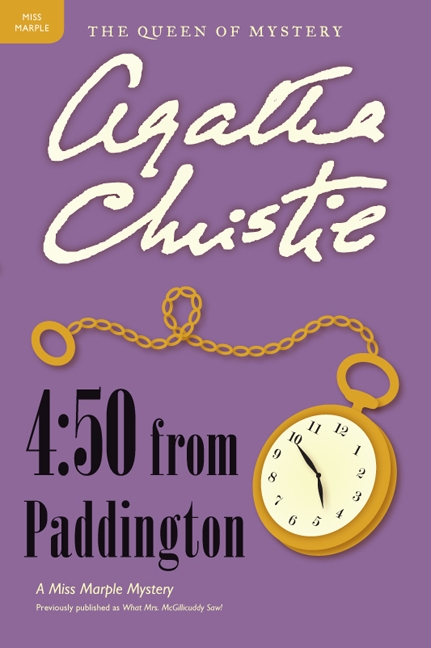
Review | 4:50 from Paddington, Agatha Christie

As I’m writing this, it’s a beautiful spring day, and I’m on my balcony with a cup of coffee and an Agatha Christie novel. Hard to beat that for my idea of a perfect day off. Reading an Agatha Christie is always a treat, and I recently went wild at Turtle Creek Books, where they have a display stand of old Agatha Christie paperbacks, some editions of which even had ads! I’m a sucker for old books and for Agatha Christie, so you can imagine the self-control it took to leave that store with only two Christies.

I’ve always been much more of a Poirot than a Marple fan, and to be honest, haven’t even read a Tommy and Tuppence novel yet. What kind of Christie fan am I, eh? New book pledge for 2012: try a Tommy and Tuppence mystery. In the meantime, however, I still have quite a few Marples to catch up on, and one of them is the classic 4:50 from Paddington. As you may already know, I’m a total sucker for book design, and a major, major fan of the new Agatha Christie paperbacks from Harper Collins. Isn’t that cover just beautiful? My bookshelf has a mix of old, practically falling apart Agatha Christies that I couldn’t resist getting at second hand bookshops, and these beautiful Harper Collins paperbacks, which I also can’t resist just because they’re so pretty.

In 4:50 from Paddington, elderly lady Mrs. Elspeth McGillicuddy is on the train from Paddington when another train passes, going in the opposite direction. At one point, Elspeth’s window lines up with one of the windows of the other train, and she witnesses a man strangling a woman. She immediately reports it to the train staff, but when police check the other train, they fail to find a corpse. Who is the victim, who is the killer, and more importantly, where is the body? No one believes that Elspeth has even seen anything at all, except for Miss Marple, who knows that while elderly ladies may have a tendency to imagine things, Elspeth is not that type of elderly lady at all.

“I’m too old for any more adventures,” Miss Marple muses, just as she realizes how the murderer could have gotten rid of the body. It’s a brilliant idea, and in classic Christie fashion, we aren’t treated to it just yet. But we do know that, despite her age and inability to run around interrogating suspects, Miss Marple is definitely on the case! She enlists the help of Lucy Eyelesbarrow, an almost frighteningly efficient housekeeper who is like a younger, feistier version of Hercule Poirot’s secretary Miss Lemon. Upon Miss Marple’s instructions, Lucy finds employment in the Crackenthorpe household, with their house located close to the train’s route. This sets off the wonderfully convoluted, twisty, surprising Christie plot we’ve all come to love.

With all the Christies I’ve read, you’d think I’d have become used to her surprising plot twists by now. Not the case with this book. I literally gasped out loud at a startling revelation midway through the story. I was also a hundred percent sure I knew who the murderer was by the halfway point, only to be completely proven wrong in the final pages. So much for my detective skills. And bravo to Agatha Christie, for keeping even an avid fan in the dark.

One of my favourite things about Agatha Christie mysteries, other than the actual mystery, of course, is the characterization. So many Christie mysteries are also comedies of manner, and the Crackenthorpe drama in 4:50 from Paddington totally drew me in. I love seeing Miss Marple play matchmaker — despite never having married, she is clearly a romantic at heart, and her knowing little smiles give her prediction the weight of years of observation. As Lucy exclaims after Miss Marple guesses some men in love with her, at a different time, Miss Marple would have been considered a witch for all the things she knew.

Long-time Christie fans, definitely pick up 4:50 from Paddington, and Christie newbies, this is a great novel to get you into the Marple series. You can check out the beginning of the story here — I hope it hooks you like it did me! Finally, I’d like to end with this fun little passage that, to me, reveals so much about Miss Marple:

“Yes,” said Miss Marple. “I had thought of that.”

“I suppose you think of everything!” said Lucy bitterly.

“Well, dear, one has to really.”

Review | The Sausage Maker’s Daughters, A.G.S. Johnson

Don’t let the cover fool you. Or the book description that begins with “It’s the end of counterculture and Vietnam. Women’s consciousness is being raised and they’re beginning to find their places outside of the home.” Far from the slow-moving, politically charged literary fiction I expected, A.G.S. Johnson’s The Sausage Maker’s Daughters is a family drama and legal thriller. Kip Czermanski has been arrested for the murder of her brother-in-law, an ex-lover whose body was discovered naked in her bed. She has no memory of what happened, and her family, owners of the Czermanski sausage empire (and therefore socially and politically powerful in her hometown) is more concerned about protecting the family name than in ensuring Kip’s well-being.

The murder case presents an interesting mystery — did Kip really kill her brother-in-law? Because she herself doesn’t remember what happened, we learn the truth along with her, through bits and pieces of evidence the prosecution uncovers. But the really fascinating part of the story is Kip’s family. The youngest of four girls, Kip can’t wait to leave her hometown with its repressive small-town mentality. Her mother died at a young age, the eldest daughter Sarah ran away to join a convent, second sister Sybel faced undue pressure to be the “mother” of the household, and third sister Samantha was left to play peacemaker between Sybel and the rebellious Kip. I know we were meant to feel sorry for Kip, but I felt even more sympathetic for Sybel and Samantha, who seemed to feel more strongly the responsibilities for the family. I enjoyed reading about the Czermanski family dynamic, and I loved that the family saga was told within the framework of a courtroom drama.

The writing falters somewhat whenever Johnson injects politics into the story. Often, despite the date markers citing the present day setting as the 1970s, I would forget that the story was indeed set in a different time. But once in a while, as if to remind us about the political background of the era, Johnson has her characters talking about the feminist movement or women’s rights, and the dialogue just sounds more written than spoken. Characters like Kip’s lawyer Phil sometimes sounded like didactic mouthpieces. Certainly, feminism is an important issue, but I wish the rhetoric had been more seamlessly integrated into the storytelling.

Similarly, when it came to really emotionally charged scenes, the dialogue felt stilted. I actually enjoyed some of the more melodramatic conversations. But, for example, in a particularly emotional confrontation among the Czermanski sisters, some of the lines just sounded like they were put there to narrate background information rather than express real emotion.

That being said, the story really takes off once the trial begins, and we get into the truth about the killing. The legal battles are fascinating, and I loved watching Phil’s legal strategies to keep the prosecution off balance. Kip is a sympathetic protagonist, though with too large of a chip on her shoulder to be really likable. Phil, both intelligent and brutally honest, is probably my favourite character; Phil’s ability to call Kip on her prejudices are definitely points in Phil’s favour. The book cover promises an ending that we don’t see coming. To be honest, I was more interested in Kip’s family drama and Phil’s legal maneuvers than in the identity of the murderer. That being said, the ending did take me by surprise, and I found it more sad than shocking.