Review | Why Men Lie, Linden MacIntyre

Why do men lie? After several failed relationships, Effie MacAskill Gillis believes she knows, at least until she runs into an old friend JC Campbell and risks getting into a romantic relationship again. Linden MacIntyre’s Why Men Lie doesn’t really provide a definitive answer to the question; rather, the feeling one gets after reading the novel is that everyone lies, and usually for no really good reason. If you’ve read The Bishop’s Man, you may recognize Effie as the sister of Bishop’s Man protagonist Father Duncan. In Why Men Lie, Duncan is still disillusioned with the Catholic church, and lives in a homeless shelter to help the residents.

Why Men Lie is a bit of a downer. Despite Effie’s confidence that her experience has shielded her from future hurt, she is unable to see the extent of JC’s temper issue. We get a glimpse into her troubled childhood, as well as her previous romantic relationships, where, at various moments, she could identify with Bill Clinton, Hillary Clinton and Monica Lewinsky. I loved that description, yet also felt somewhat let down by it. For someone so reluctant to trust, Effie herself doesn’t seem trustworthy, and it’s precisely the reality of that moral ambiguity that MacIntyre emphasizes. We are presented with a deeply flawed, sympathetic character in Effie, which makes it all the more tragic when you realize that the men in her life — JC and Duncan, for example — are both hiding things from her. She is extremely guarded and suspicious, yet it appears she has every reason to be. There’s a sinking feeling throughout that this story isn’t headed toward a happy ending.

Why do men lie? Many reasons, and we learn that women are hardly exempt from dishonesty either. MacIntyre is less interested in the reasons behind lying than in the way men and women mature — according to one character, men are more likely to remain unchanged than woman are. Why is JC obsessed with an American death row inmate, and are his physical altercations indicative of a bad temper or merely rotten timing? And how far back do JC’s deceptions actually go? Why Men Lie is about growing old; it’s about reflecting on one’s past and realizing that you now view these events differently. It’s about coming to terms with one’s past and trying to give a sense of purpose to the rest of one’s life.

I can imagine Why Men Lie making the literary prize shortlists. It’s well-written, complex and with characters so real that you can imagine them living next door. Personally, it didn’t blow me away. I felt for the characters, but didn’t really feel invested in the story or compelled to keep turning the pages. I found it a slow read, which I normally don’t mind, but in this case, I kept wishing for a bit of humour, or at the very least, a quirky character trait, to break the mood. Still, like I said, it’s a well-written story, and if you liked Bishop’s Man, you’ll love seeing how these characters’ lives turn out.
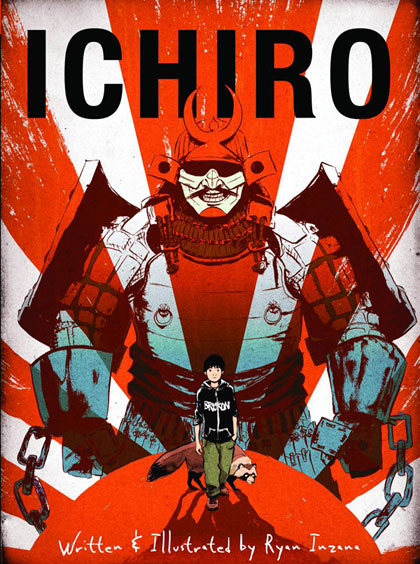
Review | Ichiro, Ryan Inzana

Raised by his mother in New York City and knowing very little about his Japanese heritage, Ichiro doesn’t feel like he fits in anywhere. He idolizes his father, a soldier killed during a war, and in his honour wears a shirt saying “Kill ’em all. Let God sort ’em out,” which his Grandpa Benny tells him is an army slogan. Grandpa Benny is racist, adding to Ichiro’s conflicted sense of self, being himself half-Japanese yet seeing his grandfather’s anger towards other immigrants. When Ichiro’s mother arranges a business trip to Japan and leaves Ichiro in the care of his Grandfather Sato, Ichiro learns a lot about that part of his heritage. More importantly, he learns that there is much more to war than a strict divide between a good side and an evil side. Ryan Inzana‘s Ichiro is an imaginative, textured graphic novel about the nature of war, and about the need for tolerance and open-mindedness.

I love that Ichiro explored the horrors of World War II from the point of view of the Japanese. Ichiro’s grandfather explains the historical context behind Japan’s belief in the emperor’s divinity, and tells Ichiro stories about victims of the atomic bomb. Inzana contrasts the horrific effects of the atomic bomb with a scene of teenage boys playing a war video game. “Waste that guy!” a boy exclaims, his friend happily pumping more virtual bullets into a soldier’s torso. This occurs right after images of Ichiro’s visit to a museum about the Hiroshima bombing, and, like Ichiro, we lose our appetite for such a form of entertainment. I have long been aware of the Japanese legend of the paper cranes — if a sick person can fold a thousand, she will be healed — yet, like Ichiro, I never knew that it originated in the historical figure of Sadako, a young girl afflicted by atomic radiation.

From identifying himself as primarily American, Ichiro is shaken at what he has seen and reacts by rejecting his American heritage. “How can you not hate America?” Ichiro asks his grandfather, to which his grandfather responds with a Buddhist saying, “Heaven and hell are in the hearts of all men.” That, ultimately, is the point behind Ichiro, that while there are two sides in any war, both sides are equally human, and equally capable of horrific destruction. The point, for Ichiro, is not to choose to be either Japanese or American, but to accept both sides of his heritage.

Inzana takes this subject a step further, and infuses his story with Japanese mythology. While trying to trap a persimmon-stealing raccoon, Ichiro is taken underground, into a land of Japanese gods and monsters. The Japanese-American war and its ensuing years of distrust and discrimination are mirrored in the underground war between the mythological lands of Ama and Yomi. Here, the injustice of war is even more pronounced, because we see how so much suffering was caused by a relatively minor misunderstanding. The parallelism turns somewhat didactic after a while, and I sometimes felt that Inzana was trying too hard to get his point across.

That being said, I love this imaginative way of portraying how senseless and unavoidable war is, and how horrible its consequences can be. In this land, Ichiro is viewed as a potential spy, making the experiences of Japanese-Americans in World War II all too real and immediate. As Ichiro begins to understand the complexity of his Japanese-American heritage, he faces the threat of being executed as a spy and worries about how he can get back to his real life.

I do wish Inzana handled his subject with more subtlety, perhaps by keeping it mostly mythological or mostly realistic rather than creating two parallel, yet equally weighty story lines. However, I do applaud his creative approach at tackling such a disturbing, emotional subject matter in the first place. I don’t know if Inzana’s story about Ama and Yomi are based on actual Japanese mythology, or if Inzana created it to parallel Japanese-American history. Either way, Inzana’s tale reminds me of how and why mythology is created in the first place — to attempt to make sense of situations that seem beyond understanding. With so much horror in history, how better for Ichiro to come to terms with his dual heritage than through mythology?

Ichiro is a rich story about a very troubling, emotional past. With so many stories about World War II, it is troubling to imagine how much in common we have with the teenagers happily killing soldiers in the arcade without reflecting on how real such horrors could be. Great graphic novel for anyone who wants to learn more about Japan, or about the Japanese side of World War II history.

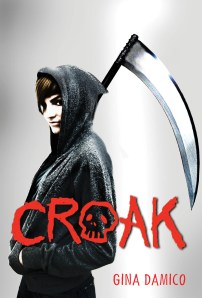
Review | Croak, Gina Damico

Lex Bartleby’s parents send her to live with her Uncle Mort for the summer in the hope that hard farm labour will help her with her anger issues. It turns out that Uncle Mort isn’t actually a farmer, but a Grim Reaper, and he is going to train Lex to be a Reaper herself. Gina Damico’s Croak has a funny premise and a cast of colourful characters. It starts off very weak, in my opinion, but the story gets better as it goes on, and I loved the ending.

My main issue with Croak is that Lex’s anger issues were just overdone. The book begins with her in the principal’s office for having bitten (literally!) a classmate because he’d called her a vampire. She’s sixteen. She’s also been a straight-A model student until a couple of years ago, when, for no apparent reason, she starts beating up practically everyone she meets. Her parents take her home and say they need to talk. “Are restraints really necessary this time?” Lex asks. I thought it was just another snark until I read that the mother really did bring out jump ropes to tie Lex to a chair, just so she won’t punch her parents when she learns she’ll be spending the summer with Uncle Mort.  Lex’s twin sister Cordy wonders if the ropes amount to child abuse, and by this point, I’m already picturing Lex as a rabid, foaming-at-the-mouth lunatic. I’m also wondering, if her parents are that scared of her, why they didn’t just ship her to a psychiatric facility at any point in those two years. For that matter, why didn’t the school do anything? Just because Cordy is still acting normal doesn’t mean that Lex’s parents are immediately cleared of all suspicion.

Over the next few chapters, Lex throws a shoe at a bus driver, stabs her uncle with a stick and threatens to beat a stranger with his sunglasses. The romance in the book kicks off with Lex giving the boy a black eye and him giving her one back. I’m not generally queasy about violence in books, and to be honest, Lex’s antics are too exaggerated, cartoon-style, to even make her scary. Still, Lex is beyond bratty. When Uncle Mort cuts off one of her rants and orders her to grow up, I wanted to hug him.

Her discipline problems are explained somewhat — apparently, all born Reapers have serious rage issues until they enter Croak, the town where Uncle Mort lives and one of the Grim Reaper centres in the US. Still, I don’t see the connection. In the Percy Jackson series, Rick Riordan explains that demigods are dyslexic because their brains are hard-wired to read Greek, and that they have ADHD because their bodies are designed to react quickly in battle. I love that, because I can understand how such characteristics can signal that one is a demigod. In Croak, however, I have no idea how wanting to beat everyone up is directly linked to being a Reaper, especially since the Reaper’s job is actually one of mercy — freeing the soul trapped a body that’s already dead.

Fortunately, it gets better. Once Lex begins training and realizes how much she enjoys being a Reaper, her anger issues fade a bit, and the book gets much more interesting. Lex and the other junior Reapers have noticed some mysterious deaths, possibly at the hands of someone from Croak, and investigate. It’s an interesting mystery, and it takes us right into the world of Grim Reaping. I really like the other junior Reapers, especially Elysia, whose bubbly personality adds some welcome cheer to the group. The whole world of Grim Reaping is very well fleshed out, and I loved learning details such as their use of jellyfish and their version of alcohol. The story just kept getting more interesting, as the mystery deepened, leading up to a powerful climax. Good on you, Ms. Damico. Brave, emotional twist, especially in what I presume is just the first book in a series, and I admire you for raising the stakes this early.

I also love that Croak raises an interesting moral dilemma. The most important rule for Reapers is that they can only take the souls of their targets. This seems fairly straightforward, but what if they enter the scene of a murder? What if they have to take the soul of an innocent child and see the man who killed her just a few feet away? In my review on Loss, I complained that the author played it safe and kept her protagonist from really exploring his dark side. In contrast, I love that Damico shows how torn up Lex is about letting murderers go. Surely it’s only justice to take the murderer’s soul as well, or at the very least, turn him in to the police. Yet such justice is beyond a Reaper’s jurisdiction, and there are dire consequences for any Reaper who disobeys this law. Lex is torn, and I love that Damico isn’t afraid to explore this subject. It’s a slippery issue, with no straightforward answer, and I enjoyed reading about it.

WIN A COPY OF CROAK!

Win a copy of Croak, courtesy of Thomas Allen.

For a chance to win, just comment on this post and answer the following question:

If you could have one superpower, what would it be and why?

Contest ends April 20th. (Canada only)