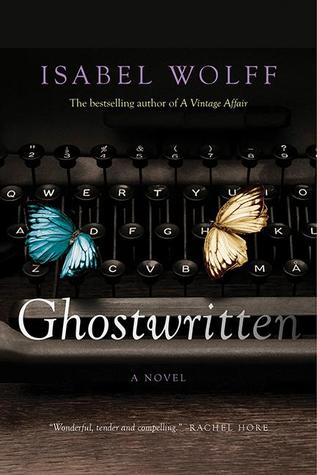
Review | Ghostwritten, Isabel Wolff

21416276Writing is generally viewed as a profession that reveals much about the individual. Even fiction writers are asked time and again about parallels of their fiction to their own lives. In Jenni’s case, however, her career as a writer helps her subsume her own memories of a childhood tragedy. She is a ghostwriter, and in exploring other people’s stories and in taking on their own voices, she is able, for the most part, to forget a bit of her own story.

That changes when she agrees to write the memoir of a survivor from a Japanese internment camp in Java. The subject, Klara, lives near the same beach where Jenni’s own childhood tragedy has occurred. Worse, Klara’s story holds some disquieting parallels to Jenni’s own experience, and forces Jenni to reexamine her past.

Isabel Wolff’s Ghostwritten isn’t an easy story to read. Klara’s tale in particular is filled with violence and horror. Wolff doesn’t shy away from depicting some of the more gruesome aspects of these internment camps, and the tale is an eye opener for anyone unfamiliar with the history of the Japanese occupation in Gaza. Especially difficult to read are tales of prisoners who turn on other prisoners, either to escape punishment or to receive some form of special treatment for the guards.

The moment when we learn the decision that has haunted Klara all her life is heartrending, and while Jenni’s response is the right one, it also feels much too inadequate. Klara’s grief over this act is all too real and understandable, and to be fair, no response would likely have been enough to make her fully get over it.

Paling in comparison to Klara’s story is Jenni’s. Her struggle to come to terms with her own childhood tragedy is touching enough, but the parallel to Klara’s story just feels forced. The interweaving of the stories feels orchestrated, which is especially egregious when compared to the depth of emotion in Klara’s story. Jenni does indeed have her own demons to contend with, but I found myself skimming over her sections, and being impatient with her reluctance to open up.

Klara’s story is told ostensibly as a plot device to help the protagonist fulfill her own character arc, but Klara ends up stealing the show. There are some subplots within her tale that I wish I’d learned more about — the story about the neighbourhood bully and his mother, for example, and a star crossed romance between two of Klara’s neighbours — and I wish Wolff had focused more on this part of the novel.

+

Thank you to Harper Collins Canada for a copy of this book in exchange for an honest review.

Review | Benediction, Kent Haruf

17978442Benediction is a deliberately paced, contemplative read about a man dying of cancer, and the people around him. The restraint of Haruf’s prose keeps the story from becoming maudlin, and while Dad Lewis’ strength is admirable, the novel resists the easy turn towards the inspirational. Instead, what we have is a story that rings with quiet truth.

There’s a large cast of characters, some of whom are a bit difficult to keep straight, but there are many memorable figures among them. A young girl who has lost her mother to cancer, and who finds a sense of family with a pair of neighbours. A woman who lives with her mother and who is still dealing with the remnants of a love affair gone wrong. A preacher who has just moved into town, and whose interpretation of a particular Biblical passage sparks controversy in the close-knit community and division within his own family. Dad’s own estrangement from his son, and the pain of longing to see him again before death. Dad’s battle against cancer is the linchpin upon which all these stories revolve, and Haruf creates a textured portrait of a small town.

Haruf’s narration echoes the diction of his characters, and while his use of “of” rather than “have” (“We would of had it for her”) drove me crazy throughout, the language as a whole does create a measured pace that lulls the reader in. There are also some passages that are absolutely beautiful. A character walking down a street and looking into his neighbours’ houses tells a police officer he was hoping “to recapture something… The precious ordinary.” [p. 162] I love that phrase, “precious ordinary.”

The character then goes on to confess:

I thought I’d see people being hurtful. Cruel. …But I haven’t seen that. Maybe all that’s behind the curtains. …What I’ve seen is the sweet kindness of one person to another. Just time passing by on a summer’s night. This ordinary life. [p. 163]

This is a novel about death, about violence and about loneliness, but the quotes above best capture the spirit of the text. I generally dislike calling a novel uplifting, because it makes the book sound utterly precious. But in this case, uplifting works. And it’s a good book, a quiet meditation on life through the lives of ordinary people in a small town.

+

Thank you to Random House Canada for a copy of this book in exchange for an honest review.

Review | The Pitiful Human-Lizard, Jason Loo

00cover01A Toronto superhero with a dead end day job whose name would strike fear into the heart of any self-respecting bad guy… what’s not to love about Jason Loo’s Pitiful Human-LizardIt took me a while to track down a copy of this book. I went from The Beguiling to The Silver Snail to a couple of comic book stores in Kensington Market only to find out they were either completely sold out or (in the case of the Kensington stores), they happened to be closed that day. I was having a case of Pitiful Human Lizard luck myself, it seemed, but more than that, I learned just how popular and how much a phenomenon this comic book series has become. A lesson to all of you then: if you want to get your own copy of this series, snap up a copy at your local comic book store before it’s too late. (For the record, I finally found my copy in the Toronto talent section of Silver Snail, by the Eaton Centre. There were two other copies left on the shelf when I left, and the staff member who spoke with me said she was planning to check it out herself after her shift. So like I said, snap up your copy today.)

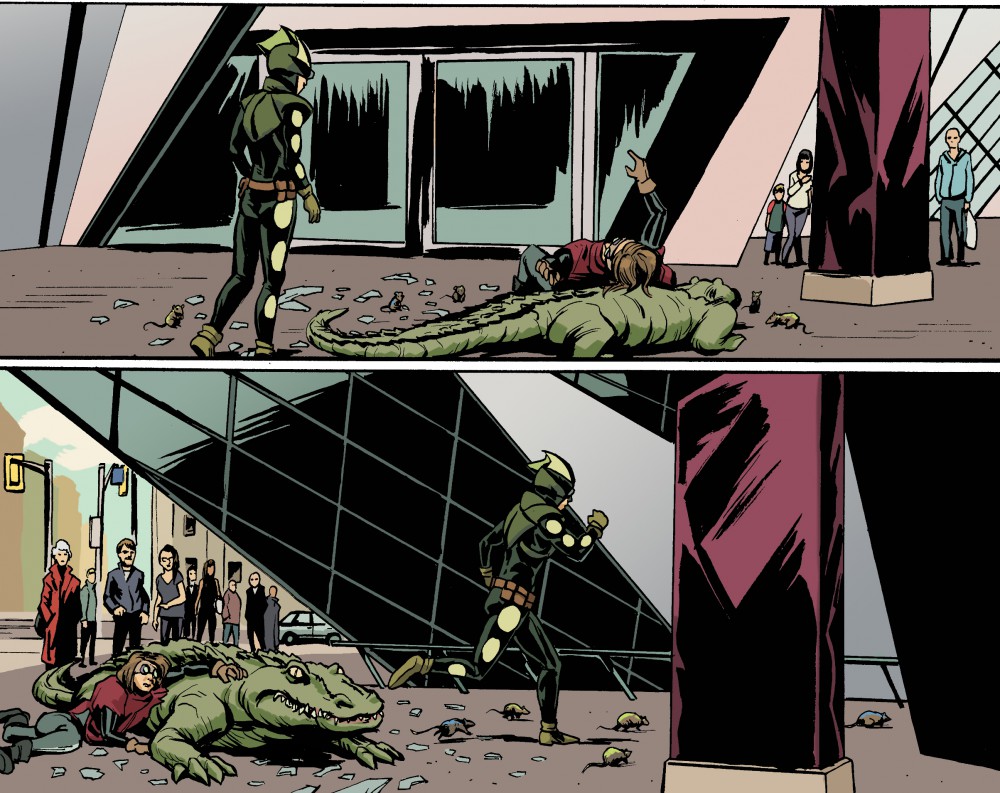
Was it worth the wait? Absolutely. This Toronto superhero story is absolutely hilarious, an everyman loveable loser-type bundle of awesome. The Human Lizard is Lucas Barrett, an office worker who can barely afford to pay for his Brazilian Jiu Jitsu lessons and who covers up his superhero exploits by telling his mother that he’s learning to play the harmonica. He signs up for a clinical trial for a super healing drug and, well, the rest is superhero history… with a pitiful twist, of course.

I absolutely love the Toronto setting. This story features a hot dog vendor, a streetcar and an epic superhero battle in one of my favourite Toronto landmarks — the Royal Ontario Museum! A ROM security guard makes a cameo in a hilarious bit that will make other museum or art gallery workers recognize a bit of themselves in him.

Loo’s self-deprecating humour is what makes this story so fantastic, and punchlines and sight gags are littered throughout. Particularly effective are Lucas Barrett’s interactions with his parents, and the scenes where the Human Lizard joins forces with the (much more traditional superhero type) Mother Wonder.

Author and artist Jason Loo was kind enough to provide some excerpts of the book for my blog, so check these out:

12

18_12

41_12

The Pitiful Human-Lizard is available at various locations in Toronto: Silver Snail, The Beguiling, The Comic Pile, and Dr. Comics. You may also purchase it online and check out the Pitiful Human-Lizard Facebook page for a schedule of upcoming events and signings!