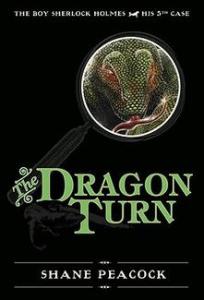
Review | The Dragon Turn, Shane Peacock

The Dragon Turn is the fifth book in Shane Peacock’s Boy Sherlock Holmes series, and the first one I’ve read. I’m a huge Sherlock Holmes fan, so reading a book about a teenage version of him will either be an absolute delight or an absolute disaster, depending on how Peacock chooses to portray him. I was also worried I might’ve outgrown YA adaptations of older characters. For example, I used to devour The Nancy Drew Notebooks, the Starfleet Academy series, even the Young Jedi Knights series. Now, while I still like YA, I’ve felt no desire to go back to those books.

I really liked Dragon Turn. Its mystery is more mystical (it involves a dragon) than I expected a Sherlock Holmes story to be, but, like all Holmes stories, presents a logical solution. A magician called the Wizard of Nottingham is killed. All that’s left of him are his blood and spectacles in the office of his professional and romantic rival Hemsworth. The climax of Hemsworth’s act involves a dragon, which offers a possible, gruesome explanation to the disappearance of the Wizard’s corpse.

Peacock’s Sherlock is a highly intelligent, logical fifteen year old, who already has plans of becoming a detective when he gets older but who, in the meantime, just wants to keep a low profile. He’s half-Jewish, and so faces discrimination, which may explain part of his desire to remain below the radar. So, rather than take credit for mystery solving, Sherlock feeds information to Lestrade, a young police officer intent on impressing his Inspector father. I love this characterization of Sherlock and young Lestrade. The adult Holmes is such a confident, almost arrogant man, and I love seeing this younger version of him as more vulnerable, insecure and self-conscious. He’s sympathetic in a much different way from the adult Holmes, yet he maintains the intelligence and logic that so characterize Holmes as a detective.

I also enjoyed seeing Lestrade as a young man longing for approval. I was expecting either a bumbling, incompetent Lestrade or an absolute bully, so I was pleasantly surprised to see him so sympathetic. He’s still incompetent as a detective, but his desire to impress his father casts a whole new light on his approach towards detecting.

Peacock even gives Sherlock a love life, which I don’t usually enjoy in mysteries, but which I liked here. Romance also prompts a reluctant Sherlock to get involved in the Wizard’s case. Sherlock’s girlfriend Irene Doyle (who, I presume, will grow up to marry a Mr. Adler and later become The Woman in Holmes’ life) was promised a boost in her stage career by Hemsworth, so she convinces Sherlock to help prove Hemsworth’s innocence. It’s a complicated case, and soon even Sherlock isn’t sure about what really happened to the Wizard. I did figure out the answer before the big reveal, but then the book is aimed at readers much younger than I am (never mind how much younger), so that’s really nothing to brag about. (I’m still bragging, though. I almost never guess the answer before the big reveal!) Still, Peacock pieces together the puzzle well, and I loved seeing Sherlock before he became the infallible detective we all know.

Dragon Turn is a wonderful book. I think its target audience (ages 10 – 14) will love it for its adventure, mystery and characters, and, as an older reader, I enjoyed it for the way Peacock wrote Sherlock Holmes. On a minor note, I much prefer Beatrice Leckie to the more worldly and manipulative Irene Doyle. As far as I know, Beatrice is a wholly Peacock-created character, and she’s just a lovely Betty Cooper-type character, and I’m crossing my fingers that Sherlock will eventually end up with her, if only in Boy Sherlock Holmes.

Review: Blood Red Road, Moira Young

I’d heard that Moira Young’s Blood Red Road was very similar to The Hunger Games, so as a Hunger Games fan, I was eager to check it out. There are certainly similarities: Blood Red Road also takes place in a dystopian future, the heroine Saba is an archer like Katniss, and Saba has to compete in a gladiator style Cage Match to the death like Katniss has to survive in the Hunger Games. Overall, however, I don’t think Blood Red Road quite matches up, at the very least in terms of the breadth of social commentary in Hunger Games. While Hunger Games delivers a scathing portrayal of contemporary society’s obsession with consumerism and voyeurism, Blood Red Road reads more like a straightforward action-adventure story, with its social commentary focused on the dangers of drug addiction.

That being said, Blood Red Road is still a very good book. It has a heroine much fiercer than Katniss, UFC-style fight scenes, language that reminded me of the dialogue in The Grapes of Wrath and a landscape and drug culture that reminded me of Dune. Saba’s twin brother Lugh (the “light” to Saba’s “shadow”) is kidnapped and Saba sets off to rescue him. Along the way, she is captured and forced to compete in no-holds-barred cage fighting, where she earns the nickname Angel of Death: when she fights, the “red hot” takes over and she can’t lose. People are addicted to chaal, a drug controlled by a King, and this addiction makes them either suppliant or, after a certain point, filled with bloodlust (hence the need for deathly cage fights). Saba also encounters a group of young female warrior rebels and a handsome young thief called Jack.

Young writes well. This type of writing (filled with intentional misspellings and grammatical errors) usually grates on me, but, as with Patrick Ness’ Chaos Walking trilogy, I thought it worked here. Blood Red Road is a fast-paced, action-packed, exciting read. It’s already been optioned for a motion picture by Ridley Scott, and I can certainly imagine some of the scenes playing out on screen. The secondary characters are well developed and likable. I especially liked Jack, who is charming, funny and sweet. Saba’s younger sister Emmi is usually the kind of character I’d hate in books and movies, the kid who always gets involved in things and so has to be rescued several times. But I really felt for Emmi in this book, and I think it has a lot to do with my major problem with the book: Saba.

I liked Saba as a narrator, but I don’t really like her as a person. I do like that her survival instinct is so strong that she dominates the cage fights. I also like that she is so devoted to her brother, even though it’s clear (Jack even tells her so) that she puts him on too high a pedestal. We do see her vulnerability at times, and also her protective instinct toward Emmi.

Thing is, as one character says, Saba is “prickly.” Beyond that, she can be downright mean, especially to Emmi. A lot of the time, other characters were offering Saba help and friendship and she kept turning them away, preferring to be a lone wolf even when it wasn’t practical. She has to be forced to accept help, and for me, at least, she hadn’t shown enough of her vulnerability to make this anything but annoying.

I was most annoyed by Saba’s relationship with Jack. It followed a standard “I hate you (but secretly I love you)” type love story. But after a while, Saba’s insistence that she really, really hates Jack just felt forced, like the author just wanted to stretch it out just a bit longer. Perhaps it’s because I didn’t really see why Saba was so defensive, unlike in Hunger Games, for example, where I could really understand how Katniss’ society had made her so defensive and afraid to trust anyone.

Overall, however, Blood Red Road is a really good book. Definitely worth checking out for fans of The Hunger Games or Divergent or kick-ass heroines and dystopian fiction in general.

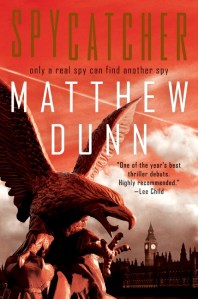
Review: Spycatcher, Matthew Dunn

Fan of John Le Carre? You’ll love Matthew Dunn’s Spycatcher. Written by a former MI6 field officer, Spycatcher takes us right into the mind and heart of master spy Will Cochrane. Cochrane is a highly skilled operative, tasked by MI6 and the CIA to locate and stop an Iranian terrorist named Meggido from launching a massive international attack.

Dunn’s background in espionage is evident. Spycatcher has an action-packed story, with some of the best fight scenes I’ve ever read. They remind me of the Sherlock Holmes movie with Robert Downey Jr, where a voice-over narration details all the moves Holmes will make and the reasons behind them (like “fake to the eye to distract, then strike to the throat to incapacitate”). When Will takes a guy out, we see exactly how he does it, and we believe in Will as a killing machine. As a fan of action movies and MMA, I loved reading such scenes of realistic, efficient hand-to-hand combat.

I also love the way Dunn describes the operations carried out by Will and his team of CIA agents. In some scenes, they seem almost unbeatable. For example, when Will has to break into a building, he has Julian, a member of his team, giving instructions in his ear. The instructions are split-second precise, with Julian telling Will where to face, when to go and when to stop and hide. They move with clockwork precision, and so even when things go wrong, we just know that such a highly skilled team can come up with a viable Plan B on the fly.

What really makes Spycatcher work, however, is the depth of insight it gives into the personal lives of spies. The CIA team and Will’s MI6 and CIA bosses are all engaging characters, but Will, in particular, is a very lonely man. In one scene, he runs into his sister, who he hasn’t seen in eight years, at a cemetery, and she comments that it’s just like him to visit the dead and not the living. It’s a striking observation; we realize that, in choosing the life of a spy, Will Cochrane has given up the chance to have a family, and even to be with the family he already has. We also get some flashbacks to Will’s childhood and the traumatic events that have made him such an effective spy and efficient killing machine.

So when Will meets Lana, a woman who can help him get Meggido, and whom Will wants to protect because of all she’s suffered in the past, and when Will realizes he isn’t as lonely with her around, I really wanted them to end up together. I don’t usually care much for the romantic subplots in thrillers; I prefer to focus on the action. But in Spycatcher, since Dunn makes such a compelling portrait of Will’s humanity and loneliness, I just wanted Will to find happiness.

In one of my favourite scenes, Will hesitates to kill a man whom he respects for his courage: “For the briefest of moments, he wanted to leave the brave man alive, just turn and walk away. But he knew he could not allow the man to live. He shot him.” So many action movies or thrillers have clear good guys and bad guys, and if a good guy hesitates at killing a bad guy, it’s because they have some kind of history. But Will had never met this man before, so it was just his behaviour in combat that made Will respect him. Will’s hesitation at killing this man, and yet killing him anyway because it was necessary, is such a wonderfully complex, emotional portrait of Will as both vulnerable human and professional spy at the same time. We feel for Will, and can relate to him, even as we admire his skills as a deadly machine.

In the book trailer on the Harper Collins Canada website, Matthew Dunn says he’s been told to write what he knows, and what he knows is espionage. Reading Spycatcher, I can definitely see it. Dunn takes us into the heart of a spy. Will Cochrane’s adventure is thrilling, but it’s his personal life that keeps us hooked, and his personal demons that we really want vanquished.