
Review | In Session, M.J. Rose


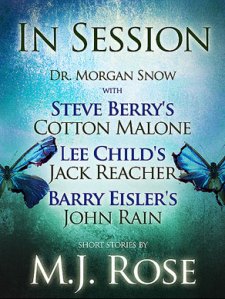
It all began when thriller writers Lee Child and Barry Eisler were chatting online about their characters, Jack Reacher and John Rain, taking each other on. Fellow thriller writer M.J. Rose suggested that her character, sex therapist Dr. Morgan Snow, psychoanalyze these tough men. Rose also got Steve Berry and his Cotton Malone on board, and the result is In Session. It’s a novelty e-book and audiobook rather than a full-fledged novel, and it is priced as such ($1.99 international price for the Kindle edition). The book is also for a good cause — all the proceeds of the audiobook and part of the proceeds of the e-book will be donated to David Baldacci’s Wish You Well Foundation, which supports family literacy. The stories aren’t thrillers, but fans of these characters may be interested in seeing their hidden, vulnerable side.

Full disclosure: I’ve never read any of these authors, though Lee Child and Steve Berry at least have been on my list of thriller authors to try. So for me, Rose’s stories provided a bit of an introduction to these characters. I love finding out in the Acknowledgements how involved these authors were in writing these stories; even if Rose wrote the stories, I’m at least assured that the characters are somehow still true to the originals.

I enjoyed the Cotton Malone story mostly because his partner, Cassiopeia Vitt, seems like such an intriguing character. What Malone reveals about his childhood also makes me want to find out more about him. Big bonus: Malone owns a rare book shop. That’s my kind of hero! Berry edited Malone’s dialogue and provided details of the rare book shop. I liked both, so I’m definitely checking out this series.

The John Rain story is my favourite. The introduction that brings Snow and Rain together is all right, but their conversation in the park is stellar — nuanced and realistic. Turns out Eisler co-wrote that scene with Rose on Google Docs in real-time, which helps explain why the dialogue flowed so naturally.

The Jack Reacher scene was my least favourite, and probably the most disappointing because Reacher was the one I most wanted to find out about. It was mostly a story within a story, which made Snow’s presence seem superfluous. Perhaps it’s because I also don’t know what Reacher does exactly that I spent the first few pages wondering why he was coming to Snow’s rescue. Did he just happen to be passing by, does he work in the area, or is he an Emergency Response specialist? Clearly, anyone familiar with Reacher wouldn’t have these questions, but it just felt more forced than the other two.

Snow herself was just okay, though in fairness she wasn’t the focus of any of the vignettes. Still, even though we see glimpses of her personal life, she just didn’t strike me enough to make me want to rush out and read more about her. Personal preference, and perhaps I just need to see her in a thriller setting to really get a feel for her character.

Overall, In Session is an inexpensive e-book and audiobook for a good cause, worth reading to get a peek into some of the contemporary thriller genre’s most well-known characters.

Review | The Very Picture of You, Isabel Wolff

Isabel Wolff’s The Very Picture of You is a light, feel-good read with likable characters. The novel has some beautiful, deeply emotional moments, and also has some scenes where the narrator tries a bit too hard to tell us about the emotion, and thus lessens the scene’s impact. Ella is a portrait painter who is hired by her half-sister Chloe to paint her fiance Nate. Ella had taken an instant dislike to Nate, but as she paints him, grows to fall in love with him.

I personally found the subplots more interesting. Behind Ella’s dislike of Nate is her hurt at her father’s abandoning the family when she was a child. In an especially poignant scene, Ella confesses that when her mother said she’d lost all photos of her father, Ella as a child

drew and painted him, obsessively […] And I believed that if I did a really good picture of him — so that it was the very picture of him — then that would somehow make him come back.

It’s a beautiful, child-like, innocent wish, one that stands in marked contrast against the adult Ella’s immediate distaste when her father emails her asking to meet up. The adult Ella is scarred, and her desire to refuse all contact with her father, warring with her lifelong desire to connect with him is a very emotional struggle, with which I can completely sympathize.

In some ways however, Wolff ends up overemphasizing the emotions. For example, when Ella reads her father’s first email, Wolff intersperses the letter with Ella’s reactions to each line. I felt like I was watching a TV sitcom with the laugh track telling me when something was funny.

There’s a passage I love where Ella describes the portraits she paints:

…a competent portrait just catches a likeness, and a good portrait reveals aspects of the sitter’s character. But a great portrait will show something about the sitter that they didn’t even know themselves.

It’s a beautiful description of Ella’s artistic process and gives added significance to the scenes with Ella’s subjects. With each one, she ends up discovering something the subject originally tried to keep secret. I found these side stories interesting and the characters sympathetic, though sometimes the parallels with Ella’s own life felt forced.

The main plot, Ella’s struggle not to fall in love with her sister’s fiance, felt a bit more cookie cutter and therefore less compelling. Ella forms a snap judgment against Nate, based on something she overhears. I found that conflict shallow and contrived, especially since it could easily have been resolved by a simple conversation. Later on, when she realizes she’s misjudged him and is actually attracted to him, it felt too sudden for me, and I think that’s partly because I found her gripe against him too easily resolved.

At times, Wolff injects so much symbolism that some scenes felt like a Katherine Heigl romantic comedy or a Nicholas Sparks melodrama that took itself far too seriously. For example, Chloe is most drawn to the “Giselle” wedding dress, inspired by the ballet of the same name. As the novel takes pains to explain to us, Giselle kills herself after being two-timed by her lover Albrecht. (I think she actually dies of a broken heart, but the general theme remains.) I love the reference to a ballet; I hate the ham-fisted symbolism.

The novel’s ending also felt too convenient, and the pun in the last couple of paragraphs just made me wince. It reminded me of puns or one-liners that sometimes end Harlequin novels, but the romance in this book just took itself too seriously to make that fit.

Still, like I said, the parts about Ella’s art and her relationship with her parents were interesting. I really like the loving stepfather, and I absolutely love the complexity of Ella’s mother. Ella’s portrait of her reveals pain:

On the surface it was the pose of a ballerina taking a curtain call, her left hand spread elegantly across her chest. But it was also a defensive gesture […] shielding her heart.

This image of vulnerability is coupled with a contrasting image of the woman’s being

every inch the prima ballerina. She didn’t just ‘sit’ in a chair — she folded herself into it, ensuring that there was a graceful ‘line’ to her body, that her limbs were positioned harmoniously and that her head was at an elegant angle to her neck.

With these images, we see what Ella meant about her portrait revealing the subject. Here is a proud woman, who always wants to maintain the illusion of control by disguising her pain. She is a controlling, manipulative figure who drives Chloe crazy with her iron control over the wedding plans, yet she is also scarred and sympathetic. She is probably my favourite character in the novel, and Ella’s relationship with her one of the plot points I found most interesting.

Picture falters in the romance department and could have used more subtlety in its presentation, but it also depicts an interesting family dynamic and I love the idea of art revealing things even the subject may not realize about himself.

Review | The Far Side of the Sky, Daniel Kalla

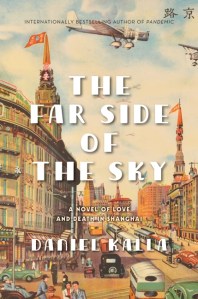
Kristallnacht. Crystal Night. Such a beautiful name for such a horrific event. Daniel Kalla’s The Far Side of the Sky begins right in the middle of this Nazi attack on Jews in Austria, and the pace never lets up. Surgeon Franz Adler is a secular Austrian Jew who just wants to stay under the radar. Unfortunately, as the “incriminating large red J” stamped on his passport proves, his very ancestry already puts him in the Nazi crosshairs, no matter what he does or doesn’t do.

So Franz takes his family (daughter Hannah and sister-in-law Esther) to Shanghai, a major refugee base for European Jews because visas aren’t required to enter. Thing is, Shanghai at that time was occupied by Japan, so it really wasn’t so much of an escape as it was a movement to a different atmosphere of fear. In Shanghai, Franz meets a Chinese-American nurse, Soon Yi “Sunny” Mah, who works with him at the Jewish refugee hospital and who is prevented from becoming a doctor only by her gender. Far Side is about people who want only to live a simple life, and yet are prevented from doing so by circumstances and their heritage. It’s tragic, yet made somewhat more bearable by their relationships with people around them.

A lot of books have been written about World War II and the years before and after it, yet most of the ones I’ve seen are about either the West or the East. Far Side stands out to me because it shows how Europe and Asia connected during this period, and how the situation in Asia was just as horrific as the one in Europe.

I love that Franz isn’t really a hero — all he wants to do is to live as normal a life as possible — and yet circumstances force him to do heroic things. I also love that both Franz and Sunny have complex backgrounds — Sunny, for example, is Chinese-American, so she faces discrimination both from the Japanese soldiers who look down on the Chinese and the Chinese who look down on those who aren’t full-blooded Chinese. In Franz’s case, his being a non-practicing Jew makes his troubles with the Nazis even more tragic; he is ostracized for a belief system to which he doesn’t even subscribe and for a race he has himself rejected.

The supporting characters are just as fascinating. The American Simon Lehrer, for example, is delightful, almost relentlessly cheerful and a welcome respite from the darkness of the material. Ernst Muhler, who wages war through his art, is a charismatic, engaging figure. Ernst is the most defiant, political figure in Franz’s community, and his fear at the realization of what he might have to sacrifice on a personal level makes him an absolutely sympathetic character. Like the victims whose unjust deaths he depicts in his art, I cheer Ernst on in his crusade; yet like Franz and other friends in Ernst’s life, I also want him to stop, and perhaps find some measure of happiness and peace.

In war, it’s far too easy to see different factions as either all good or all evil. So I love how Kalla portrays Hermann Schwartzmann and Colonel Kubota. A senior attache with the German High Commission, Hermann has no ill will towards Jews and even tries to befriend Franz. He chooses to compartmentalize, to not speak out against the Nazis so that he and his wife can have a stable life. I can understand why Franz finds Hermann’s silent complicity cowardly, even reprehensible, yet I can’t help but feel sorry for Hermann. Like Franz, Hermann also just wants to live as normal a life as possible; only difference is, Hermann is better placed to benefit from compliance. With Hermann, Kalla presents the other side of the story, the moral difficulties faced by non-Jew Germans and Austrians.

Colonel Kubota, head of the Japanese contingent in Shanghai, acts with honour and compassion. Kubota’s admiration of Ernst’s work and Ernst’s refusal to have Kubota own his art provides a kind of tension that I love. Kubota and Ernst are figures from opposite sides of two different wars, and their desire to connect or repel through art is just beautifully portrayed.

One thing I really did not like happened near the end, where Sunny does something that has a dramatic impact on a historical figure’s actions. In a novel that focuses on the struggle to live an ordinary life, that explores mundane human relationships to evince emotion, Sunny’s dramatic act rings false. It made me question, “Since this is based on history, and this character doesn’t exist in real life, then what really happened?” That part disconnected me from the story, which is a shame because of the major emotional impact already created by all the smaller scale heroic actions in the story.

Also, we are told several times that Franz’s daughter, Hannah, is handicapped. This is significant because Franz worries about how she’ll survive if he is killed or arrested. However, I see no symptoms from descriptions of Hannah herself and her actions, and so have to keep turning back to be reminded of the cerebral palsy that has other characters so worried. A small detail that shows Hannah’s “spastic weakness of left arm and leg” would have helped me picture her and better understand why Franz is especially concerned about how she would adjust in a foreign country.

Overall, Far Side is a wonderful, emotional book. Highly recommended for fans of historical fiction, romance, and David Mitchell’s Thousand Autumns of Jacob de Zoet.