
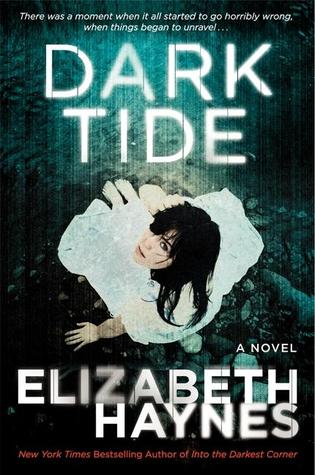
Review | Dark Tide, Elizabeth Haynes

16233477I absolutely loved Elizabeth Haynes’ first book Into the Darkest CornerI reacted viscerally to it, pulled in to the claustrophobic, terrifying, uncertain world the protagonist inhabited. So when Harper Collins Canada sent me the ARC for Haynes’ second novel Dark Tide, and particularly when I saw the haunting image on its cover, I was intrigued. I opened the book and waited for Haynes to pull me once again into her spell.

Dark Tide is a good, solid thriller; it’s just not an amazing one. In fairness to Haynes, that may just be because my reaction to Darkest Corner was so strong that it would have been difficult for any book to live up to my expectations. In a blog post, Haynes addresses the comments by many readers that unfavourably compared Dark Tide to Darkest Corner by arguing that she deliberately made both books very different from each other. Fair enough, and kudos to Haynes for not falling into the trap of sticking to a tried and proven formula.

However, what made Darkest Corner stand out from other thrillers is the gut-wrenching emotional reaction it provoked in even seasoned thriller readers. And while I certainly didn’t expect Haynes to repeat her theme of domestic abuse, or to once again use a frightened, scarred female protagonist, I did hope for a similar level of impact. Like I said, Dark Tide is a really good thriller — Haynes is a talented writer, and, particularly in the end, she ratchets up the adrenaline with suspenseful story telling. It’s just not a great one — it lacked both the urgency and the malevolent villain that propelled Darkest Corner.

Dark Tide tells the story of Genevieve, a former sales professional and pole dancer who moved into a houseboat with a mysterious package entrusted to her by a man she met while pole dancing. The book alternates between flashbacks of her attempts to keep her pole dancing a secret and the present day story of a body washing up by her houseboat and the threat of people from her old life tracking her down, presumably for the mysterious package.

Haynes again touches upon gender issues, in particular the objectification of female dancers and the social stigma against pole dancing. The fact that Genevieve is one of only two females at her sales job hints at the environment that requires her to hide her pole dancing. Genevieve’s only female co-worker seems a bit more focused on the struggle they both face in breaking the glass ceiling, and I only wish Haynes delved a bit more into the complexities of that character rather than reducing her to the role of office bitch.

The plot is fast-paced, with the twists requisite in any good thriller. The intensity is watered-down somewhat by the fact that the villains appear to be cookie cutter gangster types — Genevieve has a personal relationship to them, but never really establishes deep emotional ties. The result is that she mostly seems like an ingenue dabbling in situations way over her head. And due to the flat, rather stock aspect of the villain and the situation, the stakes, while certainly important (her life, her security, etc), never feel urgent.

Haynes does dial up the emotional intensity with Genevieve’s relationship with Dylan, a bouncer at the club where she danced, and the man who gave her the mysterious package to hide. There’s an interesting tension between the abrupt, distant Dylan in the present day, who ignores Genevieve’s calls, and the sweet, protective Dylan who befriends Genevieve in the flashbacks. Haynes has a talent for writing intense yet subtle romantic moments — a description of Dylan’s eyes as he notices Genevieve dancing for other men is just hot, and even when Genevieve just thought of him as a friend, sparks flew.

So when Dylan suddenly cuts off communication, even when Genevieve fears his package is endangering her life, there is the potential for some intense drama. Unfortunately, their relationship wasn’t developed enough to justify Genevieve’s almost unwavering trust in Dylan, nor was Dylan’s character developed enough to make such ambiguity believable. As such, the shift in character just creates a disconnect — is Dylan being a professional co-worker who may be attracted to Genevieve but isn’t necessarily emotionally attached to her, or is he a protective friend whose character traits shouldn’t make him put Genevieve in danger and abandon her? Either way, the package itself never seems important enough for Genevieve not to toss, particularly when her life and hard-won escape are endangered because of it.

Still, Dark Tide is a fun, fast-paced read, a good, solid thriller, and I loved the ending. To be fair, if I hadn’t read Darkest Corner and known just how much more Haynes is capable of, I probably would have enjoyed this book much more. As it is, I look forward to reading her next book, and hoping to see her again take the thriller genre to the next level.

+

Thank you to Harper Collins Canada for an advanced reading copy of this book in exchange for an honest review.

Review | Life After Life, Kate Atkinson

15749844What if you could live your life over and over, until you got it right? This intriguing premise informs Kate Atkinson’s new novel Life After Life, which begins with a woman named Ursula in November 1930, shooting Adolf Hitler. Flash backwards about twenty years, and Ursula is just being born in a quiet English town. She dies at birth. The narrative loops back a few hours earlier, again, we see Ursula being born, and this time, she survives. She lives a few years, then dies in an accident. She is born again, lives, and so on.

Unfortunately, the concept behind this novel is much more compelling than the novel itself. The story starts off slow — in order to establish Ursula’s unique situation, Atkinson gives her the unluckiest childhood ever — accidents and ailments befall her over and over again, only to have “darkness fall” over her, and loop us right back into that cold, snowy night in 1910 when she is born again. It is not so much unbelievable as it is predictable.

In a later scene, another character asks Ursula how she thought it would be like living your life over and over (look! clever meta moment!), and she responded that it sounded exhausting. On one hand, I do sympathize — Atkinson reveals how tired Ursula feels, as if she had “lived a hundred years.” On the other hand, reading about her string of reincarnations is wearying as well. There are moments I caught myself waiting for her to die, and I groaned when we returned to the moment of her birth — not again!

The story does pick up around the halfway mark, when Ursula herself becomes somewhat aware of her situation. She doesn’t completely understand it, but she does sense there’s something more going on than ordinary deja vu. Atkinson as well allows Ursula to live a bit longer each time, developing a bit more complexity and depth with each succeeding narrative. This, of course, is part of the conceit — the whole point of being able to live the same life over and over again is the ability to rectify your errors from the previous attempt. And despite Ursula’s limited understanding of her situation, she instinctively knows enough, for example, to discourage an overly aggressive man from kissing her the first time.

Unfortunately, this also diminishes much of the emotional impact. Each vignette is compelling, sometimes tragic, on its own, but knowing there’s the safety net of reincarnation made it difficult to care. At one point, when Ursula was trapped in an abusive relationship — a horrible situation, and one that would normally get me all worked up — all I could think was, how long until she dies in this life and starts again?

Worse, the narrative then suggests that Ursula is born over and over in order to fulfill a purpose, and until she accomplishes this purpose, she is doomed to keep repeating the cycle. The superhero/avenging angel twist is jarring, particularly after the quotidian nature of Ursula’s earlier experiences through her multiple lifetimes. I’ve suspended my disbelief throughout many of her lifetimes, as she learns each time and improves her next incarnation, but this just seemed not to fit. What began as Ursula’s very personal, private story shifted to a more public sphere, and to me, it felt tacked on. After all, and understandably, when the protagonist lives over and over again, how can you end it with a satisfying climax?

Life After Life has an interesting, and admittedly ambitious, premise. To be fair, I don’t know what else Atkinson could have done with the story that I would have liked better. Also to be fair, Atkinson is a talented writer, and even with the concerns I pointed out, I was compelled to keep reading. However, the story failed to live up to the promise of its concept.

+

Thank you to Random House Canada for an advanced reading copy of this book in exchange for an honest review.

Blog Tour: Author Q & A | Rita Leganski, author of The Silence of Bonaventure Arrow

BonaventureBT

As you’ve seen from my post this morning, The Silence of Bonaventure Arrow was an absolute treat for me to read. For this leg of the blog tour, Harper Collins Canada kindly offered me the chance to ask author Rita Leganski a series of questions about her book. I was thrilled — by the time I finished Bonaventure, it had subverted my expectations so much that I had a ton of questions I wanted to ask!

Q & A with Rita Leganski

1. Why did you choose that particular setting? What was it about New Orleans in the 1950s that you felt suited the story?

While I was growing up in northern Wisconsin, I thought of the South as an enchanted place and of New Orleans as the very embodiment of magic. Like its history, the city is colorful and surreal. Catholicism, voodoo, and hoodoo—all things possessed of mystery—have co-existed in New Orleans for a very long time. Since I consider setting to be another character in a story, I let New Orleans influence the other characters’ perceptions.

The fifties were a time of innocence that bridged the gap between the horror of the Holocaust that took place in the forties and the cultural upheaval of the sixties. In that magical setting, young Bonaventure Arrow represents an innocence that bridged the gap between a past full of pain and a future full of possibility.

2. At least twice in the book, characters explain the difference between voodoo and hoodoo. Why is it so important to the story that these two terms are so clearly differentiated? From your research, how have people viewed these two terms, and were there misconceptions you wanted to dispel?I use certain aspects of voodoo and hoodoo to symbolize good and evil. In this story voodoo is associated with placing curses, while hoodoo is associated with root work. I illustrate this by contrasting Calypso, a woman obsessed with the poisonous power of plants, with her daughter, Trinidad, who focused on their healing power.

Research shows that voodoo concerns itself with religious practices of the West African religion known as Dahomeyan Vodun. The African Kingdom of Dahomey was a location deeply involved with the slave trade. Bearing that in mind, it’s understandable that a people taken by force and enslaved would cling to their religious beliefs, desperately seeking some kind of solace or hope. When this West African culture encountered Catholic and French influences in Louisiana, it adopted and put a unique spin on facets of them, and Louisiana Voodoo was born with its gris-gris amulets (reminiscent perhaps of a Catholic scapular) and dolls (statues and relics). The major difference is Voodoo’s fascination with and Catholicism’s disdain for the occult.

Hoodoo is also called conjure, which refers to a culture’s folk magic. It involves calling upon some supernatural force to pull off a trick. Hoodoo, or conjure, seeks to bring about change. Root work falls under the hoodoo umbrella and is exactly what its name suggests—working with roots. A belief in the magical powers of plants to bring healing or harm is a driving force in THE SILENCE OF BONAVENTURE ARROW.

As far as misconceptions, I’m sure that every culture’s practices are distorted to some degree when brought into another culture; something is lost in translation, so to speak. Also, different cultures often assign different meanings to the same object/creature, etc. For instance, some cultures, like the Hopi of North America, saw the snake as a symbol of fertility and renewal. Snakes were set loose in the fields to ensure a good crop. In other cultures, snakes are symbols of the umbilical cord, an attachment to mother and nourishment. Still other cultures see snakes as evil and deadly, or as the physical incarnation of the devil.

3. I’m intrigued by the way Catholicism and hoodoo spirituality work together in this story. I would imagine them to be in conflict, as in the scene where Letice tells Trinidad that she wants Bonaventure raised Catholic and therefore free of voodoo/hoodoo influence. Yet Trinidad at least sees no contradiction in being a hoodoo practitioner and a believer in the Virgin Mary, and in fact, you integrate a lot of Catholic imagery in scenes of hoodoo healing. Why did you decide to integrate the two, instead of choosing one or the other? As well, what points of commonality did you find between Catholicism and hoodoo spirituality?

I integrated Catholicism and hoodoo spirituality in the character of Trinidad Prefontaine in order to reveal that goodness is not confined to one set of beliefs. Having been completely unloved by her biological mother, Trinidad turned to the Virgin Mary. There is a great misconception that Catholics worship Mary; they don’t. She is thought of as a mother and turned to for comfort and help. Trinidad is drawn to Mary in just such a way, while at the same time holding onto her belief in the supernatural healing powers found in Nature. I express commonalities between Catholicism and hoodoo spirituality in this passage:

She laid the note and the prisms on her homemade altar amidst those symbols and souvenirs of her deity’s Spirit—the Blessed Mother who loved every single child; the sea glass, like pieces of broken lives made lustrous and baptized by the ocean’s healing waters; the feathers of a bird that can fly precious little yet proclaims the new hope of every day’s dawn, and those odd little bits of nature’s bounty. From her pocket she pulled a holy card, one given to her in the orphanage by Sister Sulpice. The card was soft as a piece of old leather, made so by the oils in the skin of Trinidad’s hands. The front bore a picture of Francis of Assisi and printed on the back were the words to his Canticle of Brother Sun and Sister Moon.

Trinidad lives gently. Like Letice, she is a woman of strong convictions. She simply casts her net wider in order to bring close “those things she found spiritual.”

4. Why did you decide to heighten Bonaventure’s sense of hearing? What is it about the interplay between sound and Bonaventure’s silence that fascinated you?

Bonaventure’s gift of supernatural hearing connects him with the intangible. For instance, if he hears expressions of anguish or courage or joy, he also hears their cause. The idea of supernatural hearing fascinated me because by its very nature, hearing invites imagination to put a look, taste, smell, or feel to the sound. With his gift of wondrous hearing, Bonaventure uses sound to give form and substance to the originator of that sound.

5. Your novel deals a bit with Bonaventure’s struggle to fit in at school. The extent of his abilities is obviously fictional, but did you do any research into the kind of experiences children similar to Bonaventure (e.g. unable to speak, able to hear colours) undergo in school?

Rather than research, in this case I chose to draw from human nature. Life can be tough for anyone who is different, but childhood takes it to a whole new level.

6. If you had Bonaventure’s abilities, what would you do with them?

I certainly hope that I would use them as he does, to bring comfort.

+

Check out the rest of the Silence of Bonaventure Arrow blog tour! Complete list on the Savvy Reader website.

GIVEAWAY!

Win a copy of The Silence of Bonaventure Arrow – click here!

+

Thank you, Rita Leganski! It was a pleasure to read your book, and to learn more about the story from you!

Thank you again to Harper Collins Canada for an advance reading copy of this book in exchange for an honest review, as well as for the opportunity to participate in this blog tour.