
Author Encounter | Teresa Toten and Amy McCulloch

3C871CD9-C2CF-4EEE-B295-3B2FD30B9FCB

When I received this invitation from Random House of Canada, I had just recently read Amy McCulloch’s The Oathbreaker’s Shadow and had absolutely fallen in love with it. So I jumped at the chance to meet her, as well discover a new (to me) author Teresa Toten.
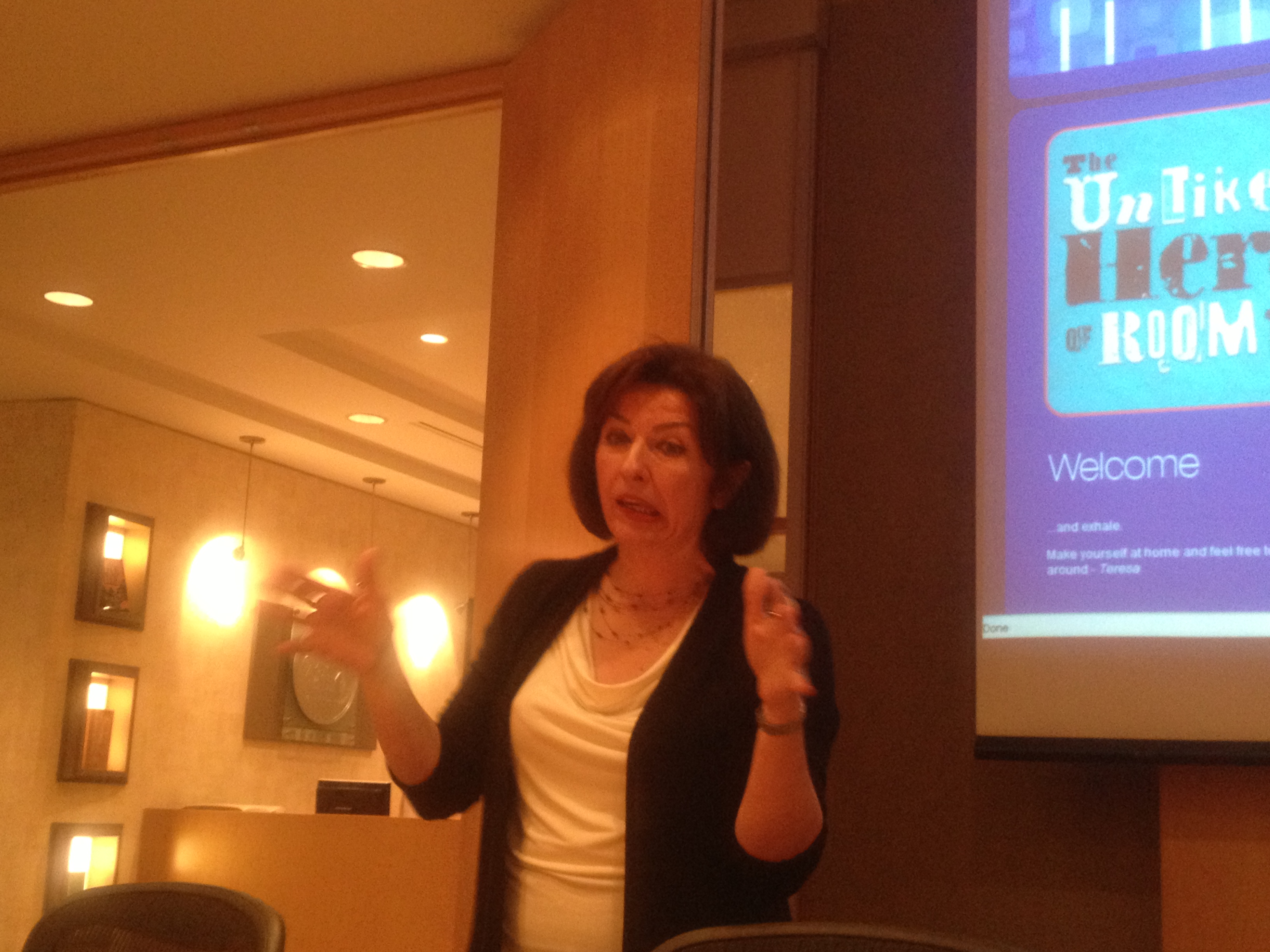
Teresa Toten, being awesome

Teresa Toten, being awesome

We got to chat with the authors over cupcakes and pop, and quite frankly, I think Teresa Toten may be my author twin. For her upcoming YA novel The Unlikely Hero of Room 13Bshe was planning to use for her epigraph a quote from a song she thought we bloggers would be too young to know: Puff, the Magic Dragon. In particular, the line “A dragon lives forever, but not so little boys,” which always makes her teary. Thing is, that line makes me teary as well. The song is particularly memorable to me for the silliest reason: my mom got a perfect score when she sang it on a videoke (like karaoke, but on a home TV) machine, proving to my sister and I that she knew the secret to high videoke scores. I later learned that the song was about drugs, but personally, I’d always found the lyrics to be unbelievably sad, about the loss of childhood. My mom passed away a couple of years ago, and it’s the silliest memories, such as that of “Puff the Magic Dragon,” that remain. All that to say that Teresa Toten immediately won me over when she quoted that song.

Then she said she changed her mind about the epigraph, and instead decided to use a verse from “If,” a poem by Rudyard Kipling. She then launched into a heartfelt reading of the poem, moving around the room and basically pulling all my heartstrings that somehow always get stirred with that poem. Yes, the poem has probably been used time and again on motivational office posters, and yes, I wish the ending had referred to women as well as men, just because. But really, that poem has been my Invictus-type inspiration for the longest time. Probably the first time I got chills at an author event for bloggers, so thank you for that, Ms. Toten.

Her upcoming novel, The Unlikely Hero of Room 13B, is about a teenage boy with OCD, and it’s not just like us flippantly saying we have OCD, but an actual psychological disorder that forces him to spend half an hour outside the door of his own house before he can enter. I have a bad habit of calling myself OCD when it comes to editing stuff at work, but Toten’s novel shows it as an actual debilitating condition, certainly nothing to be flippant over. Toten’s website includes You Are Not Alone, a list of resources for anyone who wishes to learn more about dealing with OCD. Adam, the boy with OCD, falls in love with Robyn, a girl in his teen support group, and the novel tells their love story. As part of their support group therapy, each member has to come up with a superhero persona, and Adam, naturally, decides to be Batman to his Robyn. Seriously. And Teresa Toten is a punny enough author to pull this off.

Teresa Toten has also recently joined Twitter! Follow her @TTotenAuthor.

IMG_1745

Amy McCulloch, talking about her book and her awesome Pinterest board

I read Amy McCulloch’s book The Oathbreaker’s Shadow and absolutely loved it. My review will be posted shortly, but mostly I was impressed at its Eastern influence, its unique, rather epic fantasy angle, and the way it manages to stand out among all the YA fiction in the market. The author spoke about her Pinterest board, where she includes images of the books and travel experiences that influenced her novel. Personal favourites the Dune series, the Lord of the Rings trilogy and Philip Pullman’s His Dark Materials trilogy are among her clear influences, which may explain why I loved this book so much, as were some pretty awesome travels in Cairo and Namibia.

The Oathbreaker’s Shadow is about a teenage boy who lives in a society where the breaking of a promise leaves you with a physical scar and forces you into exile. This boy grew up completely bound by the rules of honour, and aspires to be bound by oath to protect his best friend and future ruler of his world. Unfortunately, in doing so, he unwittingly breaks an oath he doesn’t even remember making, one that had bound him since infancy. The book is about his quest to discover the source of this oath, and find a way to free himself from it. It’s an amazing book, about duty, honour, and the moment when we realize that all we’ve lived our lives for may not be what we expect.

Amy McCulloch is an avid Tweeter. Follow her @AmyMcCulloch.
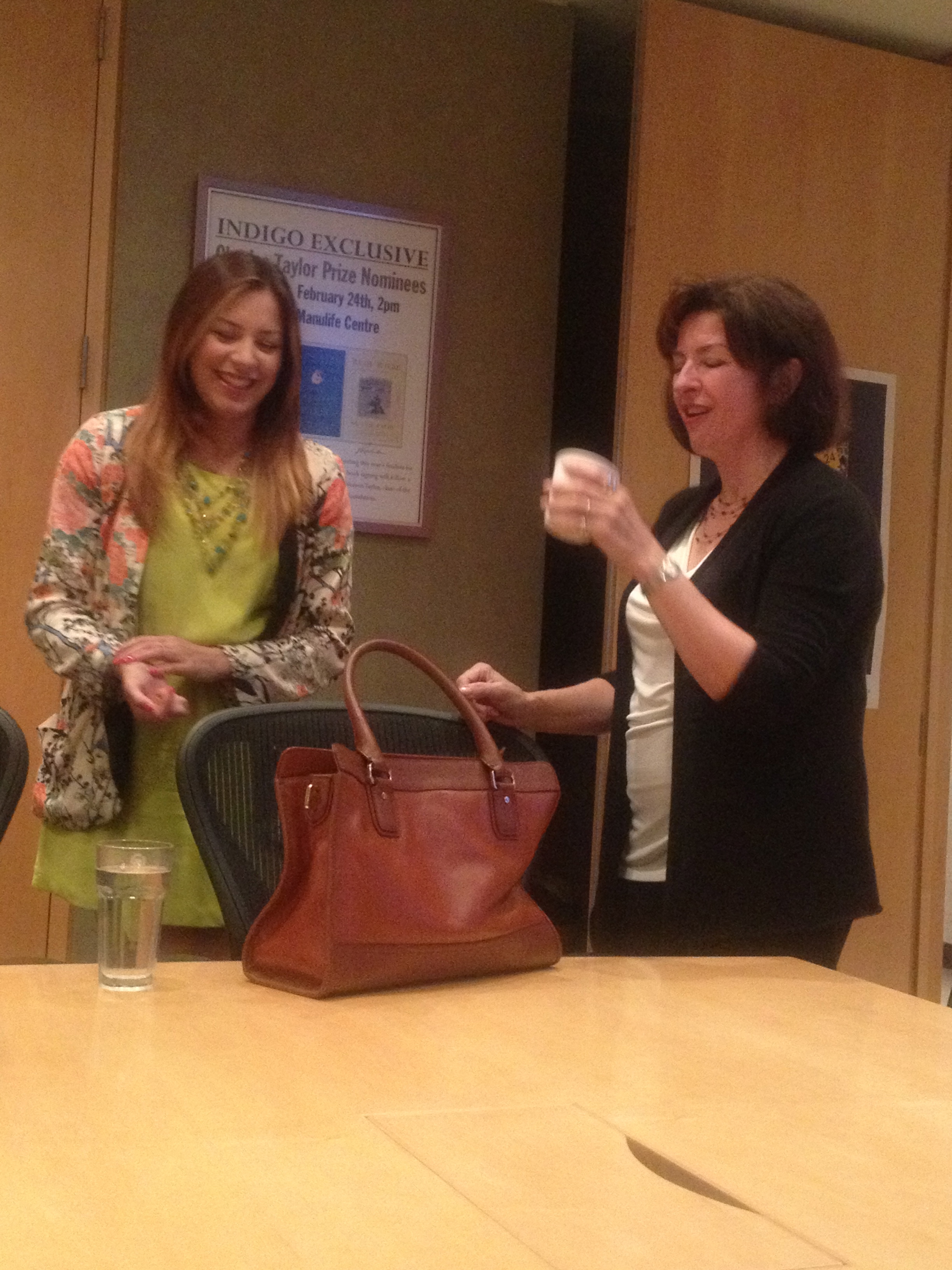
Amy McCulloch and Teresa Toten

Amy McCulloch and Teresa Toten

Thanks to Random House of Canada for the opportunity to meet these authors! Both authors were kind enough to sign copies of their books for my readers. Watch for giveaways soon, when I review their books on this blog. And with that, I leave you with this final image of cupcakes. Because cupcakes.

IMG_1736

Review | Beautiful Day, Elin Hilderbrand

4984cdf8952a88d0371a815d73eca7eeElin Hilderbrand’s Beautiful Day is a fun, soap opera-like beach read. Jenna Carmichael and Stuart Graham are getting married on a beautiful Nantucket beach… What could go wrong? For one thing, it turns out that the bride’s sister is bitter about marriage in general and about her role as the responsible mother figure. She also happens to be having a fling with a much older man. The groom’s parents have divorced over an affair, and subsequently remarried, and the woman who caused the divorce in the first place will be at the wedding with her son (the aforementioned cause of the divorce). Bridesmaids and groomsmen are in and out of each other’s beds, and soon various skeletons in various closets are brought to light. What can I say? Beautiful Day is a fun, absolutely fluffy, ride of a book. Take it with you to the beach and enjoy!

Even better, amidst the fluff and melodrama are some real tender moments. Central to the wedding is a notebook left behind by Jenna’s mother before she passed away. In it, Jenna’s mother writes down her hopes and dreams for her daughter’s wedding — a sweet way for her to be involved even though she is no longer physically around. I admit, my own mother has passed away, and the realization that she won’t be around to see it if I ever do get married is almost too painful for me to contemplate. My mom was a major romantic, much more so than I am, and to be honest, she’d probably have enjoyed the ceremony of my wedding much more than I would have. So Jenna’s mother not being around and instead leaving a notebook for Jenna to refer to did make me somewhat teary-eyed.

I can also see how the notebook, while a sweet gesture, puts far too much pressure on the family. As Jenna’s stepmother points out, Jenna has had hardly a say in her own wedding — everything had already been detailed by her mother. The notebook also, understandably, puts a strain on Jenna’s father’s current marriage — his previous wife is a much more dominant presence than even the bride herself.

There are also moments of sharp social insight. The Best Man’s boyfriend Jethro for example is hyper aware not just of being one of the only two openly gay men on that Nantucket beach, but also being the only black man at the wedding apart from a server and the bandleader. His tongue-in-cheek commentary is funny, and the way some other characters comment on his adding a welcome touch of “diversity” to the wedding is a hilarious bit of satire about the white bread nature of that predominantly upper class resort.

Beautiful Day is just a fun page-turner for the summer. Take it with you to the porch, or to the beach if you’re lucky, and lose yourself in the delightful soap opera of the Carmichael and Graham families.

Blog Tour: Author Q & A | Tanya J. Peterson, Leave of Absence

9781592998838 cov.inddFrom the publisher’s description:

In this insightful and evocative novel, Tanya J. Peterson delves deeply into the world of post-traumatic stress disorder, depression, and schizophrenia. When Oliver Graham’s suicide attempt fails, he is admitted to Airhaven Behavioral Health Center. Unable to cope with the traumatic loss of his beloved wife and son, he finds a single thread of attachment to life in Penelope, a fellow patient wrestling with schizophrenia and its devastating impact on her once happy and successful life. They both struggle to discover a reason to live while Penelope’s fiancé William strives to convince her that she is worth loving. As Oliver and Penelope try to achieve emotional stability, face others who have been part of their lives, and function in the “real world,” they discover that human connection may be reason enough to go on.

Publisher Inkwater Press and author Tanya J. Peterson generously offered me the opportunity to speak with the author and learn a bit more about her process in writing this book.

Q & A with Tanya Peterson

1. In Leave of Absence, Oliver has PTSD and Penelope is schizophrenic. Why did you choose to focus on these mental illnesses in particular?

My goal in writing Leave of Absence was to help increase understanding of mental illness.  There are many negative stereotypes associated with mental illness in general.  Schizophrenia in particular is one of the most negatively stereotyped and misunderstood of all mental illnesses.  Likewise, there is a lot of mention about PTSD in the news, but many people don’t fully understand it.  Both schizophrenia and PTSD are often feared and associated with violence.  This is sad, because violence is not inherently a part of either.  Leave of Absence shows what schizophrenia, PTSD, and depression (both Penelope and Oliver have depression) are like for those who experience them.

2. How did your experience as a teacher and counselor inform the writing of this story?

I drew on much from my background in writing Leave of Absence.  Having a graduate degree in counseling and being a Nationally Certified Counselor were definitely helpful in contributing to the factual base of the story.  Working closely with people, whether through teaching or counseling, has helped me understand people – the humanity behind the illness.  Additionally, I have personal experience of my own that was helpful in creating a realistic, albeit fictional, story.  I’ve been a patient myself, and I’ve even spent time in a behavioral health center such as Airhaven in Leave of Absence.  It was there that I was diagnosed with bipolar I disorder.

3. I’m intrigued by Penelope’s fiancée, who remains loyal even when Penelope feels herself undeserving of his love. In your experience, what are the biggest challenges facing those with loved ones who are mentally ill?

Everyone’s experience is unique, of course, so it can be a bit difficult to generalize.  Some difficulties often experienced, though, are a distancing between the loved one and the caregiver, such as what happens to William with Penelope.  There can be a sense of guilt from both sides:  someone with a mental illness can feel that they are burdening their loved one or inhibiting their lifestyle (Penelope feels that she is ruining William’s life); likewise, a caregiver can feel as though he/she isn’t doing enough to help the one they love.  There are also difficulties that are associated with the specific mental illness involved.  Each one has its own unique thoughts and behaviors associated with it that bring challenges to the person experiencing the illness as well as the people who care about them.

4. You mention in your website that you are deeply passionate about ending the stigma surrounding mental illness. How can fiction create that change?

I think that fiction can be a very powerful vehicle in bringing change.  There are many wonderful non-fiction books out there that explain various mental illnesses, and that’s great.  These are important, too, in increasing understanding.  With fiction, though, a wide variety of readers (not just those interested in a specific non-fiction topic), can connect with characters who experience mental illness.  It’s important for everyone to look beyond the mental illness to see the person behind it.  Fiction makes this possible.  Fiction can increase not only factual understanding but empathy, too, and that understanding and empathy can carry over beyond the pages of the book and into the real world.

5. You’ve also written a YA novel Losing Elizabeth. How is writing about mental health for a YA audience different from writing for an adult audience? What are the challenges unique to each genre?

I admire those authors who can write great YA books, because, for me, YA is a difficult genre to write.  While I like the story behind Losing Elizabeth (it’s about a girl who becomes trapped in an emotionally abusive relationship and was inspired by the shockingly large number of students I had across the years who became involved in unhealthy relationships), I don’t really love how I wrote it.  To me, the biggest challenge was creating thoughts and dialog that truly sounded like how teenagers sound.  I’ve worked with adolescents, and I currently have a teenager of my own, but I just don’t feel that I can make my characters sound like teens.  For me, writing for an adult audience comes more naturally.  Each reader, no matter his or her age, has different interests and tastes, and that is a challenge.  That’s absolutely not a bad thing but merely something of which I’m aware as I write.

6. What do you want your readers to walk away with after reading Leave of Absence?

I would love it if readers walked away from the story with a deeper understanding of mental illness and those who experience it.

7. What do you think of how mental illness has been portrayed in books, movies and pop culture? How does Leave of Absence present an alternative view?

So often, mainstream media negatively stereotypes people with mental illness.  A very common depiction is a mentally ill person as a deranged, raging, lunatic who is unpredictable and violent.  Another one is the person who is not “all there,” lacking sound mental faculties and with low intelligence.  Sadly, characterizations like these have been used so often that they are accepted as truths.  Accordingly, a stigma has developed against those with mental illness, and too often, people don’t want to associate with (in the workplace or socially) with someone who experiences mental illness.  I don’t believe that most people would negatively judge people with mental illness if they knew the truth about it.  In Leave of Absence, neither Penelope nor Oliver fits the stereotypes.  Readers will see what schizophrenia, PTSD, depression, and loss are like for them.  In writing Leave of Absence, I have broken away from the misunderstandings and stereotypes to help contribute to deeper understanding and empathy.

Jaclyn, thank you sincerely for interviewing me!  I appreciate the chance to share a little bit about why I wrote what I did.  It was kind of you to invite me onto your wonderful blog.  Thanks, too, to your readers for taking the time to read this interview.  🙂

+

Thank you to Tanya for giving such an insightful interview! And thank you as well to Inkwater Press for organizing this!

To learn more about Leave of Absence, check out the author’s website or see the book trailer:

About the Author

TanyaPeterson (2) (571x800) - Copy (424x585)Tanya J. Peterson is a mental health writer and speaker who holds a Bachelor of Science in secondary education, Master of Science in counseling, and is a Nationally Certified Counselor.  She has been a teacher and a counselor in various settings, including a traditional high school and an alternative school for homeless and runaway adolescents, and she has volunteered her services in both schools and communities.  She also has experience with mental illness from the perspective of a patient, as she experiences Bipolar I disorder and struggles with various forms of anxiety.

Her most recent work is the novel Leave of Absence in which she uses fiction as a powerful vehicle for portraying the realities of schizophrenia, depression, and PTSD.  Tanya has given mental health presentations in her home state of Oregon, she is active in her local NAMI, and she will be a featured speaker at the conference of Mothers of Incarcerated Sons Society, Inc. to be held in San Diego in August, 2013.