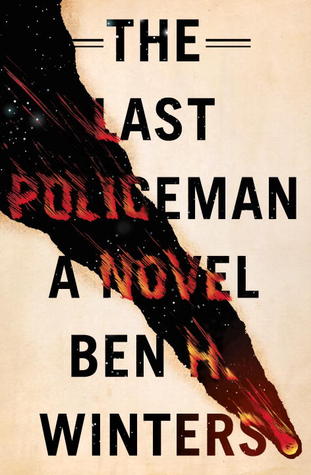
Review | The Last Policeman and Countdown City, Ben H. Winters

13330370What’s the point in solving a murder when we’re all going to die anyway? Ben H. Winters’ The Last Policeman is a brilliant pre-apocalyptic murder (is it even a murder?) mystery. Asteroid 2011GV1, also known as Maia, is 100% certain to hit the earth in six months. Many have gone “Bucket List” — quitting their jobs, getting married, following long-suppressed dreams. Some decide to commit suicide. At first glance, the insurance agent found hanging by a monogrammed black leather belt in a McDonald’s washroom appears to be just another in a long string of suicides. But something about the scene strikes Detective Hank Palace as off and, despite indifference from pretty much everyone else, he decides to investigate.

The Last Policeman is a page turner of a puzzle. The victim is a mild-mannered actuarial specialist more comfortable with his numbers rather than with people. He had one sister, no friends, and practically no social life. Who would want to kill him? As Palace examines the victim’s life, he uncovers secrets that are awesome mostly because of how nerdily they’re framed, which is very much in character for the victim.

Underlying the mystery is the ever-looming apocalypse. Why does it even matter if this man was murdered? Why bother spending the last six months of your life hunting down a killer who may not even exist? To Winters’ credit, characters mention the apocalypse but are never maudlin. In one scene, Palace’s co-worker breathlessly posits the possibility (based on a potential glitch in the video that charts its trajectory) that the asteroid may miss. Palace spills the co-worker’s coffee and points out that no matter how much they talk about how the coffee will drip to the floor, the result will remain the same. Bam. Brutal. Yet a necessary call to reality? Even that is problematized, and even Palace later regrets his actions.

Despite the bleakness of the characters’ future, the story is funny. Rather morbid humour, of course, but well, how else would you react to an impending apocalypse? In one scene, Palace is surrounded by religious fanatics calling upon him to convert. His polite responses — “Yes, thank you, I did hear about it.” — are as hilarious as they are ineffective.

16046748The sequel Countdown City, now 77 days before the asteroid hits, is a bit bleaker in tone. Martha Cavatone, who babysat Hank Palace and his sister when they were kids, has asked him to find her missing husband. Common sense says the husband left to join a mistress or have casual sex on a beach somewhere, but Martha insists he would have left only to do something noble. As with the first book, the question becomes, why bother tracking down a man who most likely just wanted to spend his last three months away from his wife?

This book delves even deeper into the human situation pre-apocalypse. The search leads Palace into an anarchist/pseudo-utopian society on a college campus. A woman there tells him that similar societies usually fail because a despot inevitably appears and again imposes a form of hierarchy. However, the asteroid has provided their group with a unique opportunity — all they have to do is last 77 more days with their current system, and they’ll have succeeded where others failed. Is this goal worth striving for, or will it be ultimately a futile exercise? Well, when the entire planet has only 77 days left, what determines success and futility?

Such philosophical enquiries are raised by Winters’ series, and while the stories never allow themselves to dwell too much on these questions (always, the focus remains on the mystery), they do stay with the reader. There’s a lot more going on within these pages than a straightforward mystery, and the author’s restraint in dealing with these issues compels the reader to ponder them long after the story itself ends.

There are many post-apocalyptic books on the market; pre-apocalyptic ones are far rarer. Even more rare is a pre-apocalyptic book where the end of the world simply features as a backdrop to a murder mystery. Even for those of us who love our job, how many would actually keep working if the world was certain to end in six months? Hank Palace is a noble man, and to Winters’ credit, no one ever makes a big deal of this nobility. Why does he keep investigating potential murders and missing persons? He doesn’t know, and no one else cares, really. He just does. And we, as readers, are all the richer for it.

The ending of Countdown City hints at a killer of a plot for the third and final instalment to this series. If I guess right, Palace will go in search of his sister and investigate a group that claims to be able to stop the asteroid (this group is mentioned in books 1 and 2). I devoured The Last Policeman and Countdown City in two days. I certainly have no wish for Hank Palace’s world to end, but I definitely can’t wait for book three.

The Last Policeman is already available in bookstores and online retailers. Countdown City goes on sale July 16.

+

Thank you to Quirk Books for a copy of The Last Policeman and an ARC of Countdown City. I received both as prizes in a Facebook contest, with no obligation to review.
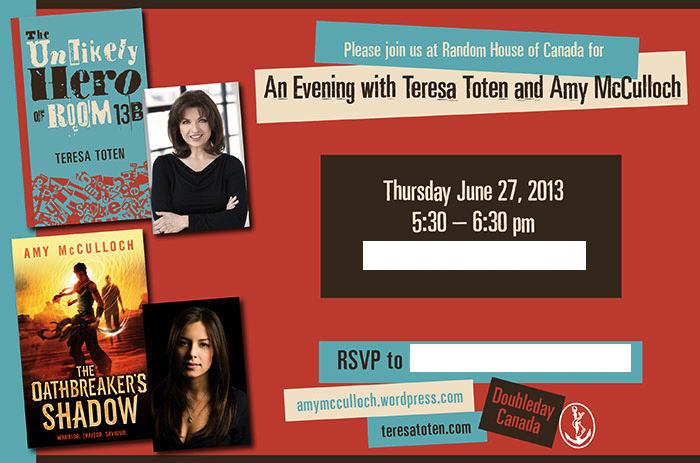
Author Encounter | Teresa Toten and Amy McCulloch

3C871CD9-C2CF-4EEE-B295-3B2FD30B9FCB

When I received this invitation from Random House of Canada, I had just recently read Amy McCulloch’s The Oathbreaker’s Shadow and had absolutely fallen in love with it. So I jumped at the chance to meet her, as well discover a new (to me) author Teresa Toten.

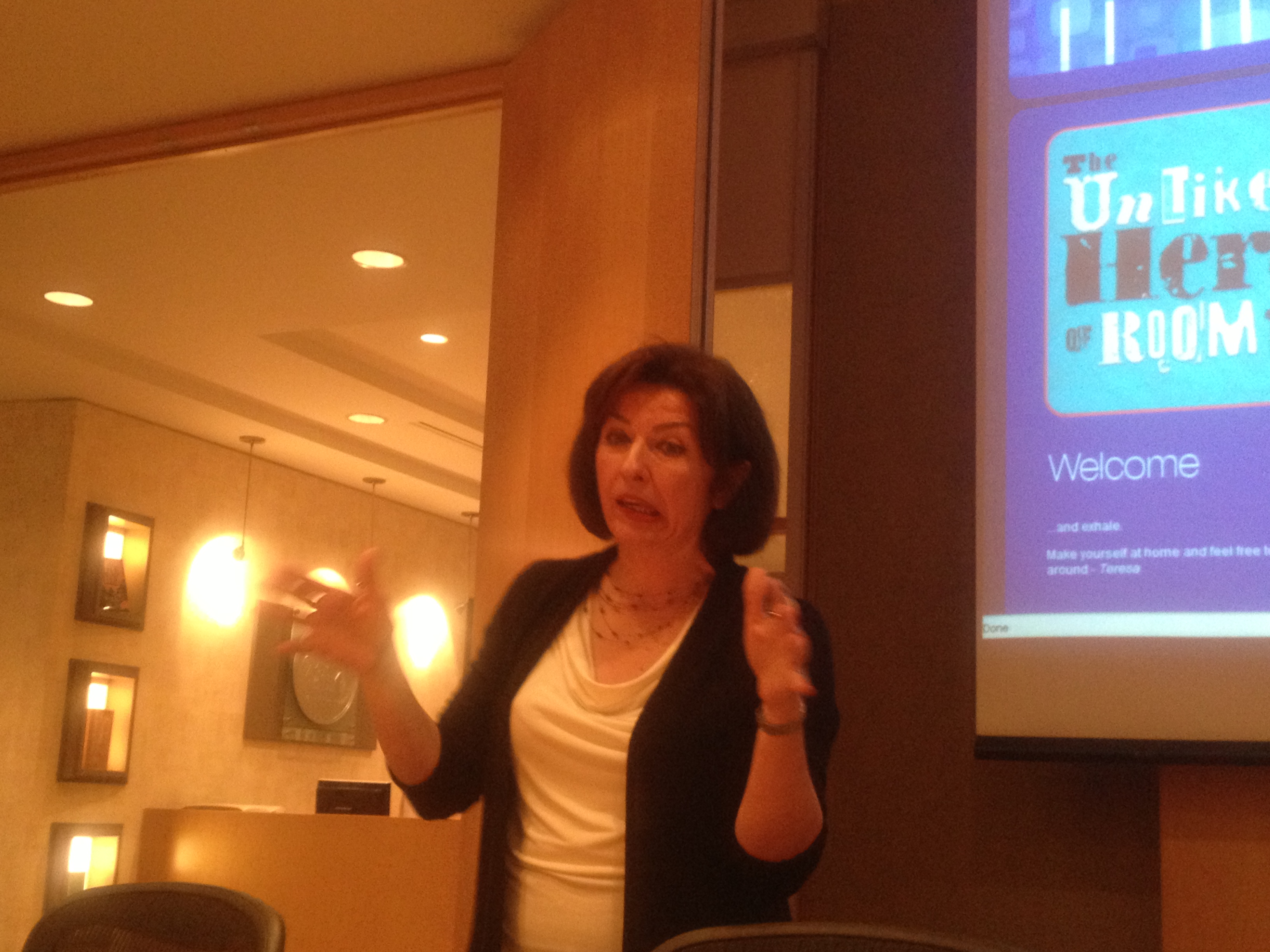
Teresa Toten, being awesome

Teresa Toten, being awesome

We got to chat with the authors over cupcakes and pop, and quite frankly, I think Teresa Toten may be my author twin. For her upcoming YA novel The Unlikely Hero of Room 13Bshe was planning to use for her epigraph a quote from a song she thought we bloggers would be too young to know: Puff, the Magic Dragon. In particular, the line “A dragon lives forever, but not so little boys,” which always makes her teary. Thing is, that line makes me teary as well. The song is particularly memorable to me for the silliest reason: my mom got a perfect score when she sang it on a videoke (like karaoke, but on a home TV) machine, proving to my sister and I that she knew the secret to high videoke scores. I later learned that the song was about drugs, but personally, I’d always found the lyrics to be unbelievably sad, about the loss of childhood. My mom passed away a couple of years ago, and it’s the silliest memories, such as that of “Puff the Magic Dragon,” that remain. All that to say that Teresa Toten immediately won me over when she quoted that song.

Then she said she changed her mind about the epigraph, and instead decided to use a verse from “If,” a poem by Rudyard Kipling. She then launched into a heartfelt reading of the poem, moving around the room and basically pulling all my heartstrings that somehow always get stirred with that poem. Yes, the poem has probably been used time and again on motivational office posters, and yes, I wish the ending had referred to women as well as men, just because. But really, that poem has been my Invictus-type inspiration for the longest time. Probably the first time I got chills at an author event for bloggers, so thank you for that, Ms. Toten.

Her upcoming novel, The Unlikely Hero of Room 13B, is about a teenage boy with OCD, and it’s not just like us flippantly saying we have OCD, but an actual psychological disorder that forces him to spend half an hour outside the door of his own house before he can enter. I have a bad habit of calling myself OCD when it comes to editing stuff at work, but Toten’s novel shows it as an actual debilitating condition, certainly nothing to be flippant over. Toten’s website includes You Are Not Alone, a list of resources for anyone who wishes to learn more about dealing with OCD. Adam, the boy with OCD, falls in love with Robyn, a girl in his teen support group, and the novel tells their love story. As part of their support group therapy, each member has to come up with a superhero persona, and Adam, naturally, decides to be Batman to his Robyn. Seriously. And Teresa Toten is a punny enough author to pull this off.

Teresa Toten has also recently joined Twitter! Follow her @TTotenAuthor.

IMG_1745

Amy McCulloch, talking about her book and her awesome Pinterest board

I read Amy McCulloch’s book The Oathbreaker’s Shadow and absolutely loved it. My review will be posted shortly, but mostly I was impressed at its Eastern influence, its unique, rather epic fantasy angle, and the way it manages to stand out among all the YA fiction in the market. The author spoke about her Pinterest board, where she includes images of the books and travel experiences that influenced her novel. Personal favourites the Dune series, the Lord of the Rings trilogy and Philip Pullman’s His Dark Materials trilogy are among her clear influences, which may explain why I loved this book so much, as were some pretty awesome travels in Cairo and Namibia.

The Oathbreaker’s Shadow is about a teenage boy who lives in a society where the breaking of a promise leaves you with a physical scar and forces you into exile. This boy grew up completely bound by the rules of honour, and aspires to be bound by oath to protect his best friend and future ruler of his world. Unfortunately, in doing so, he unwittingly breaks an oath he doesn’t even remember making, one that had bound him since infancy. The book is about his quest to discover the source of this oath, and find a way to free himself from it. It’s an amazing book, about duty, honour, and the moment when we realize that all we’ve lived our lives for may not be what we expect.

Amy McCulloch is an avid Tweeter. Follow her @AmyMcCulloch.

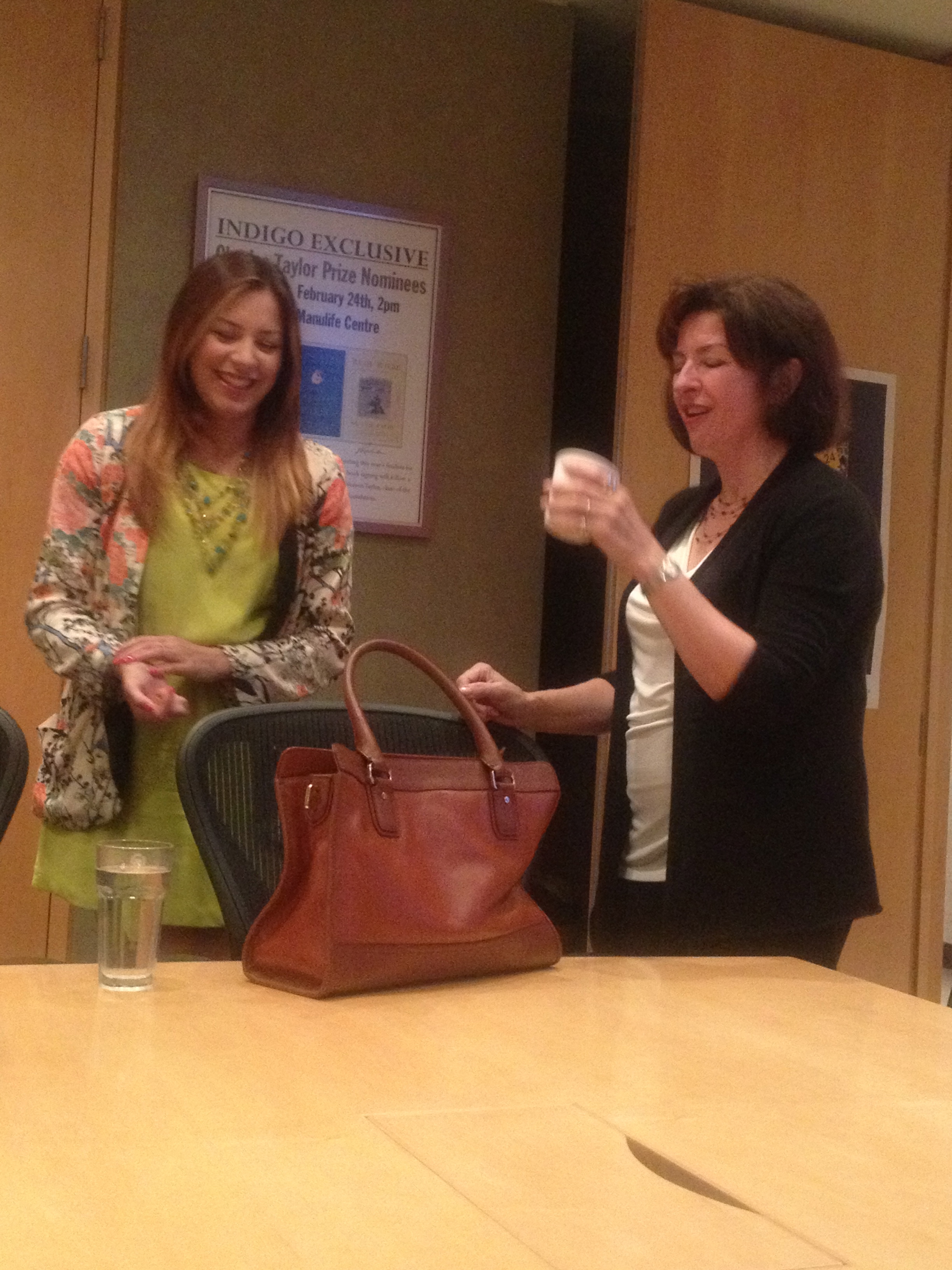
Amy McCulloch and Teresa Toten

Amy McCulloch and Teresa Toten

Thanks to Random House of Canada for the opportunity to meet these authors! Both authors were kind enough to sign copies of their books for my readers. Watch for giveaways soon, when I review their books on this blog. And with that, I leave you with this final image of cupcakes. Because cupcakes.

IMG_1736

Review | Openly Straight, Bill Konigsberg

17934215Bill Konigsberg’s Openly Straight is a thought provoking, unique, take on the LGBTQ coming out story. When Rafe came out in the 8th grade, no one made a big deal about it. His best friend Claire Olivia had figured it out long before. His classmates stopped using words like “faggot” in jokes. His parents threw him a coming out party and his mother even became the president of PFLAG. Thing is, Rafe is tired of being the gay kid. While people don’t tease him for being gay, people still think of him as gay, and he just wants to see how it feels to be seen as just Rafe. So he transfers to Natick, an all boys boarding school, for his junior year and vows to begin afresh. It wasn’t that he was going back into the closet; he just wouldn’t mention his sexuality, and people would assume by default that he was straight. It’s a form of heterosexism — people are assumed to be straight unless they say otherwise — and Rafe wanted to use it to his advantage.

Many of the LGBTQ YA books I read are about coming out, so Konigsberg’s approach intrigued me. Post-acceptance, can society move towards a point where labels don’t matter? By refusing to be labelled “gay”, is Rafe exploring a new kind of freedom or is he denying a part of himself? On one hand, Rafe is enjoying a level of friendship with other guys that he never used to have as “the gay kid.” Free from his past, he easily becomes a popular jock, and can easily converse with his soccer teammates in the locker room shower area without having to avert his eyes. At one point, he makes eye contact with a fellow jock and realizes that, at his old school, he’d have to break eye contact within a couple of seconds, because as “the gay kid,” a prolonged connection would make his classmate uncomfortable. Being just “one of the guys” is liberating.

On the other hand, can he truly be himself when he is keeping his homosexuality a secret? At one point, a couple of his teammates start harassing another teammate for being gay. Rafe stands up for the gay teammate, but then realizes he feels like a fraud: “Who was I? How could I stand up for gay people while at the same time hiding that part of me?” Even more thought provoking, at least for me, he then says:

Straight people have it so much easier. They don’t understand. They can’t. There’s no such thing as openly straight. [67% of Kindle edition]

It’s true. I can reflect all I want about how it might be for society to move to a post-label state. I can march in the Pride Parade and argue passionately for same sex marriage. But I can never fully understand the courage it must take to come out, nor can I fully understand how it must be to live an openly gay lifestyle. As this book points out, being openly gay doesn’t even necessarily mean having a same sex partner; even just having people know you’re gay can make them treat you differently.

As Rafe recalls life at his old school, we realize that acceptance can still lead to Other-ing. His mother gave him a stack of books about homosexuality and he admits that while the material may have been fascinating on their own, that fact that his mother gave them to him made the books feel like “gay homework.” His classmates laugh easily at a couple of football players in drag, but when Rafe does it, even though he too does it for laughs, it is immediately perceived as a political statement — his classmates eye him solemnly and his teachers turn it into an object lesson about the gay movement.

I got tired of feeling isolated, okay? So I decided to tear down that barrier. I came to Natick, and I made a different choice. Not like gay is a choice, but being out definitely is one.

And you know what? That barrier did come down. I arrived here, and for the first time maybe ever, that barrier between me and so-called straight guys disappeared. [92%]

But at what cost? And what happens when Rafe falls in love with one of his friends at Natick? Can Rafe truly escape being labelled gay, and more importantly, should he even want to?

There’s a lot going on in this book, and part of me wishes the ending had been less conventional. I also wish some of the other characters were less predictable — the nerdy outcasts are interesting and show more potential of becoming true friends, while the popular jock leaders are jerks. In a book where the very act of labelling is challenged, I wish these perceptions were challenged as well.

Still, this book is sure to spark much discussion. In a class lecture at Natick, Rafe’s teacher asks if tolerance is enough: “To tolerate seems to mean that there is something negative to tolerate, doesn’t it? Acceptance, though, what’s that?” [46%] And is acceptance even enough, or does it too include a value judgement? “It’s hard to be different,” Rafe’s teacher points out, and while he does propose an alternative to both tolerance and acceptance, Openly Straight shows that it’s never really that simple. And perhaps it doesn’t have to be.