
Big Girl Small, Rachel DeWoskin #50BookPledge

I read Rachel DeWoskin’s Big Girl Small mostly because of Shannon’s wonderful review of it in Savvy Reader. At 5’1”, I would never dare to imagine I can understand how a little person feels, but in other ways, I do know how it is to grow up feeling different. I imagine practically everyone has felt different in some way or another. High school is tough enough without being 3’9”, and DeWoskin’s protagonist, Judy Lohden, handles it with sarcasm and wit: “If you’re born saddled with a word like Achondroplasia, you learn to spell.”

In so many ways, the things Judy goes through are things practically every teenager experiences. She is the new kid at a performing arts high school, and worries about fitting in. She has a “teacher crush” on her inspirational AP English teacher and feels sympathetic for her dorky math teacher. She falls immediately for the handsome Kyle Malanack when she sees him at a party: “I think maybe the very not-realness of teenage love makes it the only real thing. […] what’s true about love isn’t a quantity thing — it’s a quality one. And the reason I know that is because I still feel like I’m actually going to die.”

We know from the first chapter that something big and bad is going to happen to her and cause her to run away. What happens to her isn’t much of a mystery for long (Judy drops a lot of hints along the way), but that didn’t impede my enjoyment of the book at all. It just made me feel utterly helpless, watching her moving towards her situation without being able to do anything to stop it: “If the first boy you dare love pulls the worst Stephen King Carrie prank in the history of dating, then you run and hide.” It is however the next part that really struck me as being absolutely true and heartfelt: “Because who can love you after that? Maybe your parents. But how can you face them, when you’ve all spent so much time convincing each other that you’re normal?”

In a way, her parents’ overcompensating for her dwarfism by pretending she’s normal makes things worse; Judy actually appreciates it when her friend Goth Sarah admits she admires Judy for having the guts to go to parties and face all the stares. Yet at times, when reading about Judy dressing up for a party or daydreaming about Kyle, even I forget she’s a little person. The advantage of reading her story is that I sometimes got so lost in the universality of her experiences (I had a crush like that too! I agonized over outfits like that too! I stressed over impressing a teacher too!) and only remembered Judy’s size when she makes a joke about it.

Judy jokes a lot about her size; she gets very defensive about it, yet in a way I can understand. It’s like how some comedians say they crack jokes about themselves because it’s better than having other people poke fun at them. Her jokes are actually also funny, designed to put the person she’s talking to at ease with her size so they can get on with an actual conversation. Her narration is often hilarious, her observations spot-on, and her descriptions vivid. Judy is an interesting, smart and relatable teenager.

She’s also lucky in so many ways. Unlike some other YA books, where the hero/heroine has to face obstacles alone, Judy has a very strong support system. Her parents, while completely clueless at times, clearly love her very much, and even Bill, a middle aged man Judy meets after she runs away, becomes a good friend, being her sounding board and recipient of her story. Judy’s friends Molly and Meghan are both wonderful, supportive friends, and Goth Sarah is simply a standout — quirky and loyal, the best friend a teenage girl could want. I winced whenever Judy would shun Goth Sarah in favour of the more popular Ginger, who while definitely nice and friendly, was clearly (to my twenty-eight year old brain anyway) nowhere near as interesting.

Big Girl Small is a wonderful story, with relatable characters. I would have loved to be as independent and confident as Molly or Goth Sarah when I was in high school. I was probably a lot like Judy — I knew I was good at some things (not singing, which is Judy’s big talent), I was shy and insecure about other things, and I too have had crushes where I thought I would never again feel that way about anything else. I can only hope that I’d handled it with as much wit and aplomb as Judy has.
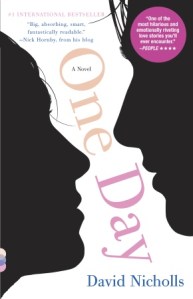
One Day, David Nicholls #50BookPledge

I read One Day on the recommendation of a fellow bookworm who thought it was a good book but hated the ending. My boss at the bookstore loves this book, has recommended it a lot of times, and is looking forward to the movie with Anne Hathaway and Jim Sturgess. So it’s been on my TBR list for a while, and when my bookworm friend lent me her copy, I was excited to read it.

One Day follows the relationship between Emma Morley and Dexter Mayhew over the course of twenty years, depicting snapshots of their lives on the same day (July 15th) each year. They meet in 1988, have sex, and set off to pursue different lives after graduation — Emma as an aspiring writer and Dexter as someone who wants to travel the world and become famous somehow. Their relationship shifts from romance to best friendship, and their lives turn out very different from how they’d imagined it in university. Taking a yearly snapshot is an interesting concept, allowing Nicholls to show gradual character development and long-lasting effects of decisions that characters make. Nicholls is a talented writer, and his characters are complex, interesting people you can imagine being friends with.

That being said, it took me a long time to get into One Day. I found myself bored for the first half of the book. Nothing to do with Nicholls’ writing, and I have to admit, the behaviour of characters and development of Emma and Dexter’s relationship felt realistic. It actually took me a while to figure out why I wasn’t enjoying the book, and I realized that while the yearly snapshot approach is an interesting idea, it made me find the story meandering. I just wanted something to happen already. While I acknowledged the Emma-Dexter chemistry, I found the single day narrative too abrupt — I’d just be getting invested in a plot thread when the day ends, I flip the page and I have to hear about the results through flashback. It didn’t help that I found the young, politically active Emma annoying. Dexter accuses her of being condescending and a know-it-all, and I had to agree. That made me a bit wary about the upcoming movie — I can imagine finding it more annoying on screen.

As Emma and Dexter grow older, however, and become a bit more settled in their respective lives, I found myself becoming more interested in the story. Secondary characters started to become more significant, and Emma and Dexter’s desire to be with each other (not just romantically, but also to connect more deeply as friends) becomes more urgent. That’s what I love most about Emma and Dexter’s relationship: it’s based on a deep friendship; they’re soul mates in a similar (though much less melodramatic) way as Cathy and Heathcliff. It’s a wonderful, touching love story, and Nicholls depicts their connection well.

Like my friend, I hated the ending. Without giving away any spoilers, I just have to say I found it unnecessary. Fortunately, Nicholls is a gifted writer and he handles it much better than I imagine others would have. I also think the one day snapshot format helped him pull off this ending well.

Would I recommend this book? Sure. I can see why so many readers like this book. Despite the movie poster image, One Day is more than just a romance. It’s a well-written look at how two individuals grow up, and, more importantly, grow up together.

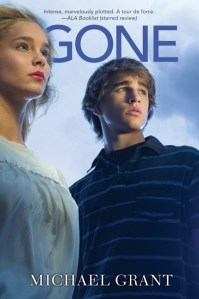
Gone, Michael Grant #50BookPledge

I read Michael Grant’s Gone on my sister’s recommendation, and I’m so glad I did. It’s brilliant and exciting, Lord of the Flies meets X-Men in a contemporary small town setting.

I was hooked by the very first paragraph: “One minute, the teacher was talking about the Civil War. And the next minute he was gone.” I can imagine lots of kids wish their teachers would just disappear, especially during really boring classes, but what if it really happens? What if all the adults in the world disappear? “No ‘poof.’ No flash of light. No explosion.” Just disappear. I actually appreciate how non-climactic the disappearances are, such that the kids the remain at first think they must have imagined  it.

The premise of Gone reminds me of a Star Trek episode where all the adults in an alien planet have died from a disease and the kids have formed a Lost Boys type society, basically being complete brats and driving the Enterprise crew insane. Thankfully, the children in Gone are more mature. Everyone 15 and older has disappeared. Main character Sam is a natural, albeit reluctant, leader. As scared as the other children, the only advice 14-year-old Sam can offer when the adults disappear and younger children look to him for guidance is eat a cookie. There’s almost a Peanuts-type wisdom in that advice, now that I think about it, but mostly it just reflects the children’s helplessness.

The adults disappearing isn’t the first weird thing to happen to Sam however. Something else has happened to him, which I won’t reveal here because part of the fun is finding it out, but basically it makes Sam worry that he has caused the adults’ disappearance. Later on, he finds out that he actually isn’t the only, um, unusual resident of the area, and the unusual nature of certain children may hold the key to what has happened to the adults.

In a world without adults, who’s in charge? As Sam’s best friend Quinn tells him, adults are no longer around to keep the bullies from imposing their rules. How can children who don’t know how to drive and barely know how to cook fend for themselves and care for the really young children? Even more urgent, what happens when they themselves turn fifteen?

Gone has an exciting premise and likable characters. I love seeing Sam’s growth from scared kid to hero, from avoiding the leadership role to embracing it and working to improve their situation. Quinn is an interesting character as well, a free spirited surfer unable to handle the pressure of responsibility, and I look forward to seeing him develop even further in the next book. I love that Astrid is such a strong female character. Nicknamed Astrid the Genius, she spouts random facts when she’s nervous. Her character however is given added nuance because of Little Pete, her autistic younger brother. When the adults disappear, she has no idea where he is, so she sets off to find him, taking Sam and Quinn with her. Mary, who takes responsibility for the day care centre, is forced to become remarkably mature, caring for babies and toddlers all wanting their mothers, and I love how she has her own personal demons to battle as well. Perhaps the most endearing character is Albert, who takes over the local McDonald’s. He takes his role so seriously he actually studies the McDonald’s manual cover to cover.

The bad guys range from bullies to an actual psychopath. Their leader is charming, intelligent and powerful, more than a match for Sam and his friends. I’ve always believed that amazing bad guys help make heroes amazing as well, and Gone has a match up I love reading about. The ending of their ultimate confrontation in this book was a bit frustrating, as my sister warned me, but good news is, there are several more books in this series.

One thing that surprised me is how religious some of the main characters are. It’s not a bad thing, just unusual in contemporary fiction. It’s not preachy in any way, which is good, and the events these kids face certainly merit some appeal to a higher power.

The book answers a lot of the questions it poses, even as it leaves a lot of other questions hanging. Gone is exciting, action-packed young adult fiction. I’ll definitely be checking out the next book in this series.