Blog Tour: The Beauty Chorus, Kate Lord Brown #50BookPledge

Kate Lord Brown’s The Beauty Chorus covers a very important topic, in my opinion: the role of the female pilots, “esp. beautiful thrill-seeking debutantes,” of the Air Transport Auxiliary Unit in World War II. They were rather dismissively labelled “The Beauty Chorus” yet served an important, vital role in transporting planes to war-torn areas.  In one scene, a couple of the female ATA pilots are laughing at a Hollywood image of them as glamourous, when the reality is that they usually end up grimy from doing a lot of physical labour.
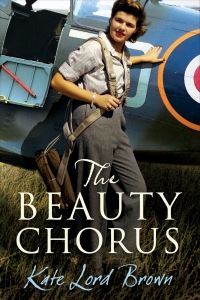
Beauty Chorus, then, ostensibly seeks to dispel those myths and show just how heroic the reality of these women are, and in some ways, the book succeeds. The italicized chapters, for example, from the perspective of ATA pilot Amy Johnson, who disappeared during a flight and was presumed dead, are touching and give us a taste of the risks these pilots take and the politics they face. The accounts of sabotage and general discrimination against female pilots also ring true, and help portray an important part of that history. And the final few chapters, where the story becomes a pure adventure-in-a-strange-land account, are enjoyable.

Unfortunately, I found Beauty Chorus so full of stock characters and melodramatic dialogue that it seemed more like the Hollywood movie the characters mocked than the reality they mentioned in passing. The main characters are adventurous debutante Evie, naive teenager Megan and young mother Stella, who left her baby with her in-laws. I found Evie mostly a standard “feisty beauty.” She gets into an altercation almost immediately with fighter pilot Beau who had immediately labelled her a spoiled brat, and as anyone who’s read a Harlequin novel can tell, that means other kinds of sparks are about to fly. In the book’s defence, Beau isn’t the stereotypical handsome brooding Alpha male. He is handsome, but scarred, literally, which adds a welcome sense of vulnerability. He is sharp, but not rude, which is good for his character, but also unfortunately makes Evie seem even pricklier.  There is the standard villanous male, who I almost expect to wear a black hat, smirk and twirl a moustache every time he appears. There is also the stereotypical ditzy, ultra-girly romantic rival, who mocks Evie’s job and clothing as being “too masculine.”

Evie has a doting father and an evil stepmother straight from a soap opera, who is after her father’s money and does everything to undermine Evie. They get into some major cat fights throughout the book, with the stepmother using baby talk on the father then demanding behind the father’s back that Evie hand over her mother’s diamonds. At times, I almost expected one of them to slap the other, though, thankfully, they show a bit more restraint than that.

Megan’s family owns land, which Megan and her brother have used to build an airstrip. With the brother dead and Megan off to war, her evil cousins are circling her father, pressuring him to sell them the land so they can use it to make money. This, on top of the Evie’s evil stepmother storyline, and the only good thing I can say is that the evil cousins don’t appear as often as the evil stepmother does.

Stella probably begins as the most interesting character: she’s a mother who has lost her husband and left her baby behind, and quite understandably suffers from depression until she meets a handsome curate who is a good listener… You can probably guess where that goes. And that’s really the main problem – with so many stereotypes and so many cookie cutter situations, a lot of the book becomes predictable.

Details about the ATA pilots being forced beyond their comfort zone are limited to characters laughing about the glamorization of Hollywood, Evie shrieking over a mouse in their cottage and characters mentioning that they have a heavy schedule for the day. Otherwise, there are scenes with Evie driving them into town to shop for their cottage, the women going to dates, and, of course, Evie shrieking invectives at the evil stepmother.

One scene that really irked me, and I’ll try not to give any spoilers away: a woman is about to have sex when she and her date run into another man. She promptly leaves her date, apologizes to the other man, and they have sex, all in the space of a couple of pages. That in itself is pretty skeevy (poor date!), but it could have worked, especially since Brown has established this woman’s naivete. Unfortunately, there wasn’t enough set-up to make me believe in the love between the character and this man. The past few chapters had her gushing about the date, and this other man hadn’t been mentioned at all. So when they suddenly declare deep feelings for each other, I couldn’t believe them. Worse, I felt I could no longer believe any of this character’s emotions in the future, and not in a good way.

There are some moments in the book I loved, mostly because I found they revealed a lot about the character, and in a non-stereotypical way. When Stella (who was still producing milk) was asked to give milk to a starving baby, she balks, and it takes the other woman a while to convince her to make the sacrifice. I thought this was just such a powerful moment, where Stella, against all logic, wants to save her milk only for her baby, even though he is in a completely different country. In another scene, when Evie sees a man beating up a dog with a stick, she takes the stick from the man and beats him up instead. I found that scene hilarious, and thought it really showed Evie’s passion for protecting the helpless.

Finally, I found the last quarter or so of the book, after a certain plot twist, to be a vast improvement. The “bad guy” characters were less prominent, which allowed Evie and the other characters to interact much more naturally, and develop beyond the stereotypes. I only wish this had come earlier, and that the villains, especially, were given more depth.

I wanted to love this book. I think it’s important to tell the stories of groups who may not have gotten as much attention in history about their war efforts, and I appreciated the Author’s Note at the end, which gave me a bit more information on the ATA pilots. Unfortunately, I didn’t find this exciting enough to be a straight-up adventure/romance story nor layered enough to be a penetrating look at the reality behind the glamour.
My Dear I Wanted To Tell You, Louisa Young #50BookPledge

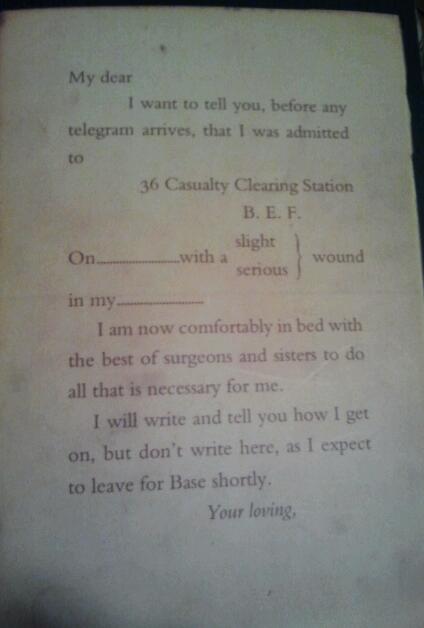
ARC cover of My Dear I Wanted to Tell You

I don’t usually post images of ARC (advanced reading copies) covers, but I just thought the ARC cover of Louisa Young’s My Dear I Wanted to Tell You unbelievably poignant. It depicts the fill-in-the-blanks postcards provided to injured soldiers at hospitals in World War I to send to their loved ones. The pain, loss, and love encapsulated in this single, impersonal document touched me, as did the book. I found the scene where this card is filled out literally gut-wrenching, in my opinion, the best scene in the book.

My Dear deals with a difficult topic – World War I – and Young doesn’t shy away from the gory details. In one scene, Julia, a nurse, talks to her cousin-in-law and non-nurse Rose about a patient whose face had been burned off. Julia describes in excruciating detail exactly how the doctor grafted the patient a new face using skin from his chest. It was horrific, which I think is Young’s point. It’s like Young presents us with snapshots of the war taken with a soldier’s point-and-shoot camera: this is war; deal with it.

The strength of My Dear lies in the characters, and with such an emotional subject, its impact is best felt when Young writes with a bit of detachment. Take for example the following passage, about a young man signing up to enlist: “He went next door to fill in forms. …Length of service: one year or duration of war. Duration of war, of course. He didn’t want to spend a whole year in the army.”

Conversely then, the impact is lessened for me whenever Young lapses into wordiness. The narrator and the characters editorialize at times, and in trying to be descriptive, grandiose and emotional, just ends up being long-winded. On one hand, there is a bit of nostalgia associated with this style of writing, which at times reminds me of some Victorian novels. On the other hand, I sometimes found it too much telling rather than showing, and on a personal level, I found myself detaching emotionally from the story at these points.

That being said, it was really the characters and their stories that stuck with me. They were all wonderfully fleshed out, and I found myself pulling for them. Young even manages to make Rose, seemingly a vain, silly character too delicate to help out in war efforts, sympathetic. Rose’s primary characteristic is great physical beauty, and while this has served her well before the war, it is Julia’s more practical set of skills (intelligence, the ability to dress wounds without fainting) that are valued. Rose’s husband Peter is off to fight in the war, and Rose obsesses about properly performing her duties as a soldier’s wife. Young’s account of her struggle to be useful, a “private war,” so to speak, turns what could’ve been an annoying character into a complex, textured human being. At times, Rose was even more sympathetic than Julia, the purported heroine who nurses soldiers back to health.

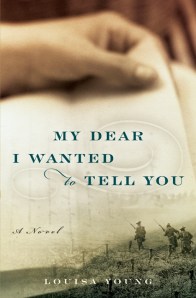
Published cover of My Dear I Wanted to Tell You

The most interesting plot point to me though was the love story between working class Riley Purefoy and socialite Nadine Waveney. They are in love, but are kept apart first by Nadine’s mother, then later by the war. Their letters to each other are beautiful and touching — long and emotional, with almost old-fashioned language, yet sincere rather than maudlin. Quite simply, I believed in their love, and I wanted them to be happy together.

With their old-fashioned language, Young again takes what could’ve been annoying and makes it work somehow. For example, when it comes to sex, both Nadine and Riley are quite prudish, unable to utter the words and relegated to blushes and ellipses. Normally, I’d be annoyed at such a potentially cutesy move. Yet, here, I found their shyness endearing; I found their romance endearing.

My Dear is definitely not a happy book. But it is a hopeful one, filled with very human characters. Even the death of a secondary character affected me. They’re that real.

Up Up Up, Julie Booker #50BookPledge

I cannot say enough good things about Julie Booker’s debut collection of short stories Up Up Up. I’m so vain I probably think these stories are about me, but chances are, if you’re a woman, you will too. Booker writes with subtlety, humour and depth, revealing layers within the most mundane situations and grounding the most exotic adventures in reality. Her writing is, at times, laugh out loud funny, but it’s the kind of humour where it’s funny because it’s true, and you feel a pang of pain because it’s the kind of situation where all you can do is laugh.

Booker’s descriptions are snappy yet vivid: a character named Heather is described as having “a man body with breasts,” the blooming of an amaryllis as “disgusting… From cock to cunt in a matter of days.” I, quite literally, laughed out loud in a mall food court while reading her speed dating story “Breakup Fresh.” To that confession, Julie Booker responded, “A mall food court + speed dating have lots in common: quick turnover, a story at every table…and some who always leave a trail of garbage.” For even more samples of her writing, check out her incredibly entertaining pieces in the National Post’s Afterword.

I tried to choose a favourite story to write about, but honestly, I just liked so many of them. Booker’s stories talk about romance, friendship, body image, aging, and so many other things that were relevant to me, personally, and she handles them with such delicacy and candour that her stories felt even more real. “Geology in Motion,” for example, is about a pair of plus-sized friends taking a kayaking trip in Alaska. They go from making fun of the image of “two fat ladies in a kayak! In skintight wetsuits. Eek!” to buying supplies and going on the trip. Booker’s description of one woman’s fear and the other’s desire to keep pushing further made me want to cheer them on, and the way the story ends made me have to stop for a moment. Then, of course, I went on to the next story, eager to see what Booker had in store for me next.

“The Exchange,” about an aspiring artist and an aspiring art collector falling in love at the Art Gallery of Ontario, is more cynical than romantic. Booker begins with the (intentionally, on the author’s part) stilted dialogue of a carefully choreographed flirtation, and goes into a very matter of fact depiction of the development of the characters’ relationship. We hear the story from aspiring artist Diana’s point of view, and while she very logically interprets Henry’s actions, the violence of her emotions comes forth in Booker’s descriptions of her art work.

The best thing about Up Up Up being a collection of short stories rather than a novel is that each story offers a different type of reading pleasure, like a box of truffles instead of a single chocolate bar. There’s a wonderful feeling in treating yourself to one wonderful story at a time. Because these tales are so short, so much emotion comes from details: a line of dialogue tossed off by a character, or a singular character trait, like the clown in “Below Below” insisting on teaching in French even though she grew up in “Bumfuck-Nowhere, Ontario.”

Up Up Up is, quite possibly, the best book I’ve read all year, and I’ve read a lot of very good ones. To all women: buy this book. Read it, then pass it on to your sister, your best friend, your mother. Even better, if you’re in or near Toronto, go see Julie Booker yourself at the Harbourfront Centre, Wednesday, June 8th, 7:30 pm. The back cover of Up Up Up warns readers, “Prepare to meet your new favourite writer.” All I can say is, Ms. Booker, it’s a pleasure.