
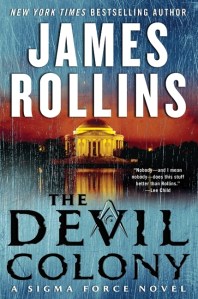
Review: The Devil Colony, James Rollins

Two things you can expect from any James Rollins book: non-stop thrills and really cool science that sounds like science fiction, but is really based on fact. The Devil Colony is no exception, and after two whole years, I’m just happy to spend a few hours again with the Sigma Force team. I love Sigma Force — secret agents with Sheldon Cooper IQs, they’re literally kick-ass nerds. That means that while they’re racing after bad guys action movie style, the problems they try to solve are just as much intellectual challenges as physical ones. It’s Michael Crichton on steroids, and a nerdy adrenaline rush all the way through.

The main plot of Devil Colony is one that, I admit, didn’t really draw me at first: the history of America is based on a lie perpetuated by the Founding Fathers and involving Mormonism. Rollins writes it well, with lots of clues to keep you guessing, and Da Vinci Code-style revelations that call into question commonly accepted beliefs about the history of America. Perhaps it’s just that I’m not American, nor am I that familiar with American history regarding the Founding Fathers. So the revelations didn’t really make gasp the way Dan Brown’s did in Da Vinci Code, where I contrasted it to everything I’d learned in Catholic school. Thankfully, however, Rollins isn’t as wordy as Brown was when discussing all the historical details. Plus, the action is vintage Rollins, and even I was swept along by the mystery and the action.

Call me a nerd, but the part that really interested me in Devil Colony was the bit about nanotechnology. I love how Rollins integrated such contemporary technology, and one I usually associate with futuristic thrillers, with the historical mystery. My main disappointment was that the scientists who were working with Sigma in exploring the impact of this nanotechnology weren’t given more scenes; I would’ve loved to read more about them, and perhaps find out what, if anything, the Founding Fathers thought of nanotechnology.

I also love how Rollins explored more of the Sigma members’ personal lives in Devil Colony. Monk is definitely one of my favourite characters, and I love seeing him in expectant father mode. Gray’s parent issues felt very real, and I love seeing Seichan’s softer, sympathetic side in dealing with him. The book ends with a bit of a surprise twist promising a future plot thread regarding Sigma and the Guild, which is exciting in itself, but honestly, I’m even more excited to see how Gray deals with what has happened in this book and what happens to Monk as a father.

Devil Colony isn’t my favourite Rollins book, but it’s definitely an exciting read. I love it, and I already can’t wait for the next Sigma adventure!
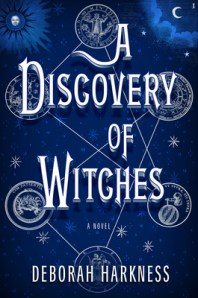
Review: A Discovery of Witches, Deborah Harkness

Deborah Harkness’ A Discovery of Witches begins with an interesting premise: reluctant witch Diana Bishop discovers an ancient book of great power in a library and sends it back. It turns out witches, vampires and daemons have been after that book for centuries, each with their own ideas about what the book contains. Together with tall, handsome vampire Matthew Clairmont, Diana tries to escape all the baddies after her (and the book) and find out more about this book. They fall in love, which unfortunately violates a centuries old treaty that vampires, witches and daemons must not mingle. Forbidden love, a mysterious ancient text and a reluctant witch who, it turns out, has the potential to be the most powerful witch in history — sounds exciting, eh? The beginning certainly was.

Unfortunately, the rest the book felt like the first six hundred pages of a three thousand page novel — full of minor threads that either get resolved or not yet, with no major story arc for the book itself. As a result, a lot of the major dramatic scenes didn’t have the impact it could have. Once, Diana is tortured by a baddie wanting to force her to reveal her powers. She survives and is praised for her bravery. Unfortunately, it comes too early in the novel to feel climactic, and as Diana herself didn’t know what her powers were at this point, her resistance seemed more unavoidable than heroic.

Several major baddies show up, all of whom are given only a few chapters before disappearing, ostensibly to reappear in a later book. The major baddie, who provided what I assumed was the climax, came almost literally out of nowhere. This could’ve been a wonderful surprise twist, if only this particular baddie had been present, even as a shadowy, unknown behind the scenes puppeteer, throughout, but that wasn’t the case. I can only assume Harkness is saving the actual climax for a later book.

Discovery is bogged down by minutiae. Harkness may have been so fascinated about vampire eating habits (they eat nuts!) that she wanted to devote practically an entire chapter to Diana serving Matthew a meal. Halfway through, when I realized the conversation was never going to move beyond Matthew praising Diana’s attention to detail and Diana’s fascination that Matthew can eat solid food, I stopped caring completely. So imagine my horror when only a few pages after this meal, Matthew decides it’s his turn to feed Diana, and to educate her about all the wines he serves. While it must be amazing to taste centuries old wine, by what felt like the tenth bottle described in loving detail, I wanted to swear off wine forever.

Minor quibble, but while I love having a heroine with a great appetite (finally!), Diana eats more toast in one book than Miss Marple drinks tea in all of Christie. That’s how it seemed anyway, from Matthew serving her tea and toast to Diana wondering if they had any more butter. I love foodie lit (Goldy Schulz! Guido Brunetti! Hannah Gruen!), but there’s a reason none of those authors spent this many pages on toast.

Diana spends a huge chunk of the novel in Matthew’s mother’s castle, where she waits around for Matthew and finds out lots about the vampires’ back stories. Way too many pages of nothing exciting happening, and way too much boring information, to the point when, after a few chapters of action, when a vampire I actually liked said “This is my tale to tell,” I had to turn off my Kindle (much less satisfying than slamming a book shut).

This book does have one of the most unintentionally hilarious scenes I’ve read in a while. When Matthew leaves Diana in the castle to go pursue baddies, Diana cries so hard she starts leaking water everywhere and creates a literal flood. Maybe it’s just because it’s such a lame reason to be that devastated, but that made me laugh. It was only afterward, when Matthew’s mother said Diana was the first witch in centuries powerful enough to command witchwater that way (Diana actually became water) and Diana admitted her fear that she’d disappear completely (think Wicked Witch of the West) that I realized the scene was meant to be solemn.

So why did I finish the book? Like I said, the premise was promising, and the parts where the characters talk about the book are interesting. There is also the possibility of a revolution and a war among the witches, vampires and daemons, which sounds exciting. So I do want to find out how this whole story ends.

The next book promises to be about Diana training to use her powers properly. Personally, I’d like to find out how many books Harkness plans to have in this series, so I can wait for the final one and read the last few chapters to see how the war turns out and what the ancient book actually contains. Till then, I leave the toast eating and vampire reminiscing to other readers.

Review: Train Man, Nakano Hitori (Bonnie Elliott, trans.)

Japan, 2004. A hopeless geek saves a young woman from a drunk on a train, and posts about it on the 2-Channel chat forum. “I’ve never been thanked by a woman before,” the twenty-two year old techie admits, “so… I got so nerrrrrrvoussss.” The next day, the woman sends him a pair of Hermes teacups to say thanks. The geek gets giddy: “Damn. I’m getting all feverish. Gotta take a chill pill.” The other geeks on the forum urge “Train Man” to call “Lady Miss Hermes” and ask her out. So begins a wonderfully sweet, endearing romance recorded on the Internet and compiled by chat forum participant Nakano Hitori in the book Train Man.

I love Big Bang Theory, but I think the geeks in this book may actually out-geek Sheldon and Leonard. These are real geeks, in a real story, and I think that just makes this story so much more touching. Train Man’s previous encounters with women are, quite literally, just from anime and manga, and he elicits dating advice from the forum. What makes this extra endearing is that, since the others in the forum are also equally clueless with women, they search on the Internet for highly rated restaurants and acceptable date fashion. The romance moves much more slowly than in Western culture, possibly partly because of Japanese culture and partly because of Train Man’s shyness, and this makes each tiny step (Hermes sent him an email!) even more significant. After the second or third date, for example, Train Man agonizes about whether it’s time to make his Big Move: admitting to Hermes that he thinks she’s cute. I loved cheering Train Man on, as he developed from being too scared to call Hermes to casually telling the chat forum he’s seeing her again in a few hours.

Perhaps even more touching, however, are the other participants in the forum, who are almost mostly hopeless geeks. As Train Man’s story develops, others share their own (mostly disastrous) attempts at talking to women. One geek was once turned down by a girl who said she wouldn’t want to see his face while she ate. When a female participant said Train Man’s story makes her think of her happy twenty-year marriage, and makes her want to be reincarnated as a geek, another participant immediately replied that he wouldn’t recommend it. They live vicariously through Train Man’s romance, rushing home right after work to see if there are any updates. They analyze each of Hermes’ actions. It reminded me of high school, when my friends and I would dissect each sentence one of our crushes had said, but in Train Man’s case, it’s people from at least all over Japan discussing each minute detail with him.

Each of Train Man’s successes elicits cheers, squeals, and at times, even tears, as some forum participants confess to crying without knowing why. After one particularly significant piece of news, the participants responded with a series of giant images (animals or humans made up of dashes and slashes in cheering poses).   Among pages of those images and various congratulatory messages, one line stood out: “Shit, forgot to get my ASCI ready.” (From the context, I assume ASCI is what they call those images? Anyway, that line made me laugh.)

Reading the forum transcript, it’s impossible not to get caught up in the emotions, and I found myself cheering Train Man all the way. He is such a sweet, shy guy, and I wanted him to succeed with Hermes. The story has apparently been adapted in many different ways in Japan (movie, TV series, manga), but I’m not sure how many are available in an English translation like the book I read. Overall, it’s a cute, touching romance, which as forum participants noted, gives hope that geeks can become gods. One participant in particular posted that, inspired by Train Man, he gave a woman directions one day. Unfortunately, he chickened out when she asked for his name. Another participant responds: “You could’ve been Guide Man!”

[I bought my copy at Fully Booked in the Philippines, but this book is also available at Chapters Indigo in Canada, if you’re interested in checking it out.]