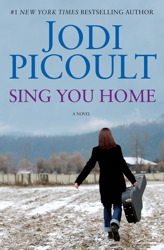
In Sing You Home, Jodi Picoult explores the issue of gay parenting. Music therapist Zoe and her partner Vanessa want to have a baby, using frozen embryos from the time Zoe and her ex-husband Max tried to have their own baby. Unfortunately, since the divorce, Max has become a member of a conservative Christian church. He believes homosexuality is a sin, and would rather his and Zoe’s embryos be implanted in his sister-in-law’s womb, for her and Max’s brother to raise in a Christian household.
Picoult handles the issue well, presenting both sides fairly. Even Max, the “bad guy,” is a sympathetic character, a recovering alcoholic who has found solace and a community in church, and is genuinely trying to reconcile his newfound beliefs about morality with his knowledge that Zoe is really a good person and would become a good mother. While I can’t personally understand Max’s pastor’s position, I think Picoult shows well how thoroughly he believes what he says, and so his motivation, however misguided I think it, is primarily to provide for the spiritual welfare of the people at his church. Picoult clearly shows her belief that gay couples should be allowed as much right to parent as straight couples, and while I completely agree with her, I’m also glad she made Zoe’s lawyer as arrogant and focused on political agenda as Max’s lawyer is. Zoe and Vanessa are wonderfully developed, flawed characters, and I’m glad that Picoult chose to show characters rather than just present her take on the issue.
It was near the beginning of the book, however, where Zoe and Max were dealing with their most devastating failed pregnancy yet, that really hit home for me. Zoe recalls being called into a dying pediatric patient’s room to provide some music therapy. She starts playing a melancholy melody, to fit in with the mood of the family, but they ask her to play instead the dying child’s favourite songs, mostly upbeat nursery rhymes. She does, and the family sings along, until the child passes. Zoe remembers that, and realizes that she is incapable of playing anything for her own child, that all she can do is hold his body and while she wants to give him some music, she can’t.
My mom passed away a couple of months ago, and at her wake the night before the funeral, we had a band play her favourite songs. I remember a cousin looking at me, brows furrowed, a few moments after the band began: “Is that Barry Manilow?” Not exactly in line with the solemn, sombre mood, but it was the most we could do for Mom. The worst part is knowing how inadequate it is, and how no matter what we did, there was no way we could give Mom any more. So, reading that scene in Sing You Home took me back to that evening. Since my mom’s passing, I’ve found it difficult to read scenes of characters dealing with the death of loved ones (mostly their children, at least in the last couple of books I’ve read). That scene, in Sing You Home, was just absolutely raw, and real, and I ached with Zoe at her inability to sing to her own child.
Possibly because the beginning, with Zoe and Max dealing with death together, affected me so much, I found the transition to Max’s conversion to Christianity and Zoe’s finding a new soul mate in Vanessa abrupt, and much too convenient. It was just too obviously orchestrated; when Max, after chapters of hating it when his brother tried to convert him, suddenly has a big experience and decides to join a church earlier shown picketing against homosexuality, I just knew that Zoe, who throughout showed no inkling of ever being attracted to women, would suddenly realize she was gay. In fairness to Picoult, she builds up the Zoe/Vanessa romance gradually, but after the emotional impact of the beginning, I felt cheated when I realized the book wasn’t about the relationship (Zoe/Max, who really did seem an intriguing couple) and the issue (Zoe’s desire to be a mother) that I’ve already become so invested in. In a way, it still is about Zoe’s desire to be a mother, but that felt like a minor thread in the main plot about gay rights. While the Zoe/Vanessa romance was certainly believable, there were portions where I felt like I was reading a primer on homosexuality. Vanessa and Zoe reflect a lot on what makes homosexual relationships different from heterosexual ones, which is fine, but I felt more like Picoult was educating us rather than showing the romance develop.
The ending is disappointing, with convenient plot twists that tie everything up neatly, but I’ve come to expect this from Picoult’s books (ever since I was horribly disappointed by the neat, convenient ending of My Sister’s Keeper). So the only thing that really disappointed me here was that I thought Lucy’s story (a troubled teen undergoing music therapy with Zoe) was just left hanging. I definitely wanted to find out more about what happened to her.
Still, overall a pretty good book. Worth checking out.

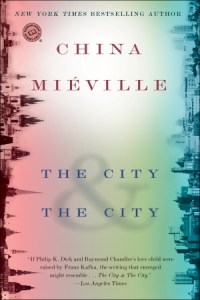 I finished China Mieville’s The City & The City days ago, and to be honest, I’m still trying to wrap my head around it. The novel begins as an apparent classic crime noir: a woman is found murdered in Beszel, and Inspector Tyador Borlu is called in to investigate. Evidence links the woman to neighbouring city Ul Qoma. Thing is, Beszel and Ul Qoma aren’t geographical neighbours as we are used to. Best I can understand, they overlap somehow, and residents of each city train themselves to un-see people and places from the other city, lest they be charged of Breach and taken away. Borlu’s investigation therefore isn’t so much about a murder as it is about the two cities, and the mythical third city that is rumoured to be between them.
 Literary Treats