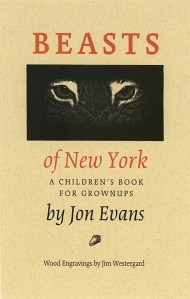
My initial reaction when I received Jon Evans’ Beasts of New York in the mail was, what a beautiful book! With the rise of e-reading, I’ve long believed that the future of print publishing is in books that are practically works of art. The Madame Bovary translation by Lydia Davis released last year, for example, had such a beautiful cover that I decided against getting the cheaper Kindle ed or waiting for the paperback. I’ve also made no secret at work of my love for the Penguin Essentials series released recently, which prompted me to buy myself another copy of The Great Gatsby.
So, when I saw the absolutely beautiful way Porcupine’s Quill printed Beasts of New York, I fell in love with the textured, cream-coloured pages and the ornate letters that opened each section. I also love the wood engravings by Jim Westergard. I was totally grossed out by the one of the rats, but overall, they’re beautiful. I love how realistic the fur looks, and am amazed whenever I remember that these images were originally created on wood. This book is a work of art, an example of the kind of reading experience e-books can’t offer (an image of a wood engraving on a screen will also be beautiful, but not quite as beautiful as on this type of paper, I think).
I was also intrigued by the plot: a squirrel named Patch travels to New York City to search for food and finds out about a war in the animal kingdom. Growing up, one of my favourite books was The Secret of NIMH, and one of my favourite movies was Homeward Bound.. To be honest, the Beasts’ first chapter excerpt on the publisher’s website didn’t really grab me. With details like a squirrel’s home being called a drey, I was afraid the book would end up being like a nature documentary. Luckily, however, the story becomes much more involved than that. I quickly became intrigued by Patch’s adventures, and loved seeing New York City through his eyes. Cars become “death machines” and apartment buildings are “mountains.” In the hands of a lesser writer, I can imagine such descriptions being cutesy, but Evans pulls it off. At times, even I felt like I was traveling in a hostile, utterly alien environment, and I grew up in a city!
Politics — alliances, betrayals, war councils — in this story is wonderfully intricate. What I loved most, however, was that Evans never lets us forget that these are animals. In a particularly chilling scene, when trapped with a group of other animals, Patch sets a fox free from his cage on the condition that the fox swear on the moon (an oath deeper than blood, so powerful Patch literally feels a shudder when he does it) never to eat squirrels again. Other creatures then beg to be set free, so the fox frees a rabbit, then promptly devours it, saying, quite reasonably, that he’d never promised the same for rabbits.
The battle scenes are gory, filled with characters biting each other, and bleeding to death. The ultimate villain, the King Beneath, is an absolutely frightening, mysterious creature. He might not have been as scary if we could just label him a certain type of animal, but because we’re seeing the story through Patch’s eyes and Patch himself doesn’t know what the King is, or indeed if the King is anything more than a legend being used by the power-mad rat Snout, the King is mostly an eerie, shadowy presence to us as well.
The one thing I didn’t like was inclusion of the coyote and the turtle, especially in the last chapter. For a book with such power in the realism of its details and dialogue, I found the attempt at mythology to be unnecessary. It was like Evans was trying to add gravitas to the story by making it part of a much larger tradition, when I was most moved by the focus of the story on one squirrel, for whom one city already seems too much for the world to contain.
Beasts of New York is a contemporary urban fable, geared for adults, but also a story that I think mature kids will appreciate. There aren’t a lot of adult books starring animals, and Evans’ animals seem less anthropomorphized than the books and movies I remember. Beasts is an exciting tale overall, and a beautiful, beautiful book.

 Hey all! Last month, I got to participate in Harper Collins Canada’s blog tour for Switch, Tish Cohen‘s contemporary take on the classic Freaky Friday tale. What if you could live someone else’s life? Whose would it be? As I said in my review, I love the book, and I was impressed by how real it felt, despite the fantastical premise.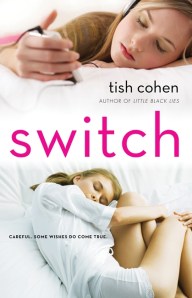
 Literary Treats