
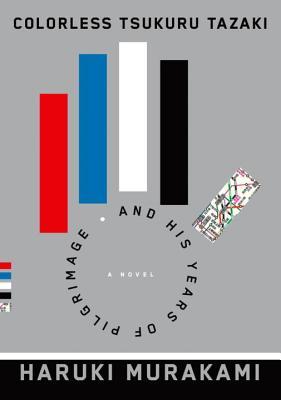
 “From July of his sophomore year in college until the following January, all Tsukuru Tazaki could think about was dying.” So begins one of Haruki Murakami’s loveliest, most lyrical novels ever. Colorless Tsukuru Tazaki and His Year of Pilgrimage marks the author’s return away from the sprawling, surrealistic narrative style of 2011’s 1Q84 to the lyrical realism of 1987’s Norwegian Wood.
Tsukuru Tazaki grew up with a tight-knit group of five friends in high school, the kind of friendship children imagine will last forever. Yet in college, Tsukuru is kicked out of the group with explanation. Something has happened, but none of his friends would tell him what. The novel takes place years later, when Tsukuru, now in his 30s, takes his girlfriend Sara’s advice to solve the mystery that has haunted him since: why did his friends reject him so completely and so suddenly?
The mystery behind the betrayal propels the story forward, but discovering the answer is far from the core of the story. Rather, Colorless Tsukuru Tazaki is about discovering oneself, about coming to an understanding about one’s place in the world, and about how childhood experiences will have power over us long into adulthood. The title of the book comes from an inside joke among Tsukuru’s friends, that with the exception of Tsukuru, all of them have colours in their names — red, blue, white, black. They each have vibrant personalities as well, colourful characters to match colourful names — one is an intellectual, another is a jock, a third is a beautiful musician and the fourth is a comedian. In contrast, Tsukuru is colourless not just in name, but in personality — he believes he is extraordinary only in being absolutely ordinary, and even wonders what he brings to the group’s friendship. Though he grows up to have an impressive job as an engineer of train stations, he dismisses it as merely a mechanical skill at being able to organize things. His name as well is symbolic. Tsukuru means “to make” — while the Chinese character could be written to mean either “to create” or “to make,” his father had chosen the more prosaic definition, not wanting to give his son the burden of a grandiose name. And this resistance to grandiosity has defined Tsukuru all his life.
This of course is Tsukuru’s view of himself, and when he meets up with old friends, he discovers a very different view of himself and his fit into the group dynamic. It’s an eye opening experience for Tsukuru, and likely one many readers can relate to. How we view ourselves is usually not how others view us, and realizing the discrepancy is a fascinating experience.
Like all Murakami works, Colorless Tsukuru Tazaki is rich in symbolism and beautifully told. The novel is a masterclass in symbolism — some may very well consider it overdone, but I love how consistent the tropes are throughout. Colour is repeated time and again; even in university, Tsukuru meets a new friend Haida, whose name means grey, and who later features in a feverish dream sequence (that may or may not have been real) with Tsukuru’s high school friends whose names mean black and white. Music, of course, is classic Murakami, and here we have the usual references to classical music, as well as a pianist among Tsukuru’s high school friends, and a fable told about a musician which later links to another story told about a train station. It all ties in perfectly, and despite the grounding in realism, the story feels very much like a fable, a mosaic of a tale where all the parts fit together to make a breathtaking whole.
There’s also a musicality and a strong sense of poetry to Murakami’s language, even in translation, and this, more than his other books, made me wish I could read the original Japanese. Take for example this passage:
As he gazed at the four names on the screen, and considered the memories those names brought back, he felt the past silently mingling with the present, as a time that should have been long gone hovered in the air around him. Like odorless, colorless smoke leaking into the room through a small crack in the door. [p. 119]
And of course, my favourite part of any Murakami book and the reason I buy them in hardcover: Chip Kidd’s jacket design is absolute perfection. Probably my second favourite Murakami cover (nothing beats 1Q84!), and I admit when I first saw the cover online last year, I was disappointed. But I should’ve known Chip Kidd wouldn’t let me down — the beauty of this jacket design is in the layers, and this piece of artistry alone is well worth purchasing the hardcover.

+
Thank you to Random House Canada for a copy of this book in exchange for an honest review.

 Literary Treats