Theatre Review | The Motherfucker with the Hat

I’d recently read Fr. James Martin’s A Jesuit Off-Broadwayan account of his time as theological advisor to Stephen Adly Guirgis’ play The Last Days of Judas IscariotThe book included excerpts from Guirgis’ play, and while the story certainly seemed compelling, much is lost seeing Guirgis’ words only on the page.
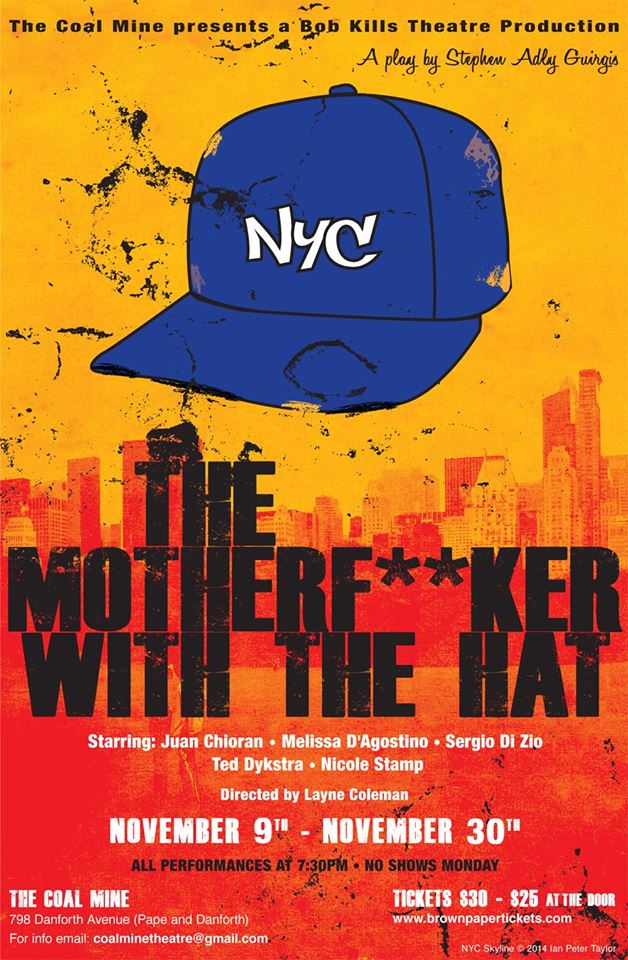
10342925_594387707339778_8339064364632971756_nFortunately, Bob Kills Theatre has just brought another Guirgis play to Toronto – The Motherfucker with the Hat. Coyly termed “the play that dares not speak its name” by the New York Times, Hat is loud, crude, in your face, and absolutely electrifying. The production in Toronto is at The Coal Mine, a new theatre at Pape and Danforth (Hat is their first production). The Coal Mine is an intimate space — two rows of viewers line the walls, and the set is right in the centre of the room. It’s the perfect setting for Guirgis’ intensely personal narrative. We can’t help but get sucked into the characters’ lives, and every nuance of emotion is visible to the entire audience.

The story follows recovering addict Jackie (Sergio di Zio), who has recently been released from prison, and his girlfriend Veronica (Melissa D’Agostino). As the play begins, Jackie comes home thrilled at having landed a job at FedEx, and is about to celebrate with Veronica when he finds another man’s hat in their apartment. He accuses Veronica of cheating on him, and turns to his AA sponsor Ralph (Ted Dykstra) for advice.

The play is hilarious, but with a definite edge. There’s an underlying sense of bitterness beneath the punchlines. At one point, Jackie screams, “I’m in pain!” and that pain just seeps through, not just from Jackie, but from all the other characters as well. Above all else, the play feels raw — the characters are all wounded in one way or another, and particularly in such an intimate venue as The Coal Mine, the audience can almost feel them bleed.

Guirgis’ genius is in the truth that reverberates throughout his words. In one scene, Ralph points out that friends are made before you’re 25 — any “friend” made after that age is merely an associate, because “friends are for the playground.” I don’t know if I completely agree, but I can certainly remember feeling that way. The sentiment rings true. Yet contrasted with that disillusionment is also a sense of hope. In one of my favourite lines in the play, Jackie says, “Your – whaddyacallit – your world view? It ain’t mine. And the day it is, that’s the day I shoot myself in the head. I didn’t get clean to live like that.” 

As the naive, almost child-like Jackie, Sergio di Zio’s performance just about broke my heart. The moment in the first scene when he discovers that Veronica may have been unfaithful, his face just falls, and you can feel the jubilation about his new job gradually draining away as realization dawns. And that final scene — I won’t give any spoilers away, but really, with that look on his face, I just wanted to give him a hug.

All the performances were really strong, but Juan Chioran as Jackie’s cousin Julio stole the show. I last saw (and loved) him as the Emcee in Shaw Festival’s Cabaret, where he pretty much dominated the stage with each of his songs — in the much smaller Coal Mine, he seemed even larger than life. As an empanada-making, kung fu fighting cousin with solid advice and a heart of gold, Julio stands out in contrast to the more fucked up characters in the cast. Chioran revels in the character’s exuberance, yet also imbues him with pathos that somehow seems much deeper than Jackie’s more overt emotion. “I’m only doing this for your mother,” Julio warns Jackie, admitting he doesn’t like Jackie very much. Yet later on, when Jackie’s world falls apart and he goes to confront the man he believes is sleeping with his girlfriend, Julio is the one who stops him, and offers to “go Van Damme” on the man himself, so Jackie won’t break parole. Chioran is charismatic and brilliant, and the moment when Julio reminisces about a childhood incident between him and Jackie is just beautiful.

If you’re in Toronto, I definitely recommend checking this play out. The play has also received positive reviews in NOW Toronto, The Globe and Mail and The National Post.

The Motherfucker with the Hat is on at The Coal Mine until November 30. Tickets are $30 and available online: www.brownpapertickets.com/event/859215.

The Coal Mine is such a new venue that they don’t even have a website yet. In the meantime, you can follow them on Facebook or Twitter, for the latest news. Keep an eye out for Mike Bartlett’s Bull in March and August Strindberg’s Creditors in May.


Wab Kinew to Host Canada Reads 2015

Great news, Canadian booklovers – CBC just announced Wab Kinew as the host of Canada Reads 2015!

Wab Kinew. Photo courtesy of the CBC.

Wab Kinew. Photo courtesy of the CBC.

If you followed 2014’s Canada Reads debates, you’ll remember Kinew as the passionate defender of Joseph Boyden’s The Orenda. This year’s contenders had some pretty big shoes to fill — Canada was looking for “the one novel to change a nation.” The Orenda won, partly because it’s a really good book about important subject matter, but also partly because of Kinew’s eloquence and obvious love for the novel.

In a CBC press release, Kinew enthuses that he “can’t wait to host the debates.” He says, “Canada Reads is an amazing show to be a part of because it is both a chance to celebrate Canadian literature, and also to have some really important conversations which concern us all.” The theme for Canada Reads 2015 will certainly spark some important conversations: “one book to break barriers.” Panelists will debate books that change perspectives, challenge stereotypes and illuminate issues. 

Personally, I’m most interested in how panelists and readers will interpret the concept of “breaking barriers.” What barriers will be privileged and deemed “significant” enough to debate? What books will be accepted as representative of whatever community is breaking these barriers? Thematically, yes, this will be a good platform to discuss diversity in Canadian literature, but I’d also be curious to see books that break stylistic barriers. A memoir written in poetry form, or a novel like S. by J.J. Abrams where handwritten notes, maps and graphic elements are incorporated into the traditional novel. Or (I hope) a book I’ve never even heard of, where the format somehow renders it more accessible for readers with some form of disability, for whom it is difficult to find books to read.

The theme is a tall order for any book. If there was a theme to push the boundaries of creative freedom in literature, this is it, and part of me wishes that with this theme, Canada Reads opened itself up to poetry, drama and other forms of literature. Imagine a work by artist and poet Christian Bök being included in the debates!

That being said, I’m still excited about the Canada Reads 2015 debates. Wab Kinew is a fantastic choice by the CBC, and the theme should raise awareness of some really important issues that literature is at least attempting to address.

Do you have a book in mind? Readers can submit their suggestions at CBCbooks.ca or tweet their suggestions to @CBCbooks with the hashtag #CanadaReads until Sunday, November 30. The Canada Reads panelists and their chosen books will be announced on January 20, 2015 and the debates will be held from March 1619, 2015.

Click here for more information, and follow @WabKinew and @CBCbooks on Twitter.

Review | After, Anna Todd

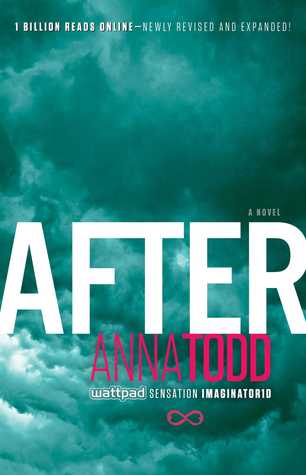
22557520Anna Todd’s After is a classic “good girl meets bad boy” love story that began as a fan fiction romance about teen heartthrob Harry Styles (of British boy band One Direction). It became such an online phenomenon that the story has since published by traditional book publisher Simon and Schuster and movie rights have been optioned.

After is a fun, entertaining read, and I zipped through the book in a weekend. Hardin (the Harry Styles character, renamed for publication) is definitely not my choice in boyfriend, whether literary or real life, but I think that’s just me being old. I can imagine teenage me going gooey at his broody grouchiness. As Anna Todd said when I met her at Indigo, there’s something undeniably attractive about being the one woman special enough to make the bad boy want to change. And indeed, as with TwilightFifty Shades of Grey, Wuthering Heights , Pride and Prejudice and other such influences for this book, in After, bad boy Hardin falls for good girl Tessa and finds the impetus to change his ways.

As a hero, Hardin insults Tessa, smirks a lot (though nowhere near as much as Edward Cullen) and acts like he’s too cool for practically everything. I had been dreading a controlling, abusive bad boy type, but he struck me more as bratty than abusive. The romance and their arguments felt immature, more Sweet Valley High than Fifty Shades of Grey, and it was more amusing than anything.

To Anna Todd’s credit, Tessa isn’t the precious snowflake that Bella Swan and Ana Steele are. She’s a young, innocent girl who is so prim and proper at the beginning that even I wanted to tell her to loosen up. She’s a realistic character, even with her odd quirk of setting alarms for every single bit of her day, but her personality shift happened much too quickly. The odd quirk of setting multiple alarms was abandoned fairly early on, and while she never turned into a Jessica Wakefield, she still felt like a completely different person a few chapters into the story.

To be honest, the turbulence of their relationship didn’t bother me as much as the fairy tale nature of Tessa’s internship. Minor spoiler alert for the rest of this paragraph: she lands a dream internship at a publishing company thanks to Hardin’s family connections (shades of Fifty Shades here). Thing is, the internship is so good that it stretches credulity past the breaking point — it’s paid, for one, and despite the job being just a part-time internship, the pay is enough for rent. Also, Tessa gets her own computer, her own phone line and her own office. Then, during her first day, the head of the company gives her a stack of manuscript submissions and tells her to send on to him any manuscripts she thinks worth publishing, and to throw away any that she doesn’t like. Seriously? I’ve never worked in publishing, so there may be some truth to this, for all I know. But I doubt it. Now, granted, a lot of my response is sour grapes at not having my own office, but well, even a wish fulfillment fantasy should have some credence of believability, no?

That being said, the romance was entertaining to read. There were some troubling aspects, but again, I think Hardin’s brand of bad boy was just too immature for me to really get into. Tessa’s jealousy over Hardin’s past relationships leads to some pretty stupid decisions, but again, it all feels very high schoolish. I generally like YA, and I know there are adult fans of this story. I’m just not one of them — I think I’m just too curmudgeonly and at multiple times wanted to tell the characters to grow up. But I did enjoy reading the book, and I even might pick up the next book in the series for a snowy weekend.

+

Thank you to Simon and Schuster Canada for a copy of this book in exchange for an honest review.