Review | White Bodies, Jane Robins

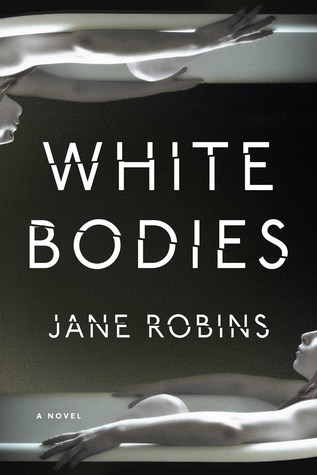
32920301White Bodies is a chilling psychological thriller that makes you think it’s going in a certain direction but manages to pull the rug out from under you at the end. The big reveal comes as a surprise, though when it happens you wonder why you didn’t see it coming. Robins does a great job in creating a troubling undercurrent of unease throughout the story, so that even when you think you have a handle on what’s happening, there’s a part of you twigging that something’s not quite right.

I’ve long been a sucker for stories about twins, and this book plays around with the tradition of the good twin/bad twin dichotomy. Tilda is the Jessica Wakefield of the pair — beautiful, glamorous, and irresistibly attracted to danger. Callie is mousier than Elizabeth Wakefield ever was; shy and unassuming, she is obsessed with her sister’s glamour. Her obsession goes beyond a Single White Female desire to be her twin, however, and is almost a desire to consume her twin — in a rather disturbing reveal, we learn that Callie ate her sister’s baby teeth, which is just really gross.

I love how Robins depicts the complexity of their relationship. There’s something definitely off about Callie’s feelings for her sister, so when Callie expresses concern that Tilda’s boyfriend Felix is abusive, it’s hard to tell how much of it is genuine love and how much is jealousy or something more sinister. We experience the story through Callie’s perspective, and the unreliability of her mental state keeps us off-balance throughout.

Tilda as well is a fascinating character. She withdraws from her twin, purportedly because Callie and Felix don’t get along, but it sometimes feels like her desire for distance is rooted in something deeper than that, and I wondered how much she intuited of Callie’s feelings. We mostly see her as Callie does — a victim of domestic violence who needs to be rescued — but again, Robins does a great job in hinting at what lies beyond Callie’s notice.

Felix’s death on the very first page plunges the reader immediately into a traditional murder mystery. Callie’s fear of police knocking on her door on page 4 makes us think we know what this mystery will be about. But as we read on, Robins uncovers layer after layer from these characters, and it’s a taut, compelling ride to the finish.

+

Thank you to Simon and Schuster Canada for an advanced reading copy in exchange for an honest review.
Event Recap | Penguin Random House Canada Fall Preview

PRHCpreview

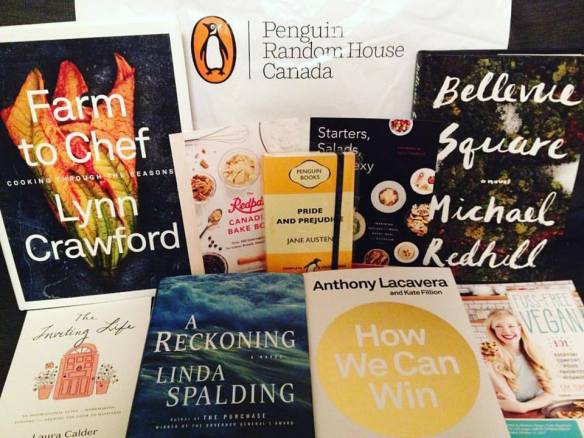
Last Thursday, Penguin Random House Canada invited booksellers and book bloggers to get a sneak preview of some of their must-read titles this season. It was an evening of pure bookworm nerding out, and a chance to meet some of their authors.

#CanLit Author Encounters

Lynn Crawford, Michael Redhill, Linda Spalding, Anthony Lacavera and Sam Turnbull all came to talk to us about their books.

  • Farm to Chef: Cooking through the Seasons by Lynn Crawford (Sept 12) – an absolutely gorgeous cookbook with recipes that, at first glance at least, sound delicious and seem simply enough to make. Recipes are arranged by season and featuring key ingredients (e.g. apples and mushrooms in Fall, cabbage and squash in Winter, asparagus and strawberries in Spring, and berries and tomatoes in Summer).
  • Bellevue Square by Michael Redhill (Sept 19) – a literary thriller set in Toronto about a young woman who investigates the mystery of her doppelganger being seen in Kensington Market. This book was already on my TBR list even before this event, so I’m very excited to have met the author and dig right in!
  • Fuss-Free Vegan by Sam Turnbull (Oct 17) – comfort food vegan recipes with no kale, no quinoa, no smoothies and no energy balls! We got a recipe card for 15-minute Peanut Noodles. I love peanut butter and noodles, and I especially love making meals in 15 minutes or fewer, so consider me sold on this vegan dish.
  • How We Can Win by Anthony Lacavera (Oct 3) – did you know the lightbulb was invented by Canadians? This book, by the founder of Wind Mobile, is about the need for Canadians to step up, own our successes and go for the gold rather than settling for bronze.
  • A Reckoning by Linda Spalding (Sept 26) – a novel inspired in part by Spalding’s own family history of her Quaker ancestors moving to Canada and taking with them their pet bear.


Already Read, Highly Recommend

  • The Heart’s Invisible Furies by John Boyne – one of the best books I’ve read this year, a Dickensian coming of age story of a gay man in 20th century Ireland. Carve out a staycation to immerse yourself in this.
  • Young Jane Young by Gabrielle Zevin – a Congressional intern has an affair with her boss and reinvents her whole identity to move on from the fall out. Told from the perspectives of the intern herself, her mother, her daughter and the Congressman’s wife.


My Top 5

  • The Book of Dust: La Belle Sauvage by Philip Pullman (Oct 19) – I remember being absolutely blown away by The Golden CompassLa Belle Sauvage is the first in a new trilogy set in Lyra’s world, and I can’t wait to revisit that world.
  • Little Fires Everywhere by Celeste Ng (Sept 12) – a family story that begins with the main character’s daughter setting fire to their house on purpose. I love Ng’s earlier book Everything I Never Told You, and @ReederReads describes this book as being “like a really good episode of The Good Wife.
  • Uncommon Type by Tom Hanks (Oct 17) – Tom Hanks wrote a book! Hanks’ love for typewriters is well-known, and each of the 17 short stories features a typewriter.
  • We Were Eight Years in Power by Ta-Nehisi Coates (Oct 3) – Coates’ essays about the Obama White House years. I need this book.
  • God by Reza Aslan (Nov 7) – I loved Aslan’s take on Jesus in Zealot and can’t wait to dive into this.

Fiction Highlights

  • The Music Shop by Rachel Joyce (Nov 7) – how beautiful is this cover? Described as AJ Fikry meets High Fidelity, this story is about a record store owner with a knack for finding people the music they need, rather than the music they think they want.
  • Dunbar by Edward St. Aubyn (Oct 3) – the newest instalment in the Hogarth Shakespeare series, a contemporary re-telling of King Lear, with Lear re-imagined as the head of a global corporation.
  • Bonfire by Kristen Ritter (Nov 7) – grip lit by the star of Jessica Jones!
  • A Column of Fire by Ken Follett (Sept 12) – book 3 in the series started by The Pillars of the Earth, which I loved. Follett does a great job creating an immersive world for his historical epics.
  • Artemis by Andy Weir (Nov 14) – a heist story on the moon by the author of The Martian. Recommended for fans of The Expanse.
  • The Rooster Bar by John Grisham (Oct 24) – this is a nostalgia pick, as I was a huge fan of Grisham’s early work but haven’t really loved his more recent titles. But this story sounds like the kind of book I would have devoured as a teen — law school students learn their school is a scam and look for a way to escape their student debts and defeat the system.
  • Smile by Roddy Doyle (Sept 12) – a whodunnit psychological thriller, this intrigued me because of its comparison to Herman Koch’s The Dinner, which I loved.
  • Christmas at the Vinyl Cafe by Stuart McLean (Oct 31) – this is another nostalgia pick for me, as the Vinyl Cafe stories were among my earliest introductions to Canadian culture. Stuart McLean passed away earlier this year, and this volume collects his Christmas stories.
  • The Boat People by Sharon Bala (Jan 9) – a group of Sri Lankan refugees come to Canada only to face the threat of deportation of accusations of terrorism in their new land.

Non-Fiction Highlights

  • The Four Tendencies by Gretchen Rubin (Sept 12) – I remember taking the online quiz to find out if I’m an Upholder, Questioner, Rebel or Obliger, and being disappointed by my result. This book is about how you can make the most of your personality type and influence others.
  • The Wolf by Nate Blakeslee (Oct 17) – about a powerful wolf in Yellowstone. Someone at the event said it’s like Dynasty or Game of Thrones, but with a wolf.
  • Endurance by Scott Kelly (Oct 17) – remember the twin astronauts who participated in a NASA study on the effect of space on the human body, where one lived on the space station for a year and the other stayed on Earth? Scott Kelly is the twin who lived in space, and this is his story.
  • I Can’t Breathe by Matt Taibbi (Oct 24) – a timely book about the roots and aftermath of Eric Garner’s killing by police.
  • The Rise and Fall of Adam and Eve by Stephen Greenblatt (Sept 12) – beautiful cover! Greenblatt’s a great go-to if you want to geek out about Shakespeare or anything historical, and I’m curious to see his exploration of the Adam and Eve story.

Movie and TV Highlights

  • Alias Grace by Margaret Atwood (Aug 29) – I haven’t read the book, but I love this TV tie-in cover and am so excited for the CBC series (Netflix in the US)! (Trailer)
  • The Snowman by Jo Nesbo (Sept 26) – I love Nesbo’s thrillers and this one stars Michael Fassbender! (Trailer)
  • Ready Player One by Ernest Cline (Jan 30, movie tie-in cover still to be revealed) – I absolutely loved this geeky tribute to 80s video games, and can’t wait to see it on-screen! (Trailer)
  • Fifty Shades Darker by E.L. James – the movie tie-in edition includes James’ photos and caption commentary from the making of the film. The Fifty Shades Freed movie comes to theatres next February!
  • Voyager by Diana Gabaldon – Outlander Season 3 launches on W network this Fall! (Trailer)

+

Thanks to Penguin Random House Canada for a great evening!

Review | Court of Lions, Jane Johnson

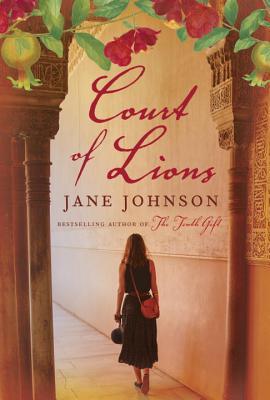
31951238Court of Lions is a rich novel, steeped in history and alternating between two time periods and two points of view. The first is Kate Fordham in the present day. On the run from an abusive and maniacally religious husband, she is living under an assumed identity in Granada as her twin sister keeps her son safe. She discovers a note tucked away in a wall, written in an old language, and her love of codes leads her to try to decipher what it says.

The note was written by Blessings, the other half of the story and a boy living in the palace of 1476 Granada as companion to the sultan’s son Momo. Momo has been prophesied to cause the downfall of his kingdom, and to anyone familiar with the history, it may be evident that the Spanish Inquisition is just around the corner.

Blessings’ half of the story is by far the stronger piece. I knew of the Inquisition and of Ferdinand and Isabella’s crusade to colonize the entire world and convert everyone to Christianity, so I very much enjoyed reading about this period in history from another perspective. Momo, who grew up to become Sultan Abu Abdullah Mohammed, in this book was a tender hearted man who couldn’t bear to see his people suffer and starve. Some may have considered his eventual capitulation weak, but Johnson presents him in a sympathetic light. Reluctant to engage with the brutality of the Spanish forces, Momo wants only to negotiate for his people to live in peace and free to worship as they choose. I wish we could’ve delved a bit deeper into his thought process. While we get a clear sense of Momo’s pain and regret as negotiations don’t go as planned, we don’t get as clear a sense of any kind of strategy on his part to defeat Spain, and while that may be part of his pacifist character, he’s often a passive figure in the battle. Part of that may be because we read this part of the story from Blessings’ perspective, and his main interest isn’t the political climate or the country’s welfare so much as it is his unrequited love for the prince. It’s a sympathetic tale and Blessings goes to great lengths for his love, even losing his leg at one point, but the broader political piece could’ve been explored deeper.

The present-day narrative just felt distracting. There is little to link Kate’s story to Blessings, other than the location and possibly a familial link to one of the characters she encounters. The mystery around the piece of paper she discovers leads to her meeting new friends, but the mystery is solved mostly off-page, and the primary focus is her escape from her husband. Thematically, her husband’s bigotry and religious fervour parallels that of Ferdinand and Isabella’s, but to make any further comparison of the storylines is tenuous at best, and insulting at worst. As a result, the two stories feel completely disconnected, and I felt that Kate’s story had enough going on in it to be an entire book. Things like self-harm and PTSD and told mostly in passing, and I know her fear only because she states it. Most of the major action (assault, a kidnapping) happens in flashback or off-page, and as a result, it loses some of its urgency. (One key exception is a rape scene, which was just creepy.)

Overall, this is a good read, and an interesting new perspective on the events in Granada during the Spanish Inquisition.

+

Thank you to Penguin Random House Canada for a copy of this book in exchange for an honest review.