Review | Runaways Vol. 1 – 3, Brian K. Vaughn and Adrian Alphona

At one point or another, many teenagers think their parents are evil. In Brian K. Vaughn and Adrian Alphona’s Runaways series, these teens happen to be right. At their families’ annual gathering, they witness their parents committing a ritual sacrifice. They learn that their parents are actually part of a super villain group called The Pride, and that they themselves have inherited some super powers of their own.

I got hooked on this series after my sister, a fan of comic books and Brian K. Vaughn’s work in particular, lent me the first book. How amazing is this series? First, I absolutely love the diversity of the main cast. I don’t want to detail all the characters and their powers, as discovering their powers was part of what made Volume 1 so much fun, but I love that we have an African American lead (Alex), a badass Japanese girl (Nico), and a plus-size purple haired girl (Gert). Book 1 is all about them discovering their own powers and coming to terms with who their parents really are. As an origin story, it’s pretty much sheer joy just to see these teens test the limits of their strengths and see how their powers measure up against their parents. The ending also reveals a mole amongst the Runaways, who leaves an anonymous note supporting their parents’ vision.

Volume 2 takes a slight detour from the teens-vs-parents storyline, and takes the Runaways on a series of mini-adventures. A food run turns into a chance for the Runaways to become friendly neighbourhood superheroes, and this in turn leads to an encounter with handsome teen Topher, who claims to be running away from super villain parents just like them. Topher also creates some fun competition for Alex (and I think Karolina as well?) as he totally charms the pants off Nico. I’m still fully shipping Alex and Nico, but I found this love triangle an entertaining diversion from the large Pride story and Topher was honestly a welcome break from Alex’s super seriousness. Much like the way the Pride storyline as a whole touches on teenagers’ conflicted feelings about their parents, Topher and Nico also end up having some very real conversations. While the Runaways may feel alone in their battle against the Pride, Topher makes some good observations about teenage life in general, and the things we often long for as teenagers.

“B-list” Marvel heroes Cloak and Dagger also make an appearance in Book 2, as heroes sent by a cop on the Pride’s payroll to track down the Runaways. I’m not familiar with their story but I thought they, and their reactions to being called “B-list”, were hilarious. I also found the glimpse into Cloak’s human identity revealing, as was the results of Dagger unleashing her powers on Nico and some other Runaways. Their battle forced characters on both sides to confront themselves in uncomfortable ways, and that too felt like a very real part of a coming of age story.

Volume 3 is a solid enough ending to this arc, but it didn’t quite live up to the promise of Volume 1. I almost wish this storyline had been extended quite a bit more, as Volume 3 felt very much like an info dump followed up a bunch of loose ends being tied off. The mole is finally unmasked. Their identity was fairly easy enough to guess, and I thought their motivation made a lot of sense, but I’m disappointed with how this storyline ended. At the risk of spoilers, I would have loved to see the big reveal launch the next story arc, with the mole becoming the next big villain for the Runaways to face, but instead, this plot thread just somewhat fizzled to a close.

The Pride’s motivations also made sense, and I like the moral ambiguity of the selfish yet also somewhat noble reasons for what they did. The backstory wasn’t quite as strongly defined as it could have been, and felt more a convenient catchall to explain their odd actions. I’m also kinda sick of the Molly ex machina plot device, especially since her use of her powers feels very ad hoc. Finally, a cameo at the end may delight some fans, but I found it unnecessary, and worse, I thought it weakened the image of the Runaways as badass superheroes, which were built up so well over all three volumes, only to have them plummeted back to ultimately being just kids who need adults to step in.

Volume 3 ends with the promise of further adventures, and while I found Volume 3 disappointing, I still love these characters and am still curious about what they do next.

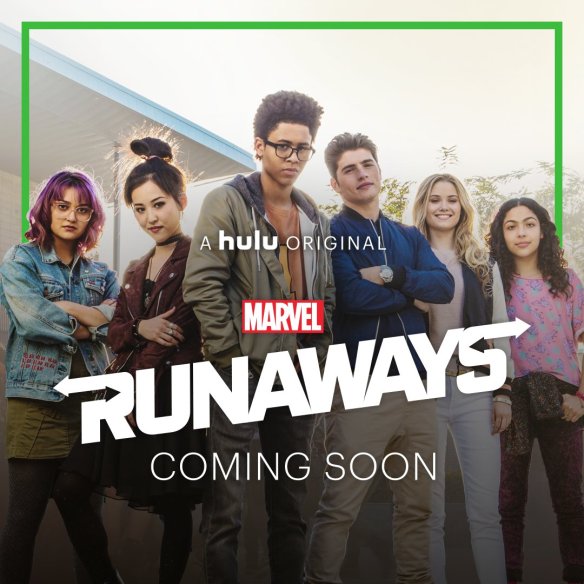
There’s also a TV show in the works. I’m imagining the on-screen version would have been more appealing to myself when I was younger, as I can imagine it being a CW/Disney channel type show, but the cast image looks pretty awesome.

Have you read any of Brian K. Vaughn’s work? I hear his other series Saga is really good, so I may give that a try next.
runaways_hulu

Review and Author Q&A | Deer Life, Ron Sexsmith

32799293A hunting accident leads to a young boy being turned into a deer in Deer Life, an ‘adult fairy tale’ by Canadian musician Ron Sexsmith. The story is less about the boy, however, and more about his village, as the witch who cursed him sets her sights on the father of a beautiful young girl and the boy’s mother falls in love with a man who had his own encounter with the witch when he was younger.
Deer Life was originally intended as a children’s book, and I think it would have worked really well as such, particularly will full colour illustrations and live readings at schools. Deer Life reads very much like a tale meant to be read aloud. The story is filled with puns (characters named Hedlight, Tourtiere, and Eleanoir with an ‘i’), punctuations (lots of ellipses and exclamation marks) and fourth-wall-breaking comments that would play very well when read aloud. For example:

Maggie wasn’t the least bit afraid of Tourtiere. She saw him as little more than an overfed bully long overdue for a smack in the behind from a wooden spoon. (Come to think of it, she had brought one with her just in case!) [p. 43]

One can almost imagine the author pausing with a sly grin for surprised laughter.

There are shades of Roald Dahl in Sexsmith’s writing, like in his description of Tourtiere:

To see him approaching down a narrow street could give one the impression that an actual meat pie was coming toward them. Roundish and pasty looking, he had the appearance of steam rising from his forehead at all times. [p. 25]

The story also reminds me somewhat of Sondheim’s Into the Woods, with the characters’ desires leading them into peril in a mysterious forest. Sexsmith doesn’t quite pull off biting humour with as much ease as Dahl, nor are his observations as pointedly insightful as Sondheim. At times, the story’s cues for laughter can be almost painfully obvious, and one almost wants to ask the narrator to relax and just tell the story.

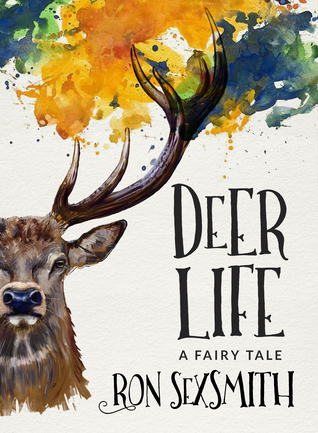
Because the story itself is lovely. Deer Life is a charming tale with a lot of heart. Villagers form unlikely friendships to protect their loved ones, and you actually want these characters with their silly names to find their happily ever after. Witches with violet eyes curse young children, and there’s a hint of a larger story there, about witches needing to claim a place to call home, that piqued my curiosity. Finally, the cover art is absolutely beautiful; much kudos to the artist who designed this!

Q&A with Ron Sexsmith

1. What is it about fairy tales that make them so compelling for adults as well as children?

I think because we’re all a product of our childhood there are certain feelings and themes that resonate with us in some deep way. For most people, the things that worried us as kids or brought us joy remain the same.

2. What was your favourite fairy tale growing up, and why?

I always loved  The Snow Queen by Hans Christian Andersen because it spoke of an evil in the world that could change people and tear friends apart which seemed like a very real threat to me.

3. How would you compare the process of writing a book to that of writing a song?

It was completely different. I felt out of my element every step of the way. The thing that I enjoyed about it though, was how thoroughly immersed in it I became. I was in the town, I could see all the characters in my mind and if one their arms went up,
my arm would go up too. It was almost like being in a trance. It’s actually a very personal story and the closest thing I ever get to writing my memoirs.

4. If this story were to be adapted to another medium (e.g. stage play, musical, TV show, cartoon), what would you like it to be, and who would you want to be involved in the adaptation?

My original thought for it was that it could make for a great movie/musical and in fact I’m actually writing the songs for it as we speak, although it may never see the light of day. I’m a “build it and they will come” sort of person.

Blog Tour

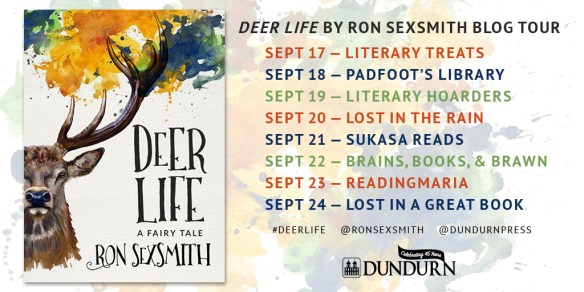
Check out the other stops on this blog tour below!

DeerLife-BlogTourGraphic

+

Thank you to Dundurn for an advance reading copy of this book in exchange for an honest review, and thank you to Ron Sexsmith for the Q&A!

Review | Belief, Mayank Bhatt

30149694A Muslim family in Mississauga, Ontario has their lives upended when they come across an email with details of a terrorist plot on their son Rafiq’s computer. Scared yet trusting in the Canadian justice system, they turn to a trusted friend for advice, only to have Rafiq arrested.

Belief is a timely novel that brings to light the discontent and disillusionment some immigrants face when their new life in Canada isn’t quite as equitable and free from racism as promised. This is certainly true for Rafiq and his sister Ziram, who struggled to fit in at school — I especially love the scene where Rafiq figures out the ‘Canadian’ voice and teaches his sister to use contractions. It’s also true for their parents Abdul and Ruksana, who came to Canada to escape the 1993 violence against Muslims in Mumbai — there’s a poignant scene where Abdul comes to terms with the fact that, despite taking ESL classes and joining networking circles, he’ll never have a lucrative career in Canada, and that his children’s future is worth this sacrifice.

Despite the broader scope of its plot involving the terrorist who tries to recruit Rafiq to his team, the book feels very personal with its focus on Rafiq’s family. We learn about their immigration to Canada and about how they deal with the fallout of Rafiq’s arrest. We also see Rafiq’s growing discontentment and how his desire for connection drew him to Ghani Ahmed and his plot to blow up various spots across the Greater Toronto Area. At one point, Rafiq realizes he doesn’t agree with Ghani Ahmed’s methods, yet he isn’t quite sure how to get out of it. Particularly affecting is a moment when he looks around one of the proposed sites, a food court at a mall, and realizes just how many people will be hurt, and how many of these people look like him.

Belief is a slim volume, but a dense story, and one not often told in CanLit. The ending doesn’t provide quite as much closure as I would have liked, but I do like that it takes a realistic view of the situation Rafiq’s in. It’s not an easy read, but it’s a thoughtful one, and a welcome addition to Mississauga Can Lit.

+

Thank you to Mawenzi House for a copy of this book in exchange for an honest review.