On Bookshops and Booksellers | Glad Day Bookshop

Last week, I walked into Glad Day Bookshop for the first time. I’d known about it, of course, and kept meaning to check it out, but I just never got around to it. I used to work at Nicholas Hoare Books, and when it shut down, I’ve heard many people say how much they loved it, that they were there several years ago and always meant to come back, but never got around to it. One person can’t keep a store in business, of course, and I’m sure Glad Day would have happily continued its operations whether or not I myself walked in. But I, at least, would have missed out, as I’ve missed out on the Sherlock Holmes exhibit the Toronto Reference Library held earlier this year, and the Ultimate Dinos exhibit at the Royal Ontario Museum, also earlier this year. All because I never got around to dropping by. (An aside: I thought I’d missed out on Sleuth of Baker Street, which I heard closed down last year, but their website is still up and running, with a June 2013 newsletter, so perhaps I may still get a chance to visit!)

Source: BlogTO

In the case of Glad Day, it was an impulse decision to attend a book launch that finally got me in the doors. The launch was on the third floor of the building, what I believe to be an art gallery/event space, and it was packed. So after I had a chance to speak to the author, I escaped the crowd and entered the bookshop on the second floor — still busy, but at least with enough room to walk around.

I love entering bookstores for the first time. There’s a tradition in the Philippines on entering churches for the first time: you say a prayer and then  you get to make a wish, which will supposedly be granted. (Mine never were, but to be fair, perhaps the tradition required praying the entire rosary or something, and I conveniently forgot everything except the wish part.) I have my own tradition in entering bookstores for the first time: I like to find at least one book to purchase. This is particularly true for indie shops, where I hope to find a book I’d never have discovered at a chain retailer.

So imagine by delight when I checked out the fiction section at Glad Day, saw quite a few with prices marked down, and realized I didn’t recognize many of the authors. If you aren’t aware of Glad Day, they are the world’s oldest LGBTQ bookshop. I do read books by LGBTQ authors or with LGBTQ content, but among the Hollinghursts and Wintersons were books I’d never heard of, by authors I’d never read. To an avid reader, there is no more exhilarating feeling than that. I was off to an adventure!

I remember a similar feeling when I first walked into Bakka Phoenix, Toronto’s premier Science Fiction/Fantasy bookstore, a few years ago. It was exciting, but also, I admit, somewhat intimidating. I knew I was in the mood for something new, but had no idea what. So I walked up to the bookseller and asked what she’s read recently that she really liked. She asked me what kind of SFF I liked to read. I was stumped. I do read the genre and I love watching Star Trek, but I don’t necessarily follow any SFF writer’s work in particular, and, surrounded by shelves upon shelves of the genre, it was daunting to make such a confession. The bookseller was wonderful — she was friendly and explained that her recommendation would depend on what I liked to read, and that what she liked may not be what I would like — but I admit, I was intimidated. So I stammered something about Neil Gaiman, Philip K. Dick and Margaret Atwood, wishing the whole time I could name a more obscure author so I wouldn’t feel like such a poser. I think I ended up scurrying out of the store with one of the staff picks.

Scott, the bookseller at Glad Day, seemed much more cheerful, and I decided to give it a go. So I walked up to him and said, “What was the best novel you’ve read recently, that you have available in this store?” To his credit, he didn’t even have the deer in the headlights look I did whenever a customer at Nicholas Hoare asked me that question. And to my relief, he didn’t tilt his head thoughtfully and ask me what I liked to read. Instead, he said, “There’s this amazing book, and I just hope we haven’t sold the last copy… Aha! We do have one copy left!” He came back with this:

12000020

He handed it to me and said (as best I can remember): “It’s about two boys who are friends. One is gay but people don’t talk about it & one has a brother in prison and all these family issues that aren’t discussed. So it’s about friendship & family & things that people try not to talk about. YA but good for adults.”

I’d heard of this book, I’d loved the title, but just never got around to actually reading it. (Book information here.) And, quite frankly, the fact that the bookseller didn’t even have to think before picking it up and that he was so enthusiastic about it convinced me of its appeal. So I bought it, and I read it, and if I don’t get a chance to blog about it, let me just say I absolutely loved it. One of the best books I’ve read all year, and personally, one of the most underrated ones. Read it. And buy it from Glad Day if you can.

One of the things about being a book blogger and about having worked as a bookseller is that some of the bookseller/customer magic is gone. As a book blogger, I’m generally aware of new releases, and any books I would like to read I’m already generally reading for my blog. As a former bookseller, I’ve had customers tell me how magical Nicholas Hoare Books is to them, and how amazing their experience always is in that store. I appreciate the sentiment, but haven’t exactly experienced it in a while. It’s work — fun, exciting work, but a job nonetheless. This visit to Glad Day was the first time in a while that I really felt that magic I missed, and the first time in a while that I realized what an experience a really good bookseller can create for a reader. In telling me why he loved Aristotle and Dante so much, Scott was inviting me to enter this wonderful literary landscape, one that I wouldn’t have entered on my own, and yet now barely want to leave.

So thank you, Scott of Glad Day Bookshop. I loved Aristotle and Dante so much I came back and asked for the second best novel he’d read recently. He suggested Abigail Tarttelin’s Golden Boy and admitted he usually reads non-fiction rather than novels. I told him to hit me up anyway, and he came up with three non-fiction books that he spoke about as passionately as he did Aristotle and Dante. On my second visit, I left Glad Day with two new books in hand. Scott hasn’t let me down yet, and my apologies to him in advance, but if I love these new books just as much, I’m afraid I will be back. And I’m afraid I will put him on the spot yet again — what’s the next best book (fiction or non-fiction) he’s read recently?

I tweeted about this experience and Jennifer Dawson (@BookishJojo) suggested I turn it into a blog post series: visiting bookstores and asking booksellers for the best book they’ve read recently. (Full conversation here.) Might turn out to be an expensive hobby, but I admit, a fascinating one as well. Why not, eh?

And in the meantime, if you’ll excuse me, I have a couple new books I’m dying to read.
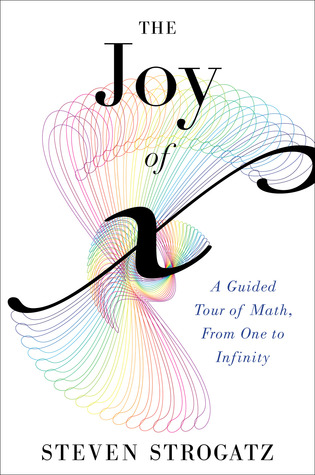
Review | The Joy of X, Steven Strogatz

13356649I’m a nerd. The idea that math can be used to explain everything, including (from the book jacket) whether or not O.J. Simpson did it, or how many people it is optimal to date before settling down, appeals to me. I love patterns, and I love the idea that numbers can be applied in the most esoteric situations in real life.

So Steven Strogatz’s The Joy of X instantly appealed to me. Life, the universe and everything… How can math play a role in understanding all that? And while I’m sure mathematicians can give me various answers, I looked forward to reading about it as written for a layperson’s perspective, and to understanding just a bit of the wonder that math can present.

Unfortunately, this book made the joy of X even more of a mystery to me. Strogatz begins with fairly basic arithmetic, and uses images like rocks and dots to explain addition and subtraction. He writes: “This side of arithmetic is important, practical, and–for many people–joyless. The playful side of arithmetic is a lot less familiar, unless you were trained in the ways of advanced mathematics.” I presume then, that the Tetris-style patterns with rocks represents this more playful side, which appears to be minor tricks with basic functions.

On one hand, I see what he’s trying to do — by presenting even the most basic arithmetic functions in new ways, he’s prepping us for the way he’ll present the (presumably) more fun, more advanced mathematics, such as how to calculate O.J.’s guilt, later on. The problem is, even the first few chapters gave me a headache. The four basic functions are math we as adults are already familiar with, and quite frankly, the struggle to see it from Strogatz’s new, supposedly more playful, perspective, just doesn’t seem worth it.

The book began as a series of columns, and possibly because of this, each chapter is a minor topic in itself, barely leading on to the next one. The result is a fairly shallow overview of various math concepts, and Strogatz seems to try too hard to make the math interesting. He explains the concepts well enough, though I personally think he either overcomplicates or underexplains his topics, yet never quite answers the question: so what? And when each chapter is its own topic, and each chapter begins a new attempt to present an aspect of math in a new light, the repeated sense of “so what?” becomes frustrating.

I remember starting Brian Greene’s The Hidden Realityabout parallel universes. I still haven’t finished it, mostly because it started getting really complicated, and honestly I think I need to start from the beginning to make sense of it all again. But unlike Strogatz’s book, Hidden Reality shows a progression — Greene begins with a really simple, accessible example of parallel universes, then slowly delves deeper into the subject, and explores further into scientific concepts. It’s not an easy read, but the payoff will be worth it — Greene tackles a complex subject and gently takes the reader deeper and deeper into it.

In contrast, Strogatz sounds like the high school teacher desperately trying to convince his bored students that math is fun (cue big grin and exclamation point). I’m not saying that the math he covers is simple — on the contrary, I’m sure most of it, particularly in the later part of the book, is over my head. But I do want to understand, and I feel Strogatz’s approach keeps one firmly in the elementary level of understanding. I’m sure this wasn’t the author’s intention, but I generally found his tone condescending — no way we readers could understand these concepts, so here’s a funny little story to convince you that it’s F-U-N!

I didn’t finish the book, so I don’t know whether or not math says O.J. did it. I did see the chapter about how many people one should date before settling down. It all boils down to a formula, and despite Strogatz beginning with a concrete example, it still ends up being really abstract. By the end of the chapter, I have a general idea of the solution (spoiler alert: it’s nothing you couldn’t have guessed without math), and still no idea of how to calculate it or why I should even bother.

A mostly joyless, shallow exercise, this book is hardly worth the effort.

+

Thank you to Thomas Allen Ltd for a copy of this book in exchange for an honest review.

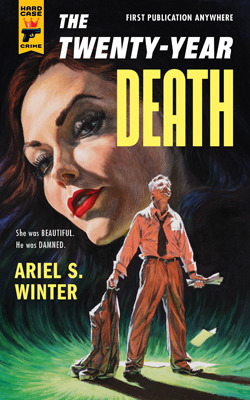
Review | The Twenty-Year Death, Ariel S. Winter

13089521I really, really wanted to like this book. When I first heard about it, I immediately begged Random House for a review copy. As a lifelong mystery fan, I was immediately hooked by Ariel S. Winter’s concept: three complete mystery novels, each set in a different decade, each told in the style of a famous mystery writer from that decade, and yet all part of a single 700-page story. Seriously. A daring idea, an amazing hook, and I applaud the author for coming up with it.

Unfortunately,  The Twenty-Year Death failed to live up to its (admittedly ambitious) promise. To be fair to Winter, noir/hard-boiled isn’t a mystery genre I’m very familiar with, so it’s possible this book is just not my cup of tea. Also to be fair, while I am familiar with Raymond Chandler (one of the authors Winter mimics), I’ve never read Georges Simenon and Jim Thompson, the other two authors Winter imitates. So I am unable to say how successful Winter was in either paying homage to or re-interpreting the genre, and these writers’ works in particular. Rather, I read it as a standalone book, hoping to discover a new and exciting mystery writer.

The three books within Twenty-Year Death tell the story of Clotilde and Shem Rosenkratz. In the Simenon-style Malniveau Prison (Book 1), the year is 1931 and Clotilde’s father has been murdered in a gutter, but he was supposed to have been locked up in a prison and no escapes had been reported. Chandler-esque Book 2, The Falling Star, takes place in 1941 — Clotilde, stage name Chloe Rose, is in a Hollywood movie and fears for her life, and a PI steps in to investigate. Book 3, Police at a Funeral, mimicking Thompson, turns the spotlight on Shem, an alcoholic writer whose life is basically falling apart.

Despite the overarching storyline, it’s difficult to review this book as a whole, because each story within is so different from the others. While Clotilde and Shem appear in all three novels, they are minor characters until the last book — the action is somewhat driven by them, but we never really get invested enough in either of them to really care about them as characters. The three plots are disjointed, and having Clotilde and Shem in all three books just gives the impression that they are the unluckiest couple ever.

I’m generally a fan of police procedurals, so the introspective Malniveau Prison is probably most to my taste. However, while the puzzle was intriguing enough, the story just didn’t hook me. I was bored, and after several tries, gave up on finishing this story. The Falling Star, with its Hollywood glamour and soap opera subplots, actually turned out to be my favourite of the three. The story was intriguing, but ultimately unmemorable. Police at a Funeral may have suffered from being the last story in a largely underwhelming but lengthy book. I admit: if it hadn’t been a separate story, but just the end of a single long novel, I wouldn’t have read that far. So I did decide to give it a chance, but, in all honesty, didn’t have much patience for it. The main character was Shem, who I really didn’t like, even when he appeared in the first two books. And while I don’t believe that all protagonists should be likeable, I also didn’t care enough about this man’s story to read beyond the hundreds of pages I’d already read about it. I gave up on this third novel fairly early.

Part of it may be the writing style. Winter had set out to mimic three classic writers, and while I am unable to tell if he succeeded in that, I thought that by the third book, his writing style was fairly standard throughout. I figure that even with the homage to various writers, a distinct Ariel S. Winter style still came through. Unfortunately, while his writing is solid enough, it just isn’t compelling. It’s okay, but that’s it. I do wonder how it would be if he didn’t bother with the homage at all, and simply wrote an original mystery. It’s possible I might have enjoyed that better.

Overall, a disappointment. Again, in fairness, it may just not be my type of mystery, or perhaps Winter was constrained by certain stylistic conventions to which he was paying homage. Still, the overarching story just wasn’t compelling enough to merit three separate novels within a novel. As well, and this is an unfortunate yet perhaps expected reaction to Winter’s project no matter how well or poorly executed: I couldn’t help thinking, if all this is is an imitation of three classic writers, why not just read the originals?

+

Thank you to Random House Canada for a copy of this book in exchange for an honest review.