
Review | Kiss Me First, Lottie Moggach

16169852Kiss Me First has an intriguing premise: what if the main thing that stops people from acting on suicidal tendencies is the thought of the grief their loved ones will suffer? And what if, thanks to people’s ever-increasing digital footprint, a website can help you ease that transition? What if this website can help you distance yourself slowly from your loved ones even after you’re gone, so that by the time they’re aware of your death, their grief won’t be as sharp?

It’s an audacious idea, and a sobering realization that for some people, this might actually work. How many of our friends and family members interact with us only through email and social media channels? If it were someone else emailing and posting on Facebook on our behalf, how many of our family and friends will really know the difference? We’d like to think that the difference would be obvious, yet for someone who is determined to disappear, how difficult would it really be to do so?

Moggach tells the story from the perspective of Leila, a lonely, isolated woman who finds a sense of belonging in the website Red Pill, where members engage in ethical debate. She soon catches the attention of website founder Adrian, who invites her to join the inner circle and help a woman named Tess arrange her own death. Here’s where the story becomes especially powerful: the concept of using the internet to mask one’s suicide is compelling enough, but Moggach points the spotlight on the people who can make it happen. A perennial outcast, Leila is understandably caught up in what she learns about Tess’s life. As Leila practices impersonating Tess online, she begins to fall in love with Tess’s life, and eventually, begins to allow it to dominate her own. The lines between the reality of her life and the fantasy of Tess’s blur, and it’s an easy slope for Leila to fall, because, after all, this fantasy is no longer a life that Tess wants for herself. And when Leila’s genuine, albeit horribly misguided, attempts to form human connection are cruelly rebuffed, it is heartbreaking to read.

Even though told through Leila’s point of view, Moggach creates a compelling character in Tess as well. Beautiful, beloved and successful in so many aspects, Tess is nonetheless deeply troubled. She desperately wants to escape her life, to the point of paying Adrian to help her make it happen, but her decision to escape is itself another kind of trap. Having hired Leila to impersonate her, it gets progressively harder for her to back out and decide to live after all. At times she hesitates, and Leila convinces her to keep going, and it is to Moggach’s credit that Leila doesn’t appear a monster in such scenes — rather, we feel her pain and understand her desire to clutch on to Tess’s life, even as we hope Tess does choose to live.

It’s an intense, emotional thriller, and the conversation around assisted suicide remains unresolved. The story does have its clear villain, though perhaps the tougher question is about the way of life that allows such a person as Leila to reach such a depressing level of isolation, and a person like Tess to be able to disappear, if not easily, at least believably. Kiss Me First is a powerful debut novel, and highly recommended.

+

Thank you to Random House of Canada for a copy of this book in exchange for an honest review. 
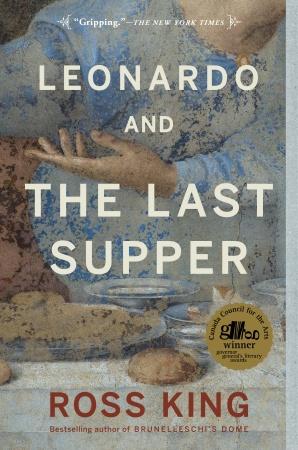
Review | Leonardo and the Last Supper, Ross King

9780385666091Ross King’s Leonardo and The Last Supper is a solid historical work on the artist and one of his most famous paintings. King does a good job setting the stage, by writing about the historical context in which da Vinci creates, as well as examining details of da Vinci’s distinct style and how it fit in within the larger context of art history.

The Last Supper has been the subject of many other art works, and yet da Vinci’s version became iconic long before Dan Brown launched a new generation of conspiracy theorists. King does a good job in examining what set da Vinci’s version apart from all others, in terms of technique, form and treatment of subject matter.

It is also interesting to get to know a bit of the man behind the work. Da Vinci has become such a cultural icon that it’s difficult to separate him from the mythos around him. King keeps the book firmly on the ground, and contextualizes da Vinci within his time, as well as paints a portrait of a man who is much more flawed than his “genius” moniker suggests.

My only concern with this book is that despite the rich history it explores, the writing itself is very dry. The beginning seemed a bit slow, and snippets of really interesting observations seemed almost lost within paragraphs of detail. I wanted to love the book, and I did learn some interesting tidbits throughout, but unfortunately, it was just very, very slow-going for me.

+

Thank you to Random House of Canada for a copy of this book in exchange for an honest review.

Guest Post | Gregory Widen on Blood Makes Noise

Thomas & Mercer has kindly provided a guest post from author Gregory Widen. In this, Widen writes about his inspiration for the novel.

17046607I remember the moment I got the idea for Blood Makes Noise. I was visiting a friend in an unnamed Latin American country who was a field officer for the CIA. Now, this friend has been involved in all sorts of craziness, including – on direct orders – supervising not only the murder of certain bad individuals, but “making it hurt.”

Despite a life of anecdotes like this, in the nights we spent drinking, the only time I ever saw him express disgust for anything was the following anecdote: “On 9/11, the FBI office in Miami was given the photos of the hijackers. This was critical – it had to get to Washington immediately – and they sent it by FedEx. Why not e-mail? Because there wasn’t an agent there who knew how to attach a photo. That is all you need to know about the FBI.”

I’d already decided at this point to write a novel titled Blood Makes Noise, centered around the craziness that accompanied the disappearance of Eva Peron’s corpse in 1955 Argentina. I knew my hero would be a troubled CIA officer sucked into those events and nearly destroyed by them. But when you write a novel, character and plot are just two of three things you need. The third, and often most elusive, is a unique background that provides the kind of catalyst to propel characters forward beyond the requirements of plot.

It occurred to me that I might have just found my catalyst.

As my friend’s white-gloved butler served us bourbon martinis at precisely six o’clock, I pressed further. Everyone knows of the historical mistrust between the CIA and FBI, but I quickly learned just how toxic it had been in South America – to the point where the CIA and Hoover’s FBI were nearly in open warfare with each other.

Prior to the CIA’s creation in ’47, the FBI had always been in charge of spying in South America. But Truman, who never trusted J. Edgar Hoover, now wanted to hand that responsibility over to his new agency. From that moment on, Hoover committed himself to strangling the baby CIA in its crib.

As servants built a fire in the living room, “drinks” became a cocktail party as various local spooks arrived. There was the BND (German spy agency) guy, another who’s family ran Cuban Intelligence, and some current and retired CIA. Working through my third martini, I soaked up the stories.

Despite Truman’s change, Hoover managed to keep many of his people in place, effectively creating an FBI-run CIA within the CIA. As the agency fought to get control, Hoover just went to greater lengths to discredit it.

As the party devolved, I remembered a dinner commitment. My friend’s crew decided to join me. Off we went to a large dinner party most memorable for the moment my friend informed me that my host was the son of the country’s biggest narco boss. I worried I’d unknowingly made some terrible mistake. But he only smiled wryly: “No. Thank you. It would have taken me months to make this meeting happen by accident.”

Both the drinks and stories kept coming: how in an effort to discredit the CIA, Hoover had ordered his men – while a CIA team burglarized a foreign embassy – to fire shots outside to alert the security people within. Or the time the CIA had arranged the defection of a KGB officer in Buenos Aires and Hoover, wanting the credit – and to embarrass the CIA – had his boys grab the defector in a restaurant first. But a CIA team arrived at the same moment and a brawl broke out between the two groups, trashing the place.

It was chaos in the CIA stations down there at the time. The old FBI officers still in place did everything possible to frustrate and humiliate the new arriving CIA personnel, including burning their files when they were finally ordered out. Those days in South America, sighed an old hand, were one wild circus.

As evening crawled to dawn, I knew now the atmosphere my character would be thrust into: a freshly minted CIA officer arriving in Buenos Aires and going to war against the old FBI hands still in place. A young man whose greatest threat would turn out not to be the KGB, but the people in his own embassy.

Walking home later, I thought, not for the first time: It’s funny where ideas come from.

+

This is a guest post by Gregory Widen, author of Blood Makes Noise. Gregory studied film and screenwriting at UCLA, and penned scripts for the films Highlander, Backdraft, and The Prophecy. He’s a native of Laguna Beach, California and he lives in Los Angeles. Blood Makes Noise is his first novel.