
Review | My Life Among the Apes, Cary Fagan

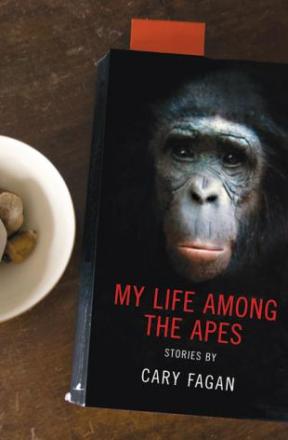
My-Life-Among-the-Apes_largeCary Fagan’s My Life Among the Apes was longlisted for the 2012 Scotiabank Giller Prize and it’s easy to see why. Fagan’s stories are striking, the subtlety of his language enhancing the emotion within the human relationships he explores. Two of my favourite stories in the collection feature the public space of a diner, and the connection between people who interact seemingly on the most casual of levels. In “I Find I Am Not Alone on The Island,” a waitress forms a lifelong bond with a favourite customer whose name she doesn’t even discover until he dies. In “The Little Underworld of Edison Wiese,” a waiter who takes pride in his job despite the crappy working conditions spends an unusual New Year’s Eve at work. The unexpectedness of lasting connection is what makes these stories so lovely. The moment when the waitress, years after having left the diner, feels the need to share a literary allusion the customer had mentioned to her in passing, hints at a far deeper significance. And the scene where the waiter realizes the importance of his job is heartwarming.

My favourite story, “Wolf,” is about a Jewish man who returns to Germany to visit his granddaughter. Seeing a Holocaust memorial, all he can think of to say to his granddaughter is that he doesn’t feel qualified to judge it. How can he, how can anyone really, express such an experience? The tension between history and the present simmers throughout the story, inflecting his visit with much that is left unsaid. It’s a powerful story, and the ending makes you wish to read more, even as you feel the story had ended on a perfect note.

Oddly, it was the title story I found least affecting, about a bank manager who finds comfort in his obsession with Jane Goodall when he has to do a difficult task. The writing was good, but the story felt disjointed, and at the end I was, like one of the characters, utterly unmoved.

Overall however, the collection is a strong one. The simplest of details — a violin in “Wolf,” a lost magic trick in “The Floating Wife” — take on much significance, and Fagan’s writing teases your mind with so much that is deeply felt, but left unsaid.

+

Thank you to Thomas Allen for a copy of this book in exchange for an honest review.

Review | Murder Chez Proust, Estelle Monbrun

16284882Can Marcel Proust inspire one to murder? In Murder Chez Proust, Adeline Bertrand-Verdon, the unlikeable president of the Proust Association, is murdered just before a Proust convention. There is an assortment of suspects, including colleagues, lovers, and her assistant Gisele Dambert. Through a stroke of luck, Gisele owns a set of previously undiscovered notebooks used by Proust which proves the originality of a key scene in one of his most famous novels. It would have settled a debate in Proustian circles, and Adeline was going to steal Gisele’s research and publish a book.

Gisele is probably the most intriguing character in the book – an aspiring Proust scholar who lives with her cat and has a penchant for carelessness. She makes some idiotic decisions, such as letting Adeline know about her research, but overall, you root for her to succeed.

Murder Chez Proust is a solid, entertaining cozy, with an Agatha Christie-type list of suspects, and a genteel approach to murder. As someone unfamiliar with Proust’s work, I probably missed a lot of the significant little tidbits the author provided, but I did enjoy the description of how the interpretation of a single scene in one of his books can cause such heated scholarly debate. I wish the book had been more steeped in the academic world – the strongest scenes featured the politicking that goes on behind the publication of academic research, and I would have liked a bit more sense of that atmosphere.

There was a subplot mystery that I admit drew most of my attention — Gisele loses the Proust notebooks and tries to track down a hotel employee who had held them last. In some ways, it stole the spotlight from the main murder mystery, but it may just be because Gisele is a more interesting character than Adeline who, though villainous and potentially intriguing, was never quite fleshed out enough to go beyond a stereotype.

+

Thank you to Thomas Allen for a copy of this book in exchange for an honest review.

Review | Tampa, Alissa Nutting

9780062280541Alissa Nutting’s Tampa is a brave exploration of an uncomfortable subject, and the author’s brazen treatment will cause even the most inured reader to stop and think. Celeste Price is an eighth grade English teacher with a sexual preference for fourteen year old boys. Similar to Lolita in theme, it is starkly different in its approach. Unlike Humbert Humbert, Celeste pulls no punches in her description. She is unapologetically sexual.  The language is forthright and highly charged. As I posted on Goodreads: “Holy hell, Tampa. Powerful, intense, and I’m only 7 pages in.” And Nutting never lets up.

Female pedophiles aren’t as often discussed in popular culture as their male counterparts. Films like The Graduate for example even romanticize the adult female/teenage male sexual relationship. Nutting takes this trope head on by making her protagonist be only in her 20s — she’s young, beautiful, certainly an object of fantasy herself for many of her students. She is also hyper aware of her age, and understands that seducing these young boys may no longer be as easy when she starts getting wrinkles. Yet she is also, unmistakably, a sexual predator, unapologetic and despite the boys’ own fantasies, abusive of her power.

Nutting uses lurid sexual detail with purpose. At times, the scene reads almost like erotica, until you remember that the object of Celeste’s fantasies is a fourteen year old boy. The story is especially horrifying because of Celeste’s job as a teacher, a profession she chose precisely because it puts her in close proximity to the boys she wants. She sets her sights on one of her students in particular, selecting him because he is just shy enough to keep her secret, but bold enough to risk pursuing a sexual relationship with her. Her schemes to seduce the boy are horrific, particularly because her openness as a narrator implicates the reader in her plot. As an adult, we see how she is manipulating the boy and we want to rescue him, yet as readers, all we can do is watch.

Here, the sensual prose also implicates the reader by forcing us into Celeste’s psyche, without even the buffer of Humbert Humbert’s coyly seductive language. Either you are hyperaware the entire time about the boy being only fourteen, in which case the very act of reading feels disgusting, or worse, you forget for a time, and find yourself drawn into the eroticism of the scene, only to recoil with even more disgust when a detail (smooth skin, hairless legs) reminds you of what exactly is happening in the scene. Nutting employs a more brazen form of seductiveness than Nabokov in her prose, and in doing so creates a different type of discomfort. The book design itself plays into this approach; the jacket of the hardcover edition is made of velour, providing a velvety soft surface that invites stroking and that provides the reader with a highly tactile experience.

Celeste is too unapologetic about her proclivities to be an anti-hero, or anyone the reader can ever really cheer for. However, she is certainly a compelling, memorable character. Her utter lack of remorse, and total disregard for the need to sugarcoat her desires for the reader make her in some ways even more reprehensible than Humbert Humbert. Still, when she describes her disgust for the adult male form, you understand why sex with an adult male isn’t an option at all for her. Her horror at the thought of sex with her husband, or with any adult male, is palpable. You do not cheer her on, yet when things come crashing down, you can’t help but feel for her. It’s a difficult balancing act, yet Nutting manages it well.

Tampa is not an easy book to read, but it is powerful. Nutting uses shock value to a purpose, and creates a memorable protagonist in Celeste. The ending somewhat falters because it feels rushed, and the final page in particular feels unresolved. Still, overall a compelling book that demands attention.