
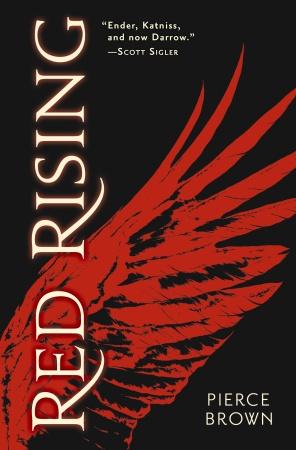
Review | Red Rising, Pierce Brown

9780345539786Darrow is a Red, a member of the lowest class in the colour-coded society of the future. Part of a human colony in Mars, he and his fellow Reds work to make the surface of Mars habitable for future generations. Except it turns out, the surface of Mars has been habitable for some time, and a different class of humans — the Golds — have been living in luxury thanks to the work of the Reds and other colours within society. When a personal tragedy opens Darrow’s eyes to the truth, he undergoes a painful physical transformation to become a Gold and infiltrate the highest echelons of society in order to destroy it from within.

As with any dystopia published within the last few years, Pierce Brown’s Red Rising has been compared to The Hunger Games, and Darrow to Katniss Everdeen. There are certainly similarities — unjust society, hot temper, heroism and sacrifice, etc. However, Red Rising isn’t quite as concerned as The Hunger Games with youth and the loss of innocence. Perhaps it’s because Darrow, like most teenagers in his society, is already married. Or perhaps it’s because we meet Darrow in the middle of a work day, practically indistinguishable from the adults he works with — unlike Katniss, who is forced to hunt so her family will survive, Darrow fulfills an accepted role in his society as a breadwinner for his family. Distinguishing this as well from other YA dystopias, the story actually feels more adult than young adult until the second half, when Darrow goes undercover in a training institute for Golds and the book reverts to familiar YA dystopia territory.

Red Rising is an exciting, action-packed science fiction thriller. Reds and other colours are kept subjugated so that the ruling class can maintain their supremacy. This is clearly wrong, and a rebellion has begun. But first, Darrow must face the Gold training system, which turns out to be horrifically brutal (like, Hunger Games-level brutal), to the point that it strains credibility that society would allow such a ruthless system to continue for their children. Within this training system, murder, rape and Lannister-level scheming are all par for the course, in the quest to be top of the class. Imagine the Hunger Games, but every one is a career. There is a girl, of course, whose loyalty is called to question, and a best friend, from whom Darrow is hiding a horrible secret. It’s brutal, it’s intense, and Brown never lets up the pace. To Brown’s credit, his world building is so masterful that it actually does end up being believable, and like Darrow, even the reader may soon forget his larger mission and the world around this training centre.

Still, the story is at its best when it deals with the machinations beyond the arena. There are some moments of nuance that give power to a more complex story — for example, when Darrow undergoes physical transformations to become a Gold, he is uncomfortably aware of how much these transformations are improvements. In terms of many physical aspects, Golds actually are superior to Reds, and while that is likely the result of conditioning and environment affecting evolution, it’s an uncomfortable observation for the author to make, and a bold one that reveals potentially much more serious effects of racial or class based segregation.

Darrow’s battle to make top of his class in Gold society and the innovation of his strategy foreshadow the eventual resolution of the larger conflict in his society. Red Rising is a promising start to what could be a powerful trilogy; one just can’t help but be impatient for the training to be over, and the actual rebellion to begin. It’s a trilogy custom-made for the screen — non-stop action, non-stop thrills, very little time for contemplation. Yet the seeds for a deeper story are there, and I at least can’t wait to see how the story progresses beyond the arena.

+

Thank you to Random House Canada for a copy of this book in exchange for an honest review.

On Re-reading Harper Lee’s To Kill a Mockingbird

mockingbirdLast weekend, I re-read Harper Lee’s To Kill a Mockingbird for the first time in years. It’s undeniably one of the most significant books published in the 20th century, and certainly a personal fave for myself and the absolute favourite book of all time for my younger sister. So when I re-read it last weekend, I expected to feel nostalgic, to be brought back to the person I was when I first encountered this book, and to lose myself once more in a world that had made such an impact on me as a child.

To my surprise and delight, it wasn’t nostalgia that characterized my re-read, but rather a sense that I was reading the book for the first time. So many things that I don’t remember being affected by when I first read the book struck me strongly in this re-read. Mockingbird is a seminal classic in literature about race relations, yet I realized only now how much casual race distinction exists even in the progressive characters. For example, when Scout and Jem enter Calpurnia’s church, or sit with the black townspeople during the trial, why are they automatically given front row seats? In the case of the trial, a few African Americans gave up their seats in the front row. On one hand, it is a lovely gesture of hospitality and welcome, a sense that Scout and Jem are guests to the community and therefore accorded good seats. On the other hand, it bothers me that even within the black community, the white characters are given pre-eminence, even with something as simple as a place to sit.

I also found myself noticing the gender disparity highlighted by the trial. Mayella Ewell, the woman who falsely accuses Tom Robinson of rape, is far from innocent in the sense that she wrongfully convicts a man who by virtue of his skin colour is even more powerless than she. Yet in a sense, she is also a victim, subject to the whims of her father and bound by the terms of female propriety dictated by her society. As a woman, she is expected to maintain a certain level of purity, and it is because her fulfilling her sexual desire with a black man violates that code of conduct that her father beats her up.

The trial is not just a case of the strong preying on the weak (white characters attacking black ones) as the weak (a woman) forced to prey on the weaker (a black man). Or to be exact, the strong (Mayella’s father) exploiting the weak to prey on the weaker. In a passage I found profoundly disturbing, Jem gleefully outlines the ridiculously high standard of proof required for a woman to convict a man of rape — no means no, but the “no” must be accompanied by violent protest. Within the context of this story, Jem’s happiness over this sets the stage for his eventual loss of innocence — even a man as obviously innocent as Tom Robinson can be convicted simply because of his skin colour. But the whole idea that, due to notions of female sexuality, such a ridiculous burden of proof is laid on the rape victim is horrific, and seeing a good character like Jem so enthusiastic about it bothers me.

Loss of innocence happens not just for the characters, but also for the society in which this book is read. Boo Radley is a creepy, unknown, figure for most of the book, but I found myself responding to his gestures toward the children in a very different way. What kind of man carves detailed figures of children in soap and leaves them in a tree for the children to find? Within the context of the story, Boo Radley is a rather simple, harmless man, but if such a thing happened today, my mind immediately jumps to Law & Order: SVU territory. Is this man a predator? What does he have planned for the children? Why has he observed them to the point that he can create realistic soap sculptures?

Someone on Twitter commented that while Mockingbird now is seen as a testament to how far we’ve come as a society in terms of race relations, it would have been a lot more contentious when first published. Readers would have been as divided as Atticus’ town, with some readers cheering Tom Robinson on, and others horrified that an author would paint such a sympathetic portrait of a black man.

The idea of our society having progressed beyond Mockingbird is itself rather contentious. Stories like Trayvon Martin, Jordan Davis and the “Stand Your Ground” law debate reveal dispiriting facts about the role that racism still plays in American justice. There is more of an outcry against it certainly, and in today’s world, Tom Robinson’s conviction would have merited at least an angry editorial on Huffington Post, but it would be naive to think we’ve gone far beyond the world Harper Lee critiques.

Still, the conversation I had on Twitter made me think: To Kill a Mockingbird has become such a powerful piece of literature partly because it was published at a time when such views were contentious. Atticus Finch, currently recognized as a hero, may have been viewed by some readers as a villain at the time of publication. I wonder then, what issue is just as contentious and divisive for contemporary society? And with that, what work of literature faces this issue head-on, and may have an impact as powerful for that issue as Mockingbird did for racism?

I think the closest parallel may be the question of marriage equality, or perhaps even just gender equality in general. Most of my friends, at least as far as I know, agree with me that same sex couples should be accorded the same rights as heterosexual ones. I’m less familiar with the conversations surrounding trans* rights and other similar gender issues, but as far as I’m concerned, people should be allowed to be whatever gender they really are, regardless of biology at birth. I’m dismayed by the number of people I see online who disagree with these views, and disgusted particularly by a recent bill passed in Arizona that allows blatant discrimination against LGBTQ individuals in the interest of purported religious freedom. As much as I’d like to believe these issues are past debate, they clearly aren’t, and are perhaps as hotly debated now as racial equality was back in Harper Lee’s time.

My question then: is there a novel that engages with these issues in as powerful a way as To Kill a Mockingbird did? Is there a To Kill a Mockingbird for our time, in terms of potential lasting social impact? Is there an Atticus Finch for our time, who will inspire readers around the world to stand up for justice?

Let me know.

Poetry | bit by bit, Leonarda Carranza

I usually try to keep my work life separate from my blogging life, but a couple of weeks ago, the Art Gallery of Mississauga (where I work) hosted a poetry event by a group of young writers whose words touched me on such a personal level that I wanted to share the experience. The group is called Pages on Fire, and their work explores themes of race and racism, love and oppression, body image and shame. I generally stay away from what I (unfairly) label as “message poetry,” and I admit poetry is in general not my genre of choice. But the range of works I heard that night, from the sharp edge of Renee McPhee’s “30 Lines by Beyonce” to the understated narrative power of Tina Chu’s poem on an immigrant family’s relationship with language (full disclosure: Tina is a close personal friend) takes the medium beyond its message. These are poems on race, oppression and so on, yes, but these are first and foremost, good poems from perhaps the next generation of Canadian poetry greats. 

Below is a poem by Pages on Fire organizer Leonarda Carranza. During the event, Carranza admitted she was reading this poem first, because she knew it would be difficult to get through. She was visibly choked up, and it took her several tries to get past the first verse. After the event, a woman approached her and said that she, too, was moved to tears by the reading. I love this poem for the subtle yet potent emotional wallop of the first couple of lines, which, by the end of the piece, have taken on a level of texture belied by the sparseness of the text.

[My apologies to Leonarda if WordPress messes up the text formatting. I tried to follow the spacing as best I could.]

+

bit by bit


bit by bit and step by step

Grandma teaches me about

colours

Bit by bit

And step by step she teaches

And I learn

About the texture of indifference

What it feels like not to be wanted

not to be embraced or held

not to sit on her lap

Bit by bit

And step by step I learn

Not to expect a smile

Not to feel her

I don’t go to her when I’m afraid

I don’t ask for her when I am sick

And she teaches

like the mothers

and great-grandmothers that came before taught her

To stand back

To watch

As she offers herself and her love to

White and light skinned bodies

And bit by bit

And step by step

I learn about colour

– Leonarda Carranza