
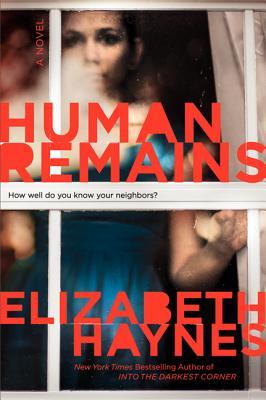
Review | Human Remains, Elizabeth Haynes

17349279The cover of Human Remains by Elizabeth Haynes holds the intriguing teaser: How well do you know your neighbours? But the crux of the book is really in the question: How well do your neighbours know you? More to the point, if you were to die when alone at home, how long would it take before someone found your body? How long would it take before anyone even noticed you were missing?

Haynes’ first book Into the Darkest Corner is still one of my favourite books of all time. I read it years ago and can still remember the intense claustrophobia, disgust and fear I felt as I read it. Her second book didn’t quite grab me as much as the first, but I was still intrigued by her characters. Her third, Human Remains, did not affect me as viscerally as Darkest Corner did, yet I believe it just may be her most powerful yet.

Haynes’ brilliance is in her uncanny insight into the human psyche, whether it’s a woman struggling to move on from an abusive relationship or a woman trying to escape her past, as in her first two books. In Human Remains, Haynes plays on our fears of loneliness, an almost ironic condition in today’s hyper connected world, yet it’s this very hyper connectivity that sets into sharp relief how alone some of us really are. The protagonist in this book, Annabel, is a police analyst who notices a trend of deaths in her hometown where the victims’ bodies weren’t discovered for several days. There is nothing to tie the deaths together — all appear to be from natural causes — and Annabel’s colleagues don’t deem it worth an investigation. But Annabel is intrigued by how all these victims had been dead for some time before anyone even noticed their absence, and while she had never really considered herself lonely, the pattern forces her to take a look at her own life and wonder who would notice if she were gone.

It’s a disquieting notion, and one that will haunt the reader as well. Haynes tells the story from multiple points of view — Annabel’s, of course, and also a creepy man named Colin. We also get chapters from some of the victims, and rather than a violent description of an attack that leads to their deaths, these chapters feel almost elegaic. There is no hint about what or who caused the deaths, but there is a glimpse at the person who lived before that moment. In a story where you know these characters will be forgotten, there is both comfort and a touch of despair in these all too brief tributes to their memory.

The drive to keep turning the page isn’t so much to find out how the people are dying. There is a great sense of mystery, with almost a locked room feel because the answer is hard to figure out. The answer, once revealed, is chilling, and not because of its inhumanity, but because it is all too human. The villain is probably even more reprehensible than the one in Into the Darkest Corner, because this one preys on the very weakest in society — and on weaknesses that likely everyone can relate to.

Human Remains isn’t the page turner Into the Darkest Corner is, nor will it be counted among my absolute favourite books ever as Darkest Corner is, but the issues Human Remains raises will stay with you long after you finish reading. Haynes taps right into our darkest fears, and lays bare our deepest vulnerabilities — that we are, in the end, truly alone, and that no one will care when we’re gone. We support Annabel’s fight for these victims, and we rage against the murderer’s predation, because ultimately, the idea behind this story hits far too close to home.

+

Thank you to Harper Collins Canada for a copy of this book in exchange for an honest review.


Review | The Marrying of Chani Kaufman, Eve Harris

19547815At its heart, Eve Harris’ The Marrying of Chani Kaufman is a love story. 19 year old Chani Kaufman has never had a boyfriend but must now marry a man she barely knows. Fortunately, she and future husband Baruch are actually attracted to each other, and the conflict has more to do with his disapproving mother and both characters’ apprehension about the wedding night, rather than with any actual distaste for the marriage. Parallel to this story is that of the rabbi’s wife Rivka, who is charged with training Chani how to become a Jewish wife and yet who begins questioning her own decision to leave behind her own relaxed religious background and adhere to the strict rules of her husband’s. Can Chani and Baruch overcome both his mother and their nervousness about sex and relationships to find true love? Can Rivka reconcile her love for her husband with her growing discomfort with his way of life?

The Marrying of Chani Kaufman was referred to by its publisher as an Orthodox Jewish Pride and Prejudice, and while Chani and Baruch never actually went through the will they/won’t they love/hate cycles that made Elizabeth Bennet and Mr. Darcy’s romance so popular, they still face opposition from family due to class differences. Both books also take a somewhat bemused perspective of their characters’ societies, employing sharp wit and gentle humour to present the foibles of various social traditions. One big difference though, and the reason Chani Kaufman perhaps falls short, is that while Austen seemed fully immersed in her society and her pointed jabs at its conventions still reflect the exasperated affection of an insider, Harris’ narration sounds like it’s coming from the outside looking in.

To be honest, I am completely unfamiliar with Orthodox Judaism and its customs, and as someone who has taught at an Orthodox Jewish school, the author is certainly far more familiar with this society than I am. So I’ll take her word that all the customs she describes and all the details she includes are accurate.

That being said, there’s an almost gossipy tone in the descriptions that, to my ear, present the customs and traditions as exotic and at points almost absurd, which seems at odds with the insider’s perspective the book purports to present. While reading, I had a strong sense of the characters wanting to break away from tradition, but little sense behind the desire for these traditions in the first place. Characters like the rabbi and ultra-Orthodox neighbours are presented as one-dimensional and unreasonable, clinging on to outdated notions and deaf to any thought beyond their rules.

I grew up Catholic, and while there are many Church teachings I disagree with and certain traditions I’d be hard-pressed to explain to non-Catholics or even to non-Filipino Catholics, part of me will always find a sense of beauty in the intention behind these traditions. It is this sense of beauty that I found lacking in Harris’ novel — traditions were presented with amusement and at times annoyance, but rarely with affection or understanding.

The book is an enjoyable, amusing read, a broad-strokes comedy and light-hearted romance with a nice parallel story of a woman looking for a change in her life’s direction. My only hesitation is that Harris gives the impression of eagerness in presenting Orthodox Jewish culture, a task I fully support, and yet I don’t think she quite pulls it off. It may well be accurate, but I wish it had been presented with more nuance.

+

Thank you to House of Anansi for a copy of this book in exchange for an honest review.


Review | The Body on the T, Mike Martin

17913594A corpse washes up on a beach in the small town of Grand Bank, Newfoundland and Sgt. Winston Windflower, an RCMP officer and a Cree from Northern Alberta is called in to investigate. In The Body on the Tthe second book in the Sgt. Windflower series, Mike Martin strikes a balance between the police procedural and the cozy mystery genre, and presents a small town whodunnit.

With the best cozy mysteries, the place itself becomes a character, and the reader loses themselves in the protagonist’s world. Donna Leon’s Brunetti, Agatha Christie’s Miss Marple, Martin Walker’s Bruno — in all these series, reading the mystery feels like escaping into a different world for a few hundred pages. We get to know the series protagonist — they seem almost a friend, and figuring out whodunnit alongside them becomes a comforting ritual.

Mike Martin makes a pretty solid attempt at creating such a world, and yet falls short. We get interesting anecdotes such as a moose crossing the road and almost causing an accident, and a lovely romance with a coffee shop owner that later has its own dramatic subplot. We get series characters to cheer for — Sgt. Windflower is a duty-bound RCMP officer, his girlfriend Sheila is likeable, and I like the mentor/protege relationship he has with his deputy, Tizzard. There is a welcome touch of diversity in a genre all too often lacking in PoC characters — we get descriptions of Sgt. Windflower’s smudging ritual, and he and the coroner, Dr. Sanjay, have a weekly samosas and Scotch evening, an interesting combination.

Unfortunately, while the characters are likeable, none are particularly memorable. Thus, when a major event puts one of the characters in grave danger, I wasn’t invested enough in that character for it to affect me much beyond wondering what, if anything, this had to do with the case.

Martin also takes his love for detail too far, with, for example, a step by step description of Windflower getting up in the morning. There are also numerous descriptions of meals, lots of delicious smoked cod, but the descriptions lack the mouth-watering flair of Donna Leon’s Paola Brunetti or even Carolyn Keene’s Hannah Gruen.

The mystery itself was a solid whodunnit. There are the usual skirmishes with other departments trying to take over the case and some potential suspects actually being more interesting characters than the series ones. The pacing is slow, which is in line with the cozy mystery genre, yet there aren’t enough other details to keep me hooked in the meantime.

I like the idea of a mystery series set in small town Canada and featuring an RCMP officer. I particularly like the author’s attempts to include details about Cree rituals and small town wildlife, without resorting to tokenism — these details are in the story organically, and I don’t get the impression that he’s checking off a list on showcasing diversity. Still, overall, the story and its characters fell flat for me — not bad, but not particularly compelling or memorable either.

+

Thank you to the author for a copy of the book in exchange for an honest review.