I’d recently read Fr. James Martin’s A Jesuit Off-Broadway, an account of his time as theological advisor to Stephen Adly Guirgis’ play The Last Days of Judas Iscariot. The book included excerpts from Guirgis’ play, and while the story certainly seemed compelling, much is lost seeing Guirgis’ words only on the page.
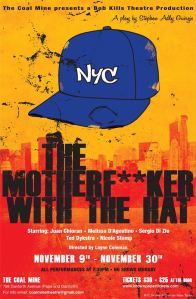 Fortunately, Bob Kills Theatre has just brought another Guirgis play to Toronto – The Motherfucker with the Hat. Coyly termed “the play that dares not speak its name” by the New York Times, Hat is loud, crude, in your face, and absolutely electrifying. The production in Toronto is at The Coal Mine, a new theatre at Pape and Danforth (Hat is their first production). The Coal Mine is an intimate space — two rows of viewers line the walls, and the set is right in the centre of the room. It’s the perfect setting for Guirgis’ intensely personal narrative. We can’t help but get sucked into the characters’ lives, and every nuance of emotion is visible to the entire audience.
The story follows recovering addict Jackie (Sergio di Zio), who has recently been released from prison, and his girlfriend Veronica (Melissa D’Agostino). As the play begins, Jackie comes home thrilled at having landed a job at FedEx, and is about to celebrate with Veronica when he finds another man’s hat in their apartment. He accuses Veronica of cheating on him, and turns to his AA sponsor Ralph (Ted Dykstra) for advice.
The play is hilarious, but with a definite edge. There’s an underlying sense of bitterness beneath the punchlines. At one point, Jackie screams, “I’m in pain!” and that pain just seeps through, not just from Jackie, but from all the other characters as well. Above all else, the play feels raw — the characters are all wounded in one way or another, and particularly in such an intimate venue as The Coal Mine, the audience can almost feel them bleed.
Guirgis’ genius is in the truth that reverberates throughout his words. In one scene, Ralph points out that friends are made before you’re 25 — any “friend” made after that age is merely an associate, because “friends are for the playground.” I don’t know if I completely agree, but I can certainly remember feeling that way. The sentiment rings true. Yet contrasted with that disillusionment is also a sense of hope. In one of my favourite lines in the play, Jackie says, “Your – whaddyacallit – your world view? It ain’t mine. And the day it is, that’s the day I shoot myself in the head. I didn’t get clean to live like that.”
As the naive, almost child-like Jackie, Sergio di Zio’s performance just about broke my heart. The moment in the first scene when he discovers that Veronica may have been unfaithful, his face just falls, and you can feel the jubilation about his new job gradually draining away as realization dawns. And that final scene — I won’t give any spoilers away, but really, with that look on his face, I just wanted to give him a hug.
All the performances were really strong, but Juan Chioran as Jackie’s cousin Julio stole the show. I last saw (and loved) him as the Emcee in Shaw Festival’s Cabaret, where he pretty much dominated the stage with each of his songs — in the much smaller Coal Mine, he seemed even larger than life. As an empanada-making, kung fu fighting cousin with solid advice and a heart of gold, Julio stands out in contrast to the more fucked up characters in the cast. Chioran revels in the character’s exuberance, yet also imbues him with pathos that somehow seems much deeper than Jackie’s more overt emotion. “I’m only doing this for your mother,” Julio warns Jackie, admitting he doesn’t like Jackie very much. Yet later on, when Jackie’s world falls apart and he goes to confront the man he believes is sleeping with his girlfriend, Julio is the one who stops him, and offers to “go Van Damme” on the man himself, so Jackie won’t break parole. Chioran is charismatic and brilliant, and the moment when Julio reminisces about a childhood incident between him and Jackie is just beautiful.
If you’re in Toronto, I definitely recommend checking this play out. The play has also received positive reviews in NOW Toronto, The Globe and Mail and The National Post.
The Motherfucker with the Hat is on at The Coal Mine until November 30. Tickets are $30 and available online: www.brownpapertickets.com/event/859215.
The Coal Mine is such a new venue that they don’t even have a website yet. In the meantime, you can follow them on Facebook or Twitter, for the latest news. Keep an eye out for Mike Bartlett’s Bull in March and August Strindberg’s Creditors in May.

 How did you get to be the woman you are today? Eighty-five year old Addie Baum is asked this question by her granddaughter, and thus begins a reflection on a young woman’s life in 20th century America. In Anita Diamant’s The Boston Girl, we learn about Addie’s involvement with a women’s reading society, her battles with sexism in the field of journalism, and her budding romance with her eventual husband.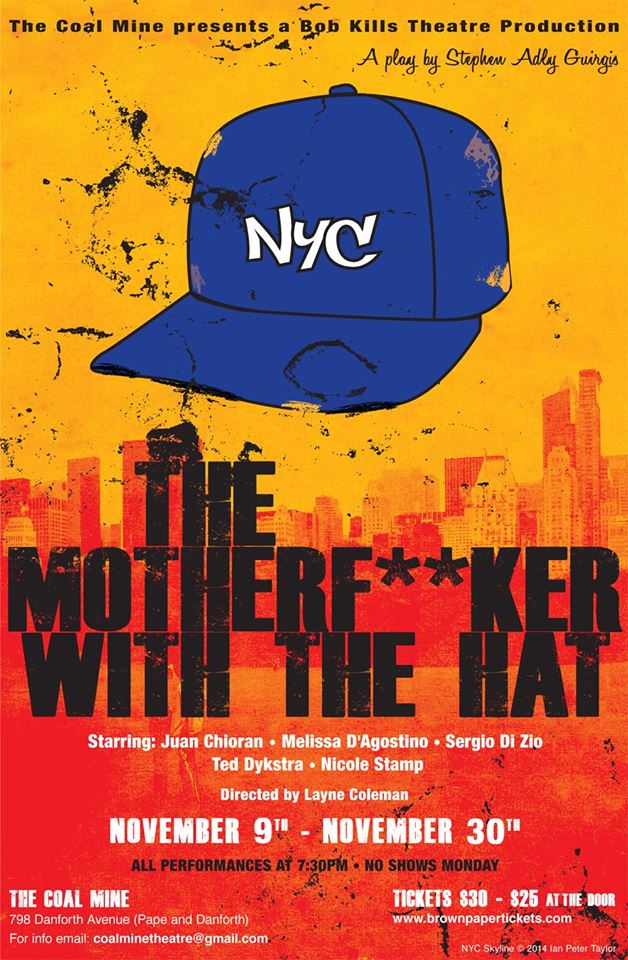

 Literary Treats