
Unknown's avatar

About Jaclyn

Reader, writer, bookaholic for life!

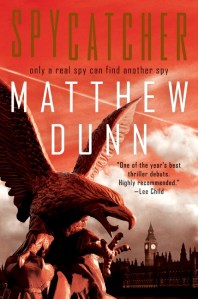
Review: Spycatcher, Matthew Dunn

Fan of John Le Carre? You’ll love Matthew Dunn’s Spycatcher. Written by a former MI6 field officer, Spycatcher takes us right into the mind and heart of master spy Will Cochrane. Cochrane is a highly skilled operative, tasked by MI6 and the CIA to locate and stop an Iranian terrorist named Meggido from launching a massive international attack.

Dunn’s background in espionage is evident. Spycatcher has an action-packed story, with some of the best fight scenes I’ve ever read. They remind me of the Sherlock Holmes movie with Robert Downey Jr, where a voice-over narration details all the moves Holmes will make and the reasons behind them (like “fake to the eye to distract, then strike to the throat to incapacitate”). When Will takes a guy out, we see exactly how he does it, and we believe in Will as a killing machine. As a fan of action movies and MMA, I loved reading such scenes of realistic, efficient hand-to-hand combat.

I also love the way Dunn describes the operations carried out by Will and his team of CIA agents. In some scenes, they seem almost unbeatable. For example, when Will has to break into a building, he has Julian, a member of his team, giving instructions in his ear. The instructions are split-second precise, with Julian telling Will where to face, when to go and when to stop and hide. They move with clockwork precision, and so even when things go wrong, we just know that such a highly skilled team can come up with a viable Plan B on the fly.

What really makes Spycatcher work, however, is the depth of insight it gives into the personal lives of spies. The CIA team and Will’s MI6 and CIA bosses are all engaging characters, but Will, in particular, is a very lonely man. In one scene, he runs into his sister, who he hasn’t seen in eight years, at a cemetery, and she comments that it’s just like him to visit the dead and not the living. It’s a striking observation; we realize that, in choosing the life of a spy, Will Cochrane has given up the chance to have a family, and even to be with the family he already has. We also get some flashbacks to Will’s childhood and the traumatic events that have made him such an effective spy and efficient killing machine.

So when Will meets Lana, a woman who can help him get Meggido, and whom Will wants to protect because of all she’s suffered in the past, and when Will realizes he isn’t as lonely with her around, I really wanted them to end up together. I don’t usually care much for the romantic subplots in thrillers; I prefer to focus on the action. But in Spycatcher, since Dunn makes such a compelling portrait of Will’s humanity and loneliness, I just wanted Will to find happiness.

In one of my favourite scenes, Will hesitates to kill a man whom he respects for his courage: “For the briefest of moments, he wanted to leave the brave man alive, just turn and walk away. But he knew he could not allow the man to live. He shot him.” So many action movies or thrillers have clear good guys and bad guys, and if a good guy hesitates at killing a bad guy, it’s because they have some kind of history. But Will had never met this man before, so it was just his behaviour in combat that made Will respect him. Will’s hesitation at killing this man, and yet killing him anyway because it was necessary, is such a wonderfully complex, emotional portrait of Will as both vulnerable human and professional spy at the same time. We feel for Will, and can relate to him, even as we admire his skills as a deadly machine.

In the book trailer on the Harper Collins Canada website, Matthew Dunn says he’s been told to write what he knows, and what he knows is espionage. Reading Spycatcher, I can definitely see it. Dunn takes us into the heart of a spy. Will Cochrane’s adventure is thrilling, but it’s his personal life that keeps us hooked, and his personal demons that we really want vanquished.

Review: Vital Signs, Tessa McWatt

Tessa McWatt’s Vital Signs begins with an image of the narrator’s wife Anna wearing an electrode cap. She has a brain aneurysm that causes her to mangle her sentences and that endangers her life. The narrator Mike is devastated by his wife’s condition and guilt-ridden over an affair he’d had years ago. He wants to confess.

When I started reading Vital Signs, all I could think of was, this is such a depressing book. I ached for Anna and her inability to express herself. I found the opening scene with Anna wearing the electrode cap and speaking about hummingbirds very painful, and for a book to begin with that image should’ve warned me that this book was just going to get even more depressing.

Still, it’s sadness with sweetness as well. I love hearing about Mike and Anna’s love story, and how their family deals with Anna’s condition. In one of my favourite passages, Mike thinks that perhaps Anna’s nonsensical sentences are her way of exerting control, of perhaps playing a game with her doctors. It’s false hope, of course, but I was moved by his all too palpable need to grasp any bit of hope he can.

I cared about Mike, Anna and their children. The entire time, I wanted more than anything for Mike to decide not to confess his affair. Seriously, with what his wife is going through, what would his confession achieve other than salving his own conscience? If Anna were to be trapped in a world where she can communicate only to herself, I wanted her to hold on to the wonderful memories she’s had with Mike, and not have to deal with the less-than-wonderful truth. I cheered their daughter Charlotte on when Mike sensed she didn’t want him to tell. I wanted Anna to get better, and worried with her family whether surgery was an acceptable risk.

That is why I was so let down by the plot twist near the end of the book. Without giving any details about it, all I can say is that I felt cheated. I felt like it just provided an easy resolution to what was, till then, a gripping plot point. Other than that, I thought Vital Signs is a good book, with a fitting overall ending. It’s a short book, but by no means an easy read.

Review: Sand Queen, Helen Benedict

What a powerful book! Also somewhat depressing, so definitely not something to read if you’re in the mood for something light. Helen Benedict’s Sand Queen tells the stories of nineteen-year-old American soldier Kate Brady and Iraqi medical student Naema Jassim in Iraq in 2003. I don’t usually enjoy war novels, so I wasn’t sure how much I’d like this one, but I quickly found myself engrossed in the tales of both women.

Kate is assigned to an American prison in Iraq, where Naema’s father and thirteen-year-old brother have been unjustly detained. The first thing that struck me about this novel is the less than heroic portrayal of the American military. Seen through Naema’s eyes, American soldiers are bullies, much less brutal than Saddam’s soldiers, but still picking on innocent Iraqis like her brother. I like how Benedict shows this, and also shows the other side’s perspective. For example, Kate notices how the Iraqi prisoners are actually getting better food and accommodations than the American soldiers.

I like the scene where Naema tells Kate that she’s a medical student, and Kate admits she thought Iraqi girls “weren’t allowed to do anything except get married.” “Do you know nothing of my country?” Naema asks, and they chat a bit about their families.  I love that bit of cross-cultural interaction, and the idea that, even in the very midst of the war, an American and an Iraqi can discover common ground and become friends.

Naema’s story started out emotionally gripping. We see her enjoying a quiet dinner with her family, her father and brother being arrested, and her outrage and desperation in trying to find out about them. However, I found Kate’s story much more engrossing, and shortly after Naema and Kate’s initial interactions, I found myself skimming over the Naema chapters.

Kate’s story is just very disturbing. As a young, female soldier, she routinely gets harassed by her fellow soldiers and by prisoners. In Sand Queen, Benedict uses the real life stories of female soldiers in Iraq that she had researched for her earlier, non-fiction book The Lonely Solder: The Private War of Women Serving in Iraq, and perhaps it’s because of this source material that Sand Queen ends up feeling much more like Kate’s story than like Kate and Naema’s stories.

The level of harassment and sexism that Kate and her fellow female soldiers face is horrific, and it was difficult but felt utterly real, to see her turn from a somewhat innocent girl just trying to do her job to a rage-filled, hurting woman capable of kicking a bound man and grinding his face into the ground. We see glimpses of Kate’s life after the war, and we understand how she got there — after all she’s been through, who wouldn’t be broken? There’s a sweet romance with a fellow soldier who tries to protect her from a rapist, and I was cheering on that romance all the way. With so much horror everywhere else, that friendship and developing love stood out as the potential for hope.

Sand Queen is a powerful and, quite frankly, depressing novel. It’s wonderfully written; even with such heavy subject matter, the story moves really quickly. It’s an eye opener, both to the lives of Iraqis during the war and to the experiences of female soldiers. Not a breezy read, but definitely worth reading.