Unknown's avatar

About Jaclyn

Reader, writer, bookaholic for life!

Happy birthday, Jess! ~ Review roundup in honour of my sister

My sister Jessica is celebrating her birthday today. She’s introduced me to some of my favourite books and writers ever, including:

  • The Harry Potter series by J.K. Rowling
  • The Rebus series by Ian Rankin
  • The Spenser series by Robert B. Parker
  • The Guido Brunetti series by Donna Leon

… and lots, lots more. So, I figured, what better way to celebrate her birthday on my blog than by writing about some books and genres she loves?

The Hunger Games trilogy, by Suzanne Collins

I don’t have to tell you how awesome this series is, do I? It’s one of the most brilliant YA series I’ve read, possibly second in my mind only to Harry Potter. It took me months to convince Jess to read it, and she’s now an even bigger fan than I am. It just has everything: an inspiring heroine, self-sacrifice, politics, reality TV, family, kick ass action scenes, and yes, a love story.

If you’re one of a handful who hasn’t read the book yet, check out the website here to find out more about it. Better yet, read the books already. Trust me on this one.

Even better, there’s a movie out in 2012.

Love The Hunger Games and looking for your next read? May I suggest Moira Young’s Blood Red Road or Veronica Roth’s Divergent.

And, if you’re a nerd like me, check out The Girl Who Was on Fire, full of essays about the books.

View my review of The Girl Who Was on Fire 

To Kill a Mockingbird, by Harper Lee

One of Jess’ favourite books ever, and I’m sure a lot of you already agree about how awesome this book is.

Harper Lee’s To Kill a Mockingbird still feels as relevant today as it did when it was first published. Despite all the tense race relations Lee depicts in her story, Lee also offers us some of the most inspiring characters in literature. How often do we watch the news and wish we had lawyers or politicians with as much integrity and passion for justice as Atticus Finch? How much do we wish we had the same staunch beliefs in right and wrong that Scout has? In Lee’s tale of a white lawyer defending a black man in a racist town, we simply fall in love with her characters, and cheer them on, whole-heartedly, in their battle, which is a battle for justice, but more importantly, a battle against hate.

The Sigma Force series, by James Rollins

Actually, any book by James Rollins is guaranteed to have two things: insane thrills and science that seems too weird to be true, but is actually based on extensive research. The Sigma Force series, which Jess introduced me to and we both love, has the added bonus of starring a team of kick-ass nerds. Seriously, imagine Sheldon Cooper with a black belt in karate and Iron Man type gadgets.

Reading Rollins is always like watching a good movie: you’re riveted by the action, and freaked out by the knowledge that there’s a kernel of truth in the story. His latest, Devil Colony, isn’t my favourite of his books, but it’s still pretty damn good.

View my review of Devil Colony

For Rollins fans: he’s a very active tweeter, and chats often with fans.

Follow James Rollins on Twitter

Spycatcher by Matthew Dunn
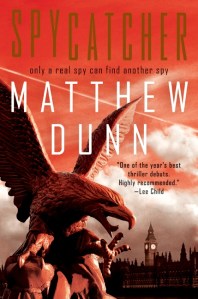
Jess is a huge fan of spy novels, especially those that feel “close to the ground.” John Le Carre, Alan Furst and Len Deighton, rather than Ian Fleming. Matthew Dunn’s Spycatcher caught my eye as something she’d enjoy. To my delight, I absolutely fell in love with this book myself, and I’m not even much of a spy fiction fan.

Dunn is a former MI6 agent, and like Le Carre, his field experience is almost palpable in his writing. (Unlike Le Carre, Dunn doesn’t use a pseudonym, which I find interesting.) Spycatcher follows Will Cochrane as he tries to stop an Iranian terrorist. It’s a thrilling story, and while Cochrane and his team appear almost superhuman at times in their strategies, Spycatcher works so well because we see Cochrane’s vulnerability, his humanity. We feel his pain at not having seen his sister in eight years, and we long as much as he does for him to be able to settle down with the woman he loves. Incredible book, and I can only hope Dunn writes even more.

View my review of Spycatcher

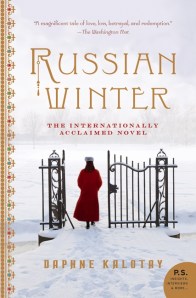
Russian Winter by Daphne Kalotay

Jess loves books about Russia, especially books written bySolzhenitsyn, Dostoevsky and Chekhov. I haven’t blogged about any of their books (I’ve also never read Solzhenitsyn, though Jess assures me he’s really good), so here’s the next best thing: Kalotay’s Russian Winter is about Nina Revskaya, a former ballet dancer now living in Boston and auctioning off her jewelry. A mysterious link between her and a man who appears to own a necklace that belongs to one of her sets leads Nina to remember her past in Russia under Stalin. The present-day scenes were okay, but I just love the scenes in Russia. The descriptions of ballet are just beautiful, and Kalotay makes us feel both the fear of Stalin and the characters’ desire to escape this fear through art.
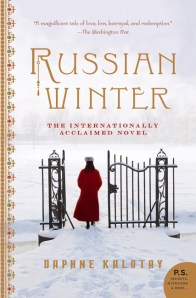
View my review of Russian Winter

Review: Russian Winter, Daphne Kalotay

Daphne Kalotay’s Russian Winter is a beautifully written book. The pacing is a bit slow, but that somehow fits with the book’s reflective, nostalgic nature. And once in a while, Kalotay injects a cheeky line or two into an otherwise serious scene. Take for example a character whose ex-fiance’s new woman had “all her ducks in a row.” The character’s mother “let slip” that the ex-fiance was moving to Seattle with “the woman with the ducks.” It’s a toss away phrase, but one that turns a cliche into an opportunity to giggle. Later, a solemn TV interview scene includes a nurse who sneaks into camera view, waves, and scurries back off screen. It’s farcical, and definitely welcome, keeping the book from taking its heavy subject matter too seriously.

Nina Revskaya is an elderly former dancer from the Bolshoi ballet. Now living in Boston, she has decided to auction off her jewelry. This dredges up memories she would rather forget, of her life in Stalinist Russia. The auction also reveals a mystery in the present — why is Nina so reluctant to meet Grigori Solodin, a Russian professor with an amber necklace so apparently part of a set Nina owns?

The Russian scenes are beautiful and captivating. I loved reading about Nina’s rise to principal dancer. Kalotay describes ballet with a storyteller’s eye. We are drawn into Nina’s dancing because Kalotay goes into such detail that we can almost imagine we’re watching the ballet and feeling the magic of live theatre. Take for example:

Nina revels in the leaps and kicks and high jumps her body loves. […] She greets her Spanish girlfriends in mime and flirts with some of the young men, all the while aware that Stalin is watching–yet even as she makes her sequence of leaps around the square, slapping the ground firmly with her fan, Nina feels fully in control. When she dances her first variation, clicking her castanets defiantly, her sissonnes are fully split, so that as she arches her back in midair, her head points back parallel to her leg and her arm behind her almost touches her outstretched back foot.

We can practically see Nina happily flirting with men onstage. Her joy is marred by the presence of Stalin in the audience, the man responsible for her friend Gersh’s fall from grace and eventual arrest. Yet, with that final pose, Kalotay presents us with such a beautiful image of triumph. It may not mean anything in practical terms, but, reading that passage, we can believe that Nina has defeated Stalin, that she is free from his regime’s control. And we realize, isn’t that the power of art? Doesn’t art provide us with a sense of freedom, of transcendence? It’s idealistic, and as Nina’s story reveals, only temporary. But in passages like that one, we not only believe in this power; Kalotay makes us feel it.

I was drawn into Nina’s story: her romance with the poet Victor Elsin, the complexities of her friendship with Vera, and, in the present day, her overwhelming desire to both confront her past and forget it. I loved reading about her friends in Russia. Set against the backdrop of the Stalin regime, yet full as well of personal drama, their stories drew me in.

Less compelling are the scenes in the present. Kalotay does a good job fleshing out the other two main characters, the Russian professor Grigori and Drew, the woman organizing the auction of Nina’s jewelry. The mystery of why Nina refuses to acknowledge Grigori’s necklace as part of her collection is intriguing, and certainly what kept me interested enough in the present day scenes. Grigori and Drew are likable enough characters; they just pale in comparison to Victor, Vera, and even Nina’s nurse Cynthia. I was more interested in Grigori, mostly because his necklace shows some kind of link between him or his family and Nina. Drew’s story mostly just bored me.

That being said, it was a present day character, Zoltan, an immigrant in America, who said one of my favourite lines in the entire novel:

This country has been good to me. But it doesn’t hold the indentation of my body on the mattress, if you see what I mean.

What a beautiful, striking image! An immigrant myself, I do see what he means. I don’t necessarily feel that way all the time, but when I read that passage, my immediate thought was: that’s it exactly.

Russian Winter is very much Nina’s story, and she’s a fascinating woman with an even more exciting past. Zoltan’s sense of not being truly home is an echo of Nina’s own situation — a woman who has broken free from Stalin’s government, yet in doing so, has also given up the life of dance that had come so naturally to her. Elderly, with arthritic knuckles, Nina is as much a stranger in her own body as Zoltan feels in his current home. We feel Nina’s pain, as she remembers the wonder of being able to dance even as she struggles now to walk. We fret with her when she realizes mistakes she’s made and feels it’s too late to fix them. And we hold on as tight as she does to the memory of that young dancer, triumphant in her pose mid-flight.


Review: Blood Red Road, Moira Young

I’d heard that Moira Young’s Blood Red Road was very similar to The Hunger Games, so as a Hunger Games fan, I was eager to check it out. There are certainly similarities: Blood Red Road also takes place in a dystopian future, the heroine Saba is an archer like Katniss, and Saba has to compete in a gladiator style Cage Match to the death like Katniss has to survive in the Hunger Games. Overall, however, I don’t think Blood Red Road quite matches up, at the very least in terms of the breadth of social commentary in Hunger Games. While Hunger Games delivers a scathing portrayal of contemporary society’s obsession with consumerism and voyeurism, Blood Red Road reads more like a straightforward action-adventure story, with its social commentary focused on the dangers of drug addiction.

That being said, Blood Red Road is still a very good book. It has a heroine much fiercer than Katniss, UFC-style fight scenes, language that reminded me of the dialogue in The Grapes of Wrath and a landscape and drug culture that reminded me of Dune. Saba’s twin brother Lugh (the “light” to Saba’s “shadow”) is kidnapped and Saba sets off to rescue him. Along the way, she is captured and forced to compete in no-holds-barred cage fighting, where she earns the nickname Angel of Death: when she fights, the “red hot” takes over and she can’t lose. People are addicted to chaal, a drug controlled by a King, and this addiction makes them either suppliant or, after a certain point, filled with bloodlust (hence the need for deathly cage fights). Saba also encounters a group of young female warrior rebels and a handsome young thief called Jack.

Young writes well. This type of writing (filled with intentional misspellings and grammatical errors) usually grates on me, but, as with Patrick Ness’ Chaos Walking trilogy, I thought it worked here. Blood Red Road is a fast-paced, action-packed, exciting read. It’s already been optioned for a motion picture by Ridley Scott, and I can certainly imagine some of the scenes playing out on screen. The secondary characters are well developed and likable. I especially liked Jack, who is charming, funny and sweet. Saba’s younger sister Emmi is usually the kind of character I’d hate in books and movies, the kid who always gets involved in things and so has to be rescued several times. But I really felt for Emmi in this book, and I think it has a lot to do with my major problem with the book: Saba.

I liked Saba as a narrator, but I don’t really like her as a person. I do like that her survival instinct is so strong that she dominates the cage fights. I also like that she is so devoted to her brother, even though it’s clear (Jack even tells her so) that she puts him on too high a pedestal. We do see her vulnerability at times, and also her protective instinct toward Emmi.

Thing is, as one character says, Saba is “prickly.” Beyond that, she can be downright mean, especially to Emmi. A lot of the time, other characters were offering Saba help and friendship and she kept turning them away, preferring to be a lone wolf even when it wasn’t practical. She has to be forced to accept help, and for me, at least, she hadn’t shown enough of her vulnerability to make this anything but annoying.

I was most annoyed by Saba’s relationship with Jack. It followed a standard “I hate you (but secretly I love you)” type love story. But after a while, Saba’s insistence that she really, really hates Jack just felt forced, like the author just wanted to stretch it out just a bit longer. Perhaps it’s because I didn’t really see why Saba was so defensive, unlike in Hunger Games, for example, where I could really understand how Katniss’ society had made her so defensive and afraid to trust anyone.

Overall, however, Blood Red Road is a really good book. Definitely worth checking out for fans of The Hunger Games or Divergent or kick-ass heroines and dystopian fiction in general.