Author Encounter | Anna Todd, at Indigo Green Room Eaton Centre

22557520With the success of Fifty Shades of Grey (originally Twilight fanfiction) and the Mortal Instruments series (which allegedly began as Harry Potter fanfiction), the success of Anna Todd’s After series should come as no surprise. Originally published on Wattpad as fanfiction of British boyband One Direction, After received millions of views and was eventually picked up by Simon and Schuster for traditional publishing.

I was fortunate to have had the opportunity to meet Anna in the Indigo Green Room before her signing last Wednesday. I hadn’t read the After series on Wattpad and new little beyond the fact that it starred Harry Styles and had millions of fans online, and I was interested in finding out more.

In brief, After is about innocent college freshman Tessa falling in love with bad boy older student Hardin. Their relationship is a classic good girl/bad boy romance, with Tessa’s goodness making Hardin want to reform.

Fellow blogger Hayley commented that the relationship between Tessa and Hardin was “so toxic, but I couldn’t stop reading!” Anna admitted that their relationship was indeed toxic, but pointed out that it’s fiction. She brought up an interesting point about what we look for in book boyfriends versus real life boyfriends. Readers want some level of difficulty in book boyfriends, she says, without necessarily wanting it in real life. She spoke about the popularity of the bad boy trope and pointed out that the idea of a boy wanting to change for the better, for the sake of a girl he loves, is attractive. Anna was quick to point out that most readers distinguish between the fantasy of this within fiction, and what we actually look for in real life. “I wouldn’t want my husband to treat me like [Hardin treats Tessa],” she said. Yet fiction is a safe place to indulge these fantasies, and allow ourselves to fall for a boy who would be better for no reason other than love for us, and us alone.

Anna says that After is “a combination of all these things I love.” Beyond the hero being originally inspired by Harry Styles, Anna’s love of the Fifty Shades trilogy is also reflected in Hardin and Tessa’s romance. Another influences include Wuthering Heights and Pride and Prejudice (an early scene between Hardin and Tessa closely resembles Elizabeth and Darcy’s first encounter at a party).

Meeting Anna at the Indigo Green Room, Eaton Centre

Meeting Anna at the Indigo Green Room, Eaton Centre

The transition from Wattpad fanfiction to published novels was very smooth, which Anna credits to her editor at Simon and Schuster. She views the published version as a definite improvement to the unpolished original. Awkward phrases and grammatical errors were smoothed out, and the story expanded to add complexity to certain characters.

Despite her positive experience with traditional publishing, Anna maintains loyalty to the Wattpad community, and asserts her thankfulness at the support of the online community. She particularly loves the constant stream of feedback from readers that Wattpad provides. When working with her Simon and Schuster editor, Anna admits the switch from crowdsourced editing to editing by a single person felt odd, and that, in order to mimic the Wattpad environment, her editor gave more detailed edits than he usually would.

After has since been picked up for a movie deal, and we naturally asked Anna about who she sees in the roles. She says Indiana Evans is far and away the definitive choice for Tessa in her mind. For Hardin, she thinks Douglas Booth would be a great choice, and she would love to see Ansel Elgort as Landon (a classic good boy and friend to Tessa). For Zed (a friend of Hardin’s whom fellow blogger Hayley describes as “the Wickham” in the series), Anna admits that he was originally based on Zane from One Direction, and in her mind, she still can’t think of anyone else in the role.

Just a small section of the long line awaiting Anna's book signing at Indigo Eaton Centre

Just a small section of the long line awaiting Anna’s book signing at Indigo Eaton Centre

What’s Anna working on now? Other than publicity for this title and writing the fourth book in the series, she’s also expanding on a story about Landon’s romance with someone (I can’t remember the name and can’t find it on Google, but Hayley, who’d read the entire series on Wattpad, was really excited to hear this, so I think fans of the series will be thrilled). The next two books will be published by Simon and Schuster over the next couple of months, and Anna highly recommends waiting for the published versions — Simon and Schuster’s editing has smoothed out the rough edges, and the stories have been expanded for print. As well, Anna says that she may change the ending of the entire series for the print version, just because of the way the characters and storylines have developed in print.

+

As an aside and possibly minor, but to my mind important, note about my feelings on celebrity fanfiction in general: while I have few reservations about fanfiction on fictional characters getting mainstream recognition, the idea of fanfiction about real people does make me very uncomfortable. Not that I’ve never fantasized about celebrities, but to actually make these fantasies public seems to me somehow a violation of those celebrities’ boundaries. All that to say that the origin of After makes me uncomfortable not because of its plot or any pre-formed opinion about the quality of fanfiction, but because of its use of a real celebrity as the hero.

I did receive a copy of this book for review, and will put aside my reservations about its origin and celebrity fanfiction in general as I read it. Just a thought, and if celebrity fanfiction becomes more of a trend, I’d love to know what the rest of you think about it.

+

Thank you to Simon and Schuster Canada for the opportunity to meet and speak with Anna Todd.

Blog Tour | Review: Gottika, Helaine Becker

9781770863910Helaine Becker’s Gottika is a powerful retelling of an old Jewish legend about the golem, a magical humanoid being made from clay who is brought to life to protect Jewish towns from anti-semitic attacks. The world that Becker creates in Gottika bears many similarities to Panem and other contemporary YA dystopias, but the reference to Jewish legend turns the into an unsettling allegory for the horrors of the Holocaust.

Fifteen year old Dany is a Stoon, in Western Gottika where Stoons are treated as second class citizens and killed for no reason under the tyrannical rule of Count Pol. Unrest is brewing, and Dany’s father must decide if he must stop trying to keep a low profile and use the secret knowledge he possesses to bring clay to life and transform it into a weapon against Count Pol.

There’s a lot going on in Gottika, multiple plot threads that, though resolved, rarely ever take off. What’s the “staring sickness”, why do all the families in town only have one child each, why is Count Pol kidnapping teenage girls? The final question in particular does have a pretty big significance in the story, but the question feels so tangential, and buried beneath so many other plot points, throughout the story that the payoff feels disjointed.

More powerful are the encounters between Stoons and Count Pol’s soldiers. In one particularly memorable scene, Dany and his father are swimming when soldiers order them out of the water and castigate them for not wearing their hats. The casual injustice, coupled with Dany and his father’s powerlessness to resist, is difficult to read. In another scene, soldiers storm Dany’s house to confiscate his family’s books. The novel breaks from text narration then, switching over to graphics and demonstrating how some horrors are beyond just words.

While more of the main characters are male, I love that the female characters seem to have more complex motivations for their actions. While most teenage girls fear being kidnapped by Count Pol, Dany’s cousin Dalil welcomes it. She is attracted by Pol’s lifestyle, and manages to turn a blind eye to his faults. Later in the story, she is forced to face the truth of Pol’s tyranny, and becomes instrumental in the resistance against it. I love her character arc, how her desire for comfort initially outweighs her loyalty to her people, until she is forced to realize just how much she is condoning by her actions. Dany’s mother as well, quiet and unassuming at first, later reveals a dark secret she’s had to live with for many years. In contrast to Dany and his father’s more traditional heroic roles, I love the nuances and  questions raised by Dalil and Dany’s mother’s more problematic arcs.

The horrors of the Holocaust are difficult to discuss, particularly in fiction for children. Gottika isn’t exactly a simple allegory for that, but it does speak to the oppression experienced by certain groups of people. The story is futuristic, but the tone is that of a classic fairy tale. There’s a timelessness to Dany’s story, and despite the supernatural elements, the sense that there have been, and continue to be, far too many Count Pols throughout history.

+

Thank you to Dancing Cat Books for a copy of this book in exchange for an honest review, and for inviting me to take part in this blog tour.

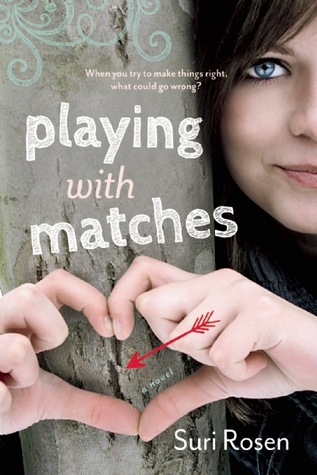
Review | Playing with Matches, Suri Rosen

20578768When her sister’s heart is broken, 16 year old Raina Resnick decides to set up the anonymous matchmaking service “Match Maven” and help her sister find true love. Leah, after all, is twenty-three and unmarried, and as Raina points out, this is a big deal because “you have to think in dog years when you’re single in a traditional Jewish community” (page 31).

Playing with Matches is a hilarious tale of matchmaking, filled with increasingly ludicrous scenarios and yet anchored throughout by Raina’s very real desire to reconnect with her sister. The Match Maven dates are hilarious — a scene involving a Porta Potty is just so over the top that all you can do is laugh. For anyone who’s tried online dating and had some pretty horrific experiences, this book will make you feel better about your love life. And yet there is also the story of Esther, an elderly woman who lost her husband to a brain aneurysm years ago and is now looking for a second chance at love. Just as Raina does, we can’t help but feel invested in these singles asking for help, and just like Raina, we want them to find their perfect match.

However, it is Leah’s search for a match that really propels the story. As the anonymous “Match Maven,” Raina is able to offer advice and connect with Leah at the same time as Leah is pulling away from her sister in real life. Honestly, Leah’s conversations with Match Maven made me really uncomfortable — it’s Leah’s decision whom to trust with her feelings, and she was really being tricked into revealing them to her sister. I understood why Raina felt she had to do it, and how because of her persona as Match Maven, Raina couldn’t really do much to stop it. Still, it felt like an invasion of her privacy, and despite the way things eventually turn out, it still felt like a betrayal of trust. More a criticism of a character’s actions than a criticism of the book itself, but I do wish this aspect of it had been explored a bit more.

The novel also stretches credibility, though that might just be my unfamiliarity with Jewish matchmaking customs in the 21st century. If a matchmaker is supposed to broker the deal from the first date all the way to the wedding, and if, like a wedding planner, she must be on hand to help deal with disasters as Raina is, is it believable that the matchmaker remain anonymous? Also, do matchmakers render the service for free, or are they usually paid? None of Raina’s clients ever enquire about fees, or, if she is anonymous, about methods of payment. Given the level of commitment required and the significance of the task, I’d think matchmaking would be a profession, and therefore a paid service, rather than something one does for strangers just out of the goodness of their hearts. I of course know nothing about traditional Jewish matchmaking rituals — for example, I didn’t realize it was still so prevalent in the 21st century — and this book makes me want to learn more.

Still, Rosen speaks of Jewish customs with an ease and confidence that Eve Harris lacks in The Marrying of Chauni Kaufman, an “Orthodox Jewish Pride and Prejudice” that struck me as presenting an expertise on a culture without adequate understanding. I don’t know how accurate Rosen’s portrayal of Jewish customs is, but her book is at least much more natural in tone and affectionate about these customs. Playing with Matches is also less concerned with detailing all the various aspects of the traditions — rather, it concerns itself much more with the story, providing enough details that I knew what was going on but not bombarding me with so much information that it felt like more like a Wikipedia article than a novel.

Playing with Matches is a great book for the weekend. The book blurb describes Raina’s matchmaking service as a cross between Jane Austen’s Emma, Dear Abby and Yenta the matchmaker, and that’s pretty much on point. Some of the plot threads were too neatly resolved and at times, Raina’s streak of bad luck felt like a ploy by the author to garner sympathy for the character. But overall, the story was a lot of fun to read, and featured a cast of characters you want to succeed in their search for true love.

+

Thank you to ECW Press for an advance reading copy of this book in exchange for an honest review.