
Review | Icons, Margaret Stohl

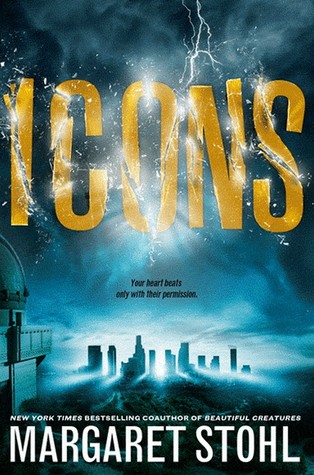
11861715Beautiful Creatures co-author Margaret Stohl begins a new YA dystopia/fantasy series with Icons. Aliens have taken over the world, and a select group of teens have supernatural powers, though it’s unclear where the powers came from, or what the purpose of these powers are (presumably to defeat the aliens and taken back human freedom?).

As the first book in any series, the primary task of Icons is to establish its world and introduce readers to the characters. As such, it does start off a bit slow, though I enjoyed the introductory scenes of Dol and her best friend Ro in the countryside. The introductory chapters in particular have much too many parallels to The Hunger Games. Apart from the obvious — dystopian world — there’s the female protagonist Dol with hot, brooding, angsty male best friend Ro who wants to overthrow the system, they’re each the only one who really understands the other, they both enjoy spending time in the outdoors. Then, we later meet Lucas, instantly recognizable to any avid YA reader as the other point in this love triangle, who is a blond ray of light and love, connecting to Dol in a very different, much more hopeful way than Ro’s anger does, and who has a natural ability to charm people. Katniss, Gale and Peeta, anyone? Dol however does suffer in comparison to Katniss, being a much less kick ass, much more emo heroine.

That being said, it’s hard to fault Dol for being emo. The superpowers in this series are closely linked to emotions, and to anyone who has studied a bit of Spanish, Dol’s full name Doloria gives a pretty strong hint what emotion she embodies. Stohl tries to broaden Dol’s range a bit by also gifting her with a heightened sense of empathy, but really, being born with the innate capacity for sorrow must really suck. There isn’t any subtlety with Stohl’s treatment of the teens and their powers, which is unfortunate given the potential richness of the world she has created. Take for example the character names: Ro’s real name is Furo, which explains why he’s always angry, Lucas’ full name is Lucas Amare (light and love), etc. It’s all just a bit too obvious, and when it comes to predicting how characters will react to any given situation, their names pretty much say it all.

Still, the book is a fun read overall, and the story picks up when Dol and Ro are captured and sent to the embassy. Along with Lucas and a fourth teen Tima, they are monitored and their abilities tested, and while the purpose is unclear, intriguing snippets from rebel documents hint at the symbolic significance of these powers. Stohl drops just enough hints to keep the villains intriguing — the aliens’ human representative, Ambassador Amare (Lucas’ mother, which adds an interesting dimension to both characters) is as much a victim of these aliens rather than a pure villain, and the ending hints at a much more emotionally gripping sequel.

I also love that the protagonist is a person of colour, as well, that the Ambassador, probably the highest position a human can attain in Stohl’s world, is a woman, Lucas’ mother rather than his father. Even better, while these details are mentioned, Stohl doesn’t beat us over the head with them, suggesting a time when it becomes mainstream for books to have people of colour as protagonists and women in top positions of power. Given the wide range of YA books in the market as well as the genre’s popularity, these little touches make a statement, and make Icons stand out in a very good way.

+

Thank you to Hachette Book Group Canada for an advance reading copy of this book in exchange for an honest review.

Review | The Lucy Variations, Sara Zarr

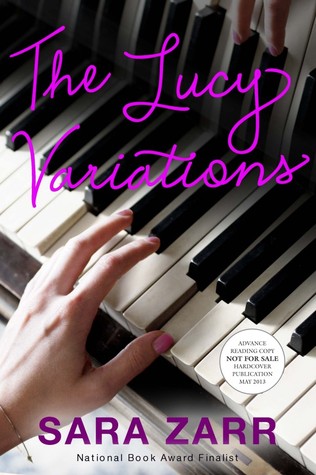
11819981Imagine being a has-been at sixteen. Sara Zarr’s The Lucy Variations tells the story of Lucy Beck-Moreau, a world-famous concert pianist by fourteen, who mysteriously walked away from a concert, and her music career, a couple of years later. Then her brother Gus gets a new piano teacher, Will, who befriends Lucy and encourages her to play the piano again, if only just for herself.

Lucy has faced a tremendous amount of pressure, particularly for a teenager, and her ability to deal with it is remarkable. I was a total achiever type in high school, and I can sympathize with Lucy’s need to excel, and her concern that doing something “just for fun” is a criminal waste of potential. Thankfully, my nerditude and desire for straight A’s were much more below the radar than Lucy’s concert career. Unlike Lucy, I never had to deal with hundreds of people watching me, nor did I have to deal with media outlets speculating about my reasons for an emotional decision.

So I sympathize. I remember the fear of making mistakes, the fear that each decision I make is momentous and irreversible. I never really outgrew that, but I do remember it being much more intense when I was a teenager. What if I flunk this one test? What if I choose the wrong major in university? For Lucy, her fear that walking away from a concert career means walking away from the piano altogether is exacerbated by her grandfather’s rigid stance on the topic. I can also definitely understand the appeal of Will, the piano teacher who argues that music is, first and foremost, a passion one must pursue, rather than a career. Many of us have been lucky enough to have had an inspiring figure like that growing up, who encourages us to connect with our deepest passions. So I can sympathize with Lucy’s crush on him.

The thing is, Lucy believes way too much in her own hype. She grew up as a special snowflake, Mary Sue type character, and acts like it. Can she play the piano again? Does Will like her, like like like her? Over and again, ad infinitum. At one point, another character points out that while Lucy was famous in the concert pianist circuit, that hardly translated into stardom with a general public. Yes! I wanted to say. Thank you! Again, I understand that Lucy puts a lot of pressure on herself, and I can understand the fear of playing the piano again when you know your skills have become rusty. Still, there were times when I wanted to tell her to grow up and get over herself.

I don’t think protagonists in books should necessarily be likeable, but when an author creates much more complex and interesting characters to support her, and instead chooses to focus on the protagonist’s sense of entitlement and navel gazing angst, I just want the author to shift her focus elsewhere. Quite frankly, while certainly serious, Lucy’s dilemma is nowhere near as earth shattering as she believes, which makes it all the more frustrating when she expects that her family and friends should be more concerned about her than about their own lives.

Take Lucy’s best friend Reyna for example. Reyna is going through some major family issues, and understandably needs to vent. Instead, Lucy pressures her into going to a party and staying at that party just so Lucy will have a ride. Worse, the whole point of Lucy going to that party in the first place is to see Will, a relationship with rather skeevy romantic undertones, considering the age difference and the fact that he is her brother’s teacher. At one point, Gus, who looks up to Will as a mentor and views him as a friend, pleads with Lucy to leave Will alone, so as not to ruin things. The lack of self-awareness in Lucy’s response is grating — she can’t give up Will, because unlike Will and Gus who are really just student and teacher, she and Will actually are friends, and actually do have a connection. I can understand her wanting Will as a mentor, and I can even understand her having a crush on him. But her sense of superiority over Gus — he’s the kid while she’s the mature sibling who can hang with the adults — is just annoying, as is her unwillingness to even consider something that obviously means so much to her younger brother.

The Lucy Variations is an interesting book, and Lucy’s situation is certainly one to sympathize with. Still, and particularly after seeing how much Reyna, Gus and the others around her are beyond supportive, I just want to tell Lucy to grow up and deal with it.

+

Thanks to Hachette Book Group Canada for an advance reading copy of this book in exchange for an honest review.


Review | When Love Comes to Town, Tom Lennon

9780807589168Twenty years after its original publication in Ireland, Tom Lennon’s coming of age, coming out story When Love Comes to Town is being released in North America. In many ways, the story seems a bit dated — characters use public phones and personal ads in newspapers rather than mobile phones and social media, cross dressing men are inaccurately referred to as transvestites, and I sincerely hope that society is at least more open-minded now than the one portrayed in the book. In other ways, however, it’s disheartening to see how many of the challenges Neil faces in the 1990s are still being handled by LGBTQ teens in the 2010s. Perhaps if it were published now, the author, an English teacher at a Dublin high school, wouldn’t have felt the need to use a pseudonym, but then again, perhaps I’m just being naive.

In the Foreword, James Klise says:

The novel reminds us how isolated many gay people felt in the pre-Internet age, before connecting with others was as easy as a click. The isolation was only increased by the near-invisibility of role models […] no gay-straight alliances in schools, no Ellen Degeneres on TV, no uplifting talk in the media about how “it gets better.” [p. vi]

Beyond isolation, the main emotion throughout the story is discomfort. We see Neil struggling with his sexual urges — he’s known since he was 10 that he was gay, but he sometimes wishes for death just so he won’t have to face the consequences of that knowledge. He has a crush on a boy in school, but he joins his friends in checking out girls, and at one point pretends to have a girlfriend. Perhaps most horrifically, Neil still laughs at his friends’ anti-gay slurs just so they won’t suspect that he himself is gay. He’s a gay teen living life as a straight one, and the sensation that something just isn’t right is a strong thread throughout.

Even within the gay scene, Neil is far from comfortable. Lennon writes of Neil’s awkward evenings at gay clubs, trying to figure out the rules. Ironically, Neil is far more comfortable flirting with girls; at least, he’s familiar with that world. One of the men he meets at the club, Uncle Sugar, is a constant reminder of the man Neil fears he could grow up to be — a desperate, rather pathetic middle aged man trying to pick up younger men. While Neil does find a sense of belonging in gay clubs, he is still constantly aware of the need to keep both aspects of his life separate. In some ways, Neil’s finding a space to be himself makes life even more stressful for him. How can he explain when Uncle Sugar calls his house? How should he react when he and his mother run into the flamboyantly effeminate Daphne at the mall? In a particularly telling scene, when two cross dressing men visit Neil away from the club, they make sure to wear business suits, and when Neil’s father runs into them, even have a cover story already made up for how they know Neil. Pretence is a way of life for the gay characters in this book, and the consequences of being out of the closet are all too vicious.

Interesting as well is that even the most open-minded characters still hold prejudice.  Neil’s friend warns him off a potential boyfriend because bisexuals “can’t be trusted,” and nothing in the narration hints at Neil or, for that matter, the narrator, finding this unfair. Neil’s sister accompanies him to a gay club and happily befriends gay men, and yet visibly recoils from gay women. Neil reacts by admitting that if he were a straight man, he might react the same way to gay men. No excuse, particularly by today’s standards, but it does reflect a more conservative time and place, with people less educated about LGBTQ issues. I also grew up in a conservative Catholic country, and I remember as late as the 2000s, a male classmate telling me he had nothing against homosexuality, but gay men made him feel uncomfortable, just as he (mistakenly) assumes gay women must make me feel uncomfortable too. Just as my classmate did, Neil finds this discomfort completely natural, and again, this is indicative how just how much Neil and the other gay characters in the book must have felt they had to hide.

The writing isn’t amazing. There are hardly any nuance to the characters; even the gay men Neil meets at the club are more character types than developed individuals, and even Neil’s inner monologue gets repetitive after a while. Descriptions are fairly standard, though perhaps fittingly, Neil’s descriptions of his crushes sound like bad high school poetry. The book’s strength therefore is not in its writing, but rather in its honesty. This is the experience of a young man in an Irish Catholic school in the 1990s, and Lennon paints a stark portrait of the isolation and fear that entails.

+

Thank you to Thomas Allen Ltd for a copy of this book in exchange for an honest review.