Review | Secret Sex: An Anthology, edited by Russell Smith

SecretSex“New risky fiction — with no names attached.”

What happens when you take 24 of Canada’s most prominent authors, invite them to write sex scenes, and promise them you’ll never reveal which scene they actually wrote? From the cover design (brilliant, by the way), to the anthology title, to the masquerade book launch, the marketing for Secret Sex turns out to be much sexier than the stories themselves.

To be fair, the editor makes it clear in the foreword that this is not a collection of erotica. Rather, it is a collection of sex stories written by literary fiction authors. So the sexiness is more akin to, say, D.H. Lawrence or Marian Engel than Sierra Simone, Sylvia Day, or even Shonda Rhimes’ take on Bridgerton.

So as someone who usually prefers sexy genre romance to literary fiction, and novels to short stories, I was prepared to flip through a few pages of this, figure out it isn’t my thing, and call it a day. Imagine my surprise then when I not only loved the first story (“Sext”), but actually read this all the way through to the end.

Not all the stories were my cup of tea, of course. As with any anthology, there are some hits and misses, and as with any fiction, especially the kind that features sex, your mileage will vary. I will admit that as a reviewer, not knowing who wrote which story also brings a kind of freedom. I can judge each story without thinking of the writer involved, or other books of theirs I may have enjoyed. Which does make my response to each story more candid than usual.

For me, there was a stretch maybe two-thirds through where the stories started to bore me, and I wondered if maybe I should have stretched this out one story at a time rather than try to read it all in a few days. But then a story (“Content Farm Confidential,” about a content ghostwriter who gets with her finance bro boss) revived my interest with its smart commentary on the sometimes soulless nature of sex and love, and remaining two stories (the voyeuristic “Mirror, Mirror” and the vampire story with Henry James undertones “Portrait of a Lady”) held my attention to the end.

My personal favourites:

  • “Politics of Passion” – an Indigenous man and a white woman meet at a conference on treaty issues. I absolutely adore the incisive political commentary and subversion of stereotypes that come through in sly little bon mot descriptions through an otherwise lighthearted, flirty-sexy story. For example, the woman is “colour challenged. Pigment denied.” The man “has a smile that told of strange and desirable secrets. Therefore, he was Anishinaabe.” (The “therefore” in that last quote sticks the landing.) And finally, no spoilers but the last two lines are the perfect ending. Brilliant piece.
  • “Bite” – vampire BDSM erotica. Sexiest story in the collection, IMHO, and the story most like what I would have expected and hoped from the marketing.
  • “Restoration” – this one was probably the most literary amongst my favourites, but I really liked how the author managed to fit an entire novel’s worth of story arc within a few pages.
  • “Watching You Watching Me” – beautifully sad, about a woman dealing with divorce. I especially love this part: “All flings depend on this foundation of fantastic, the relationship with a phantom other who lives only in our head… But marriage is a fantasy too, the most elaborate one of all… The fantasy of knowing an other, of being known,of knowability itself.”
  • And finally, “Sext” (about two adults sexting, one with perhaps more feelings than the other) and “Cloudburst” (about raining cocks, literally) are both punchy and hilarious snippets of fun. Both are made extra special by their surprisingly emotional gut punch endings.

The rest for me ranged from “not bad” to “meh, had to skim.” The only other standouts for me are “Calliope” (about a disembodied brain jealous of its human friend’s human lover) for the originality of its concept, and “Patience” (a fairly straightforward love story and sex scene) for the way it revealed the narrator’s trans-ness through their description of sex: “She is sucking what I have so much, more than enough to be a cock. When I come, my throat reveals itself the way she revealed the cock I know I have…” The narrator of “Patience” had earlier expressed dislike at being called “beautiful,” and it’s only during sex that it becomes clear why.

+

Thank you to Dundurn Press for a copy of this book in exchange for an honest review.

Blog Tour | Just a Little Bit of Love, Ines Bautista-Yao

just a little bit of loveOne of Ines Bautista-Yao’s greatest strengths as a romance writer is that she is able to tap into the romantic fantasies of our high school selves. You know the type. That moment in life when it does seem conceivable that a pop star can find you in the midst of a crowd of screaming girls and fall madly in love, or that the hot captain of the sports team harbours a secret crush on the nerdy math geek.
Bautista-Yao takes these fantasies, and repackages them into sweet vignettes that actually feel real, and more to the point, realistic. Rather than Nick Carter swooning as he catches your eye at a Backstreet Boys concert (ahem), perhaps it’s a cute, shy man at the coffee shop where you work. Or the (actually cuter) teammate of that athlete you’re crushing on. Or perhaps it’s the random cute guy you encounter once at a work event and fear you may never see again.

These stories make up Bautista-Yao’s newest book Just a Little Bit of Love, a collection of short stories that are tangentially related to the main characters in her most recent novel Only a Kiss. As the blurb says, these are just small doses of romance, but they do serve up a whole lot of feels.

Q&A WITH INES BAUTISTA-YAO:

1. These stories revisit the world of Kate and Chris from your novel Only a Kiss. What inspired you to return to that world and flesh out these characters?

I wish I could give you a more creative answer but the truth is, I started writing the story blog posts to promote Only A Kiss. Then my husband asked how many stories I had and suggested putting them all together in a collection. The problem was I wasn’t done with one of my stories and no matter what I did, I couldn’t seem to finish it. So I stopped writing it and just started a new one which I fell in love with in an instant!

2. Two of the stories may be familiar to avid readers of your blog, where they were originally published. What was the reader response to those stories and what made you decide to include them in this collection?

Whenever I would announce the stories, I’d get readers and friends messaging me asking for more. So this is it! But of course, I’m still getting requests for more haha! But that’s always a good thing.

3. In “On the Sidelines,” the romance begins with tension — Ina finds John annoying. What about this type of beginning interests you as a writer?

I like complications because I want to see how my characters figure them out and come out better, stronger, and happier in the end. Also, it makes my characters and their relationships more intriguing.

4. I love Ina’s friend Robert, who cheers on her romance while being too afraid to pursue his own. His fear is compounded by his being gay, and unsure how his crushes will respond. What inspired Robert’s character, and do you think you’ll ever write a romance between characters of the same sex?

I have no idea. I didn’t plan for Robert to be gay, he just was. When I start writing, I have a very general idea in mind and everything comes together when I start putting the words down. So I don’t know if I will write a same sex romance. Who knows? I just might one day 🙂 As for inspiration, that’s a secret because I think it’s still a secret, if you know what I mean 🙂

5. John tries to woo Ina with cheese rolls and in “Sticky Notes”, Jacob charms Carla with a sticky note. What was the sweetest thing a guy has done for you, and what made it so special?

I believe there’s a fine line between sweet and creepy. The difference lies in your feelings for the boy. If Ina didn’t like John, his persistence would have been creepy. If Carla didn’t like Jacob, she would have been grossed out by the sticky note. So given that, I’ve had boys serenade me, draw me islands, write me poetry, give me bouquets of flowers, but the sweetest thing a boy has ever done for me was something I only found out about after it happened. Before my husband and I got together, he was praying a novena to St. Joseph that I would finally come to my senses and realize I was in love with him too 🙂

+

Thanks to the author for inviting me to be a part of this blog tour!

Just a Little Bit of Love is available on Amazon.


Review | In the Country: Stories, Mia Alvar

Here’s a confession: I’ve always dreamed of writing a Filipino-American novel. I have no clue what it will be about, or even what genre it would be in, but I knew I wanted the protagonist to be Filipino, and I wanted it to resonate somewhat with readers beyond other Filipinos.

Here’s the reason: As a Filipino-Canadian bookworm and aspiring novelist, I’m dismayed by the apparent lack of books with Filipino characters or Filipino content in the mainstream literary world. With the notable exception of Jessica Hagedorn’s Dogeaters (published over a decade ago – in 1991), there aren’t a lot of contemporary examples of fiction written by Filipinos and published or read outside the Philippines. Some of the others I know of are either about the country under Martial Law (relevant history, but still far from contemporary), or written by non-Filipinos (still notable, as in the case of Angie Abdou’s recent novel Between, but not quite the same). I should add here that it’s entirely possible I just don’t know of these examples, and I would love, dearly love, to be proven wrong about this.

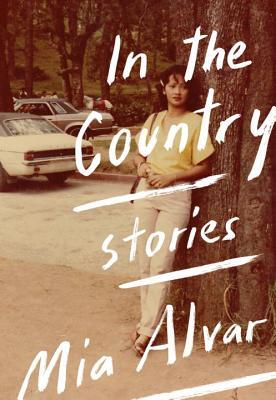
IntheCountrySo when fellow blogger Lynne from Words of Mystery offered me her copy of Mia Alvar’s short story collection In the Country, I was thrilled to discover this title. Here was a recently published book (2015!) by a major publisher (Penguin Random House!) written by a Filipino American whose stories, according to the book blurb “vividly give voice to the women and men of the Filipino diaspora.”

Here’s another confession: Alvar’s stories could have been just okay, and I still would have been liked the book, because as I mentioned, I’m starved for contemporary Filipino American literature. So imagine my thrill when I read the first story and realized Alvar’s writing is so much more than just okay — it was brilliant!

Her stories indeed “vividly give voice” to her characters, transporting the reader to locales such as Dubai or New York and describing events such that you can actually feel like you’re there. Her characters range from household helpers and young professionals in the 80s and 90s to activists in 1970s Martial Law. Filipino-ness is intrinsic and integral to her characters, without necessarily determining their stories, and references to Filipino cultural nodes like sari sari stores and telenovelas are sprinkled throughout, again intrinsic and integral to the stories without quite being the driving force. I guess that by that I mean that Alvar’s writing doesn’t quite set out to push Filipinos to the forefront, but rather takes the stories that are there and simply shares them with the world.

Given how many Filipino-American stories seem fixated on Martial Law, I found myself more drawn to her tales of Filipinos working in other countries. OFWs (Overseas Filipino Workers) form a significant part of the Philippine economy and population, and Alvar’s stories do a great job of presenting the balancing act between being away from home and forming a new home wherever you are.

I particularly love this passage from her story “Shadow Family,” about a community of Filipinas in Bahrain whose lives get upended when a flirtatious young household helper joins their group:

We too had landed vowing to stick to English — to impress others, to practice, to avoid embarrassing our children. Although the teens still found plenty to ridicule in our accents, nuns in convent school had at least taught us to pronounce our f‘s and v‘s correctly, to know our verb tenses and distinguish genders, to translate naman differently depending on the context. But at these parties we spoke Tagalog even to the babies, who barely understood it, for the same reason we served pancit and not shawarma. Between Arab bosses and Indian subordinates, British traffic laws and American television, we craved familiar flavors and the sound of a language we knew well. (p. 97)

I love the simplicity of that notion, that stubborn clinging to a language because it’s the one bit of home that you can keep, no matter what. I love it mostly because I understand it, because I understand the sense of home that can come just from hearing the sharper cadence of your language.

It’s this sense of home that I felt while reading Alvar’s stories, the sense that while the experiences she recounts are not quite my own, there are touchpoints and trademarks that resonate with familiarity. I read this collection on a train out of town one weekend, and for once, I actually wanted the journey to last longer so I could keep reading.

One question I have every time I read a book that resonates with me because of something in my background (e.g. Crazy Rich Asians), I wonder if non-Asians or non-Filipinos would respond in the same way. Is the book great just because I found familiarity within it, or would other readers also find something within it that will resonate with them? And part of me always hopes so, because that would mean that something in Filipino culture, or Asian culture in general, something far beyond the stereotypes that unfortunately are all too prevalent in books and movies, touched a chord in a broader readership. So far, I’ve lent In the Country to one non-Filipino friend, who also loved it and thought the writing was really good. Call me silly, but that response actually made my day.

In case you couldn’t tell, I absolutely loved Mia Alvar’s In the Country. Here, finally, is the book I’ve long wanted to read and, to be honest, also wanted to write. I still dream of someday joining Alvar and Hagedorn and a hopefully growing list of Filipino fictionists who have carved a space of our own in the Western literary world. In the meantime, I’m beyond glad that Alvar has written this book, and I can’t wait to see what she writes next.

+

A note that at the beginning of this year, I made a pledge to read more Asian American Women Writers. I will likely do a brief recap list nearer the end of the year rather than individual reviews for all of them, but it’s thanks to this pledge that Lynne from Words of Mystery passed this book on to me.

If you’re interested in reading more works by Asian American women, here’s the shelf I created on Goodreads, based off of Celeste Ng’s original article.

And if you have any recommendations to add to this list, in particular of Filipino writers, let me know! I’m always on the lookout for more.