
Review | MaddAddam, Margaret Atwood

17262203To end the trilogy that began with Oryx and Crake, Margaret Atwood returns to the past in MaddAddam. That is, it continues where Year of the Flood left off, with Snowman the Jimmy in a coma and Toby left as the de facto story teller for the Crakers (an all new type of humans). One of the things I love most about The Handmaid’s Tale (by far my favourite Atwood) is its insistence on the importance of stories, of words and of the power of storytelling. MaddAddam expands upon this theme with the Crakers, who are true innocents, shielded for most of their lives from the outside world and learning about reality only through the stories first of Snowman the Jimmy and now of Toby.

There is action happening in MaddAddam – the threat of Painballer (evil men) attack is ever present, the Pigoons (mutated pigs with human intelligence) also pose a physical threat, and Toby is dealing with her feelings for Zeb and a woman named Swift Fox who threatens their relationship. There’s even a strikingly emotional subplot about a woman struggling to cope with rape and abuse and a rather disturbing subplot about human women deliberately trying to impregnate themselves with a Craker baby. I was somewhat disappointed by their desperation to become mothers, as if their life wouldn’t be complete without that, but at the same time, it does raise some interesting biological issues – what new breed of human will be formed by that, and how will the child be raised within such a society?

Still, for me, MaddAddam is primarily about story telling, and more to the point, myth making. We saw a hint of it in Jimmy’s storytelling in Oryx and Crake – how he reinterprets tangible, science fiction-ish, events into myth, turning Oryx into a god and Crake into a deified Eve figure. And it makes sense – even while we know Oryx and Crake are humans like us, to the Crakers, they certainly are the creators, and therefore a form of deity. Still, in Oryx and Crake, Atwood was mostly concerned with world building, and there was plenty within those stories to catch our eye.

With MaddAddam, the world has already been created for us, and Atwood, through the character of Toby, can relax into showing in loving detail how these stories are reinterpreted. It helps that the story of Zeb and his brother Adam (Adam One) are a bit less science fiction-like than that of Oryx, Crake and Jimmy, providing us more grounding to distinguish reality from myth. Toby herself is also dealing with threats of Painballers and Pigoons, as well as her romance with Zeb, and so we are continuously being pulled out of her storytelling, and constantly see her struggling to frame real events as myths, and re-imagining interpretations of certain events in order to fit with the mythology that Jimmy had set up. I love the depiction of Jimmy’s distaste for the mythology he himself created, especially in contrast with the desire of one of the Crakers to commit all of the stories to memory, and to learn to write so that future Crakers may know it as well. This is a society coming to form, and a sacred text being written, and for us readers, being privy to the reality behind the myth holds a particular fascination.

The big, climactic scene where it all comes to a head is striking in its narrative style. Atwood chooses to have us hear it from the perspective of a storyteller, and while, having read about these characters for so long, we can imagine the harsh tones of certain points, the story is swathed in epic, and a Pigoon, who has otherwise not been featured as an individual in the trilogy, takes a pivotal role.

MaddAddam is not my personal favourite of the trilogy – I much preferred the more glamourous unreality of Oryx and Crake. But it does bring the trilogy full circle, and ends it right on the cusp of a new tomorrow.

+

Thank you to Random House of Canada for a copy of this book in exchange for an honest review.
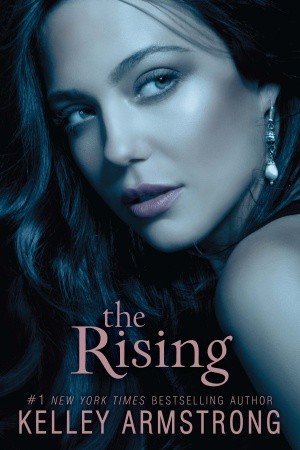
Review | The Rising, Kelley Armstrong

cover-3Kelley Armstrong’s novels have long impressed me with their strong female characters and in-depth character development amidst heart-pounding action. Her young adult fiction has impressed me even more with remarkably mature, level-headed teenagers. In The Rising, the final book of The Darkness Rising trilogy, Armstrong plunges Maya and her friends into morally obscure situations where the question of whom to trust is unclear. I loved both the first and the second books of this trilogy, and this finale lives up to expectations.

The Rising picks up right after The Calling leaves off, and leaves little room to play catch up. With so many characters, and such complex relationships, and not having read The Calling in a while, I was a bit lost at the beginning trying to remember exactly what was going on. Still, it didn’t detract much from my enjoyment of the story, and I quickly found myself sucked in. As well, I haven’t read the Darkest Powers trilogy so when Chloe and the other characters from that series showed up, I liked them as characters in this story, but I didn’t feel the same thrill of recognition I imagine I would have if I had read about them before. Often, when authors bring it characters from other books or series, the combination feels forced, and the crossover characters little more than cameo appearances. To Armstrong’s credit, the appearance of Chloe and her friends actually enhanced Maya’s story, and provided a resolution to both story lines.

The Rising also gives us deeper insight in to characters’ relationships. Maya takes a turn as a more typical angsty teen in her relationship with her biological father, but in this case, it is perfectly understandable. I absolutely love the romance that develops here, and even though the will they/won’t they aspect does get a bit old after a while, the payoff is well worth it. Armstrong also reveals how high the stakes really are, and how difficult the task for Maya and her friends: how can they find freedom from the Cabal, when the Cabal has the technology needed to help them control their powers? And is freedom even worth fighting for when it might mean reverting to a more animal state of consciousness?

There are no easy answers, and kudos to Armstrong for writing an ending that reflects that, while still satisfying the need for a resolution. In such a series as Darkness Rising, it’s difficult to pull off a quiet ending that doesn’t quite tie up all the loose ends — the temptation is to write an epic, triumphant resolution. Armstrong’s ending took me by surprise, and while she left the possibility open for a sequel, I rather wish she wouldn’t. In a series that has so far subverted so many of my expectations when it comes to YA fiction, this ending, with some remarkably mature decisions from some of the young adult characters, wraps up the trilogy perfectly.

+

Thank you to Random House Canada for a copy of this book in exchange for an honest review.

Review | The Blondes, Emily Schultz

cover-1They call it the Blonde Fury. For no apparent reason, blonde girls and women are turning into homicidal maniacs — zombies that rip people to shreds and spread death and destruction around the world. For some reason, the virus affects only females, and it affects even those with dyed hair. Emily Schultz’s The Blondes is a sharp social commentary on gender relations and the premium placed on physical beauty. Despite a concept that could quite easily have become a hilarious B movie, Schultz takes the cerebral route, a thoughtful, academic blonde zombie thriller.

Much of the tone is due to the protagonist: Hazel Hayes is a PhD candidate doing her thesis on aesthetology or “what women look like and what we think they look like.” [p. 8] Part of the story is pure zombie thriller — Hazel is pregnant and alone in the woods waiting for the wife of her baby’s father to come back for her. The Blonde Fury has taken the world hostage and Hazel is terrified about the world her baby will be born into. Yet because of her academic background, Hazel is hyper-aware of the socio-cultural issues the author brings to light. Scenes of blonde women throwing furniture around are sandwiched between flashbacks of academic discussions on the Hollywood preference for blondes during the silent film era, because dark haired women were too “ethnic,” and therefore dangerous. Beyond the immediate irony is sharp satire — why does hair colour render a woman “harmless,” and more importantly, is the preference for a more generic type of beauty systemic of a larger disenfranchisement of female power?

At one point (and tellingly before the Blonde Fury had been diagnosed), Hazel discusses her thesis with an expert in the field (also tellingly, a blonde, beautiful woman):

“Beautiful women are full of anger over their privilege,” I said. “They use deceit as a kind of trade. They receive more attention than other women, and want to be the centre of attention at all times. It’s an addiction. And like all addicts, they’re controlling and abusive, full of insecurity and rage.”

“Oh my,” Kovacs said. I think she bit her glass a little. “Is that what you really think? […] This is personal for you.” [p. 79-80]

In the character of Hazel, Schultz turns the spotlight on to the unfortunate reality that the subjugation of women is done just by men — women too are guilty of putting other women down. Hazel admits she may “simply [be] afraid of beautiful people,” and her self-awareness offers a certain perspective by which to read this book.

As a story, there are quite a few weaknesses. The virus affecting even peroxide blondes makes sense from the social commentary perspective, but makes zero sense scientifically, as does the way that shaving off hair protects you from the virus. The shifts between time periods got very confusing, and while I’m usually fine with ambiguous endings, this one just seemed to peter out.

Still, as social commentary, The Blondes is potent. Schultz subverts the stereotype of the brainless blonde by turning them into violent zombies. She also explores the fear of female power and the resulting objectification to subdue that power. In the book, the object of fear is given form — the real-life fear of women taking over corporate boardrooms and governments (and yes, unfortunately there are still people who believe a woman’s place is in the kitchen) is concretized in the characters’ fears that women will take over the world by killing everyone else. That blondes are targeted is significant, given the premium society places on blonde beauty, as stereotyped in the Barbie doll.

Perhaps most potent is the idea that the subjugation of one type of woman (in this case, blondes) eventually leads to the subjugation of all. In a twist that’s distressing because it’s so believable, women who travel are asked to present their pubic hair for inspection for any trace of blonde-ness. The degradation and the humiliation are horrific, yet is that really so far from the ridiculous amounts of security checks we go through at airports? Is that really so different from the intense scrutiny many women are subjected to on a regular basis, when their physical appearance is given primary importance?

Like any good satire, The Blondes takes elements from real life and blows them up to absurd proportions. And, as with any good satire, we soon realize that the absurdity we’d just found so humorous is far too close to reality for comfort.

+

Minor aside, just because I love it so much — kudos to CS Richardson for an amazing, amazing cover design.

+

Thank you to Random House Canada for a copy of this book in exchange for an honest review.