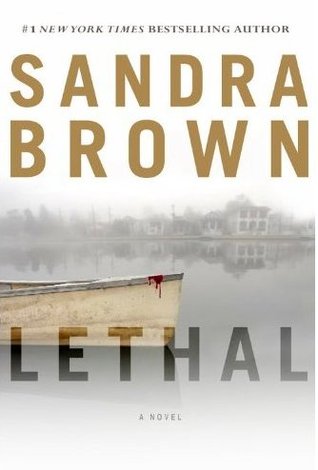
Lethalby Sandra Brown is a fun romantic thriller. Honor was enjoying a quiet day with her daughter Emily when both are taken hostage by suspected mass murderer Lee Coburn. Hardly the set up for romance, except it turns out that Lee has his own version of what happened the night of the murders. He also thinks Honor’s husband had been killed over a secret, and that that secret has now made Honor and Emily a target for The Bookkeeper, a mysterious, ruthless crime lord. Who can Honor trust, and will Coburn keep her and Emily safe? Lethal goes from plot twist to plot twist rapidly, and the chemistry between Honor and Coburn is great.
It was a bit difficult to see Coburn as a potential hero in the beginning — he was still bloodied up and injured from the evening of the murders, and he kept threatening Honor with Emily’s safety if she didn’t cooperate. So I’m glad Brown kept the sexual tension in these scenes to a minimum — we see hints of Honor and Coburn finding the other attractive, enough to set up the eventual romance, but the focus is on Honor’s fear and her concern for Emily.
Once Honor decides to trust Coburn, the story really takes off with a hunt for Eddie’s secret and to escape from The Bookkeeper. While I don’t usually like the kid characters in thrillers like this, I thought Emily was well done. Her innocence and charm help counterbalance Honor’s fear, and urge out Coburn’s softer, sweeter side. The mystery was well done — I had no idea what Eddie’s secret was, and with even Coburn in the dark, I had no idea how they could find out. I somewhat guessed the identity of The Bookkeeper before the big reveal, but that was probably more luck than anything (as in I had about three major suspects and one of them turned out to be right).
On a minor note, there’s a subplot that I loved, about the FBI agent Tom, his wife Janice and their special needs child Lanny. Tom is a desk jockey, somewhat out of his depth in a murder investigation (the manhunt for Coburn), yet hopeful that his more exciting role will impress his wife. In a touching scene, Tom suggests to Janice that they put Lanny in a facility.
…he spoke before she could. “That’s not a criticism of you. Your patience and endurance amaze me. Truly. But caring for him is killing you.”
“You’re exaggerating.”
“Am I? It’s shredding you, body and soul. I see evidence of it daily.”
“You can look into my soul?”
Her sarcasm was more effective than a flat-out rebuke would have been. [p.101]
In the midst of all the thrills and adrenaline over Honor and Coburn’s story, Brown gives us this quiet, fraught exchange between a long-married couple. It’s an intense scene, one that immediately made me care for both characters and want them to work things out. That scene ended even more sadly, with Tom going to bed and realizing his wife preferred playing word games on her phone with someone in Singapore to sleeping with him. The Tom and Janice story turned out to have a bit of a twist in the end, adding even more layers to their relationship. Personally not too happy with their part in the story, but I do like their characters.
I’m also not too thrilled with the way Lethal ended. It just felt gimmicky to me, and I wish Brown had opted for a more traditional ending. Still, I like the chemistry between Honor and Coburn, and I thought the mystery was fun and fast paced. Overall, Lethal is a fun, exciting, romantic read.
+
Thank you to Hachette Book Group Canada for a finished copy of this book in exchange for an honest review.
I like Jennifer Weiner. I like her Bachelorette tweets, and I applaud her for calling attention to the gender imbalance in mainstream book reviews. I loved In Her Shoes — that scene where Cameron Diaz’s character (who has difficulty reading) reads a poem for her sister’s wedding makes me cry every time. And yes, when I read it in the book, that scene made me cry as well.
So, when in the mood for a fun, lighthearted read, I decided to pick up Weiner’s new book The Next Best Thing. The book is about Ruth Saunders, a young writer who moves to Hollywood with her feisty grandmother and gets the green light for her sitcom, the eponymous Next Best Thing, about a young chef who moves to the big city with her feisty grandmother. Fine. A lot of writing is autobiographical, and even with the additional meta layer (meta meta?) of Weiner herself having been a screenwriter, I could deal with it. After all, I started the book looking for a fun, lighthearted read, not an earth shattering emotional tale.
Weiner adds gravitas to her character by giving her physical scars. Ruth’s parents died in a car crash when she was a child; she’d been in the car with them and her scars had never healed. In one of the few truly poignant scenes in the book, eight year old Ruth writes in her diary, “I will never be beautiful.” Personally, I thought it was a bit much — physically scarred Ruth writes about an overweight chef, hoping to inspire other girls who don’t fit the traditional idea of physical beauty. Ruth also falls in love with a man who is paralyzed from the waist down. It’s a bit heavy handed with all the physical and emotional scarring, though to Weiner’s credit, she never gets maudlin about them.
Here’s the thing though: I really didn’t like Next Best Thing. It read like a mediocre sitcom meandering from plot point to plot point yet never hitting its stride. My overall reaction: meh. And in my view, such indifference may be an even worse reaction than utter disgust. 50 Shades of Grey at least, while much, much more horribly written, at times fell into the “so bad it’s funny” category. Weiner had some funny lines — I especially love the description of one man as looking like a favourite uncle who’d bring you the latest Baby Sitters Club book, and one woman whose cleavage was big enough to hide an iPad. Overall, however, I was reminded of something a character said about the process of a screenplay being turned into a TV show: it’s a lot of waiting. Reading this felt like that, checking off plot point boxes one by one while still waiting for something to happen that’ll make you care.
The crux of the plot is that Ruth had written a screenplay that would inspire the everywoman. Her character was plus size, insecure, yet witty, and that character’s success will inspire the viewers to go for their own dreams. Hollywood takes over Ruth’s show and begin to turn it into a standard sitcom, with a size zero heroine, crazy sex-crazed elderly lady and stupid, sexist jokes.
This story could work only if we believed that Ruth’s original screenplay was worth fighting for. It’s not. We are given scenes with Ruth’s unadulterated vision, and later see her dismay at the studio’s interference, and all I could think of was that while the edits did make the show more stupid and offensive, they weren’t much worse than the original. The scene that Ruth was so proud of, an emotional, rah rah scene between the heroine and her grandmother, just sounded trite. I admit, a confrontation scene between the heroine and an ex-boyfriend did make me cheer, but that was one good moment in a TV show pilot that we’re supposed to believe would have been the next Golden Girls, if only Hollywood hadn’t interfered. It’s not. Even Ruth’s original is blah, and because of that, the stakes for the entire story are depressingly low.
As for the subplots — Ruth’s relationship with her grandmother and her crush on her boss (the aforementioned paralyzed man in a wheelchair) — again, the stakes just aren’t high enough to care. The grandmother is the most colourful, most interesting character in the book. I love the description of her waltzing into a restaurant like a movie star and the maitre’d wondering who she was. Unfortunately, she isn’t given many interesting things to do, and serves mostly to provide rah rah support to her granddaughter. Even the big conflict that put Ruth and her grandmother’s relationship at risk — while it did have the potential to be big and emotional — barely fizzles. The romance is sweet, and the sex scenes endearing, but again the conflict feels contrived and the outcome easy.
I wasn’t expecting to be blown away, but I was expecting to be entertained. Unfunny and lacklustre, The Next Best Thing failed to deliver.
I can’t say I wasn’t warned. My sister told me about this awesome tumblr where someone live blogs her reading of the Fifty Shades of Grey trilogy. Spoilers abound and yes, her reactions are pretty much spot on. Fifty Shades is as bad as people say, though the good news is, it’s often funny bad rather than boring bad. It’s best read out loud — gather a group of your best girlfriends, track down an available copy at the library (seriously, not worth spending good money on, unless perhaps there are a dozen of you and each only has to contribute a dollar or so), and make a drinking game out of it. Every time Ana bites her lip, every time Christian mutters darkly for no good reason, every time Ana’s subconscious primly purses her lips, every time Ana calls Christian “my Fifty Shades” — drink! You’ll be drunk within two chapters.
Reading Fifty Shades was, in turns, confusing, hilarious, infuriating, and most unfortunately, boring. Rather than write a long, well-thought-out review, I figure it most effective to just talk about plot points and passages that inspired a sticky note-level reaction from me. Fair warning: this post may contain spoilers and explicit material. Caveat: there isn’t much of a story arc to spoil, and there are more explicit scenes in Harlequin novels.
The first chapter (Ana interviews Christian for a school paper) confused the hell out of me. I could not understand Ana’s reactions at all.
[Christian says] “The harder I work the more luck I seem to have. It really is all about having the right people on your team and directing their energies accordingly.”
[Ana replies] “You sound like a control freak.” [page 10]
Huh? How is attributing your success to the people who work for you a sign of being a control freak? I see no reason for Ana’s reaction rather than to give Christian the opportunity to give the double entendre “I exercise control in all things, Miss Steele.”
In that same interview, Ana asks why Christian invests in farming technologies. He replies that it’s to feed those without enough to eat:
“It’s shrewd business,” he murmurs, though I think he’s being disingenuous. It doesn’t make sense–feeding the world’s poor? I can’t see the financial benefit of this, only the virtue of the ideal. [page 12]
Ana, you idiot. Yes, Christian may have a philanthropic side, but to seriously think there can be no monetary benefit to investing in farming technologies?
“Until we meet again, Miss Steel.” And it sounds like a challenge or a threat, I’m not sure which. I frown. When will we ever meet again? [page 15]
If anyone says that to me in a challenging or threatening tone, I won’t bother wondering when we’ll meet again. I’d be making sure we didn’t.
They do meet again, and Christian takes Ana to his home.
My mouth drops open. Fuck hard! Holy shit, that sounds so… hot. But why are we looking at a playroom? I am mystified. “You want to play on your Xbox?” I ask. [page 96]
This is a 22 year old college graduate. She may be a virgin, but she wasn’t raised in a glass bubble.
He steps out of his Converse shoes and reaches down and takes his socks off individually. [page 112]
Show of hands: has anyone ever tried taking their socks off any other way? I know this scene is supposed to be hot, but I kept imagining a male stripper whipping both socks off at the same time like some circus trick. Wheee!
So they have sex, and it actually is getting pretty good. Like Harlequin good. Then this passage:
Suddenly, he sits up and tugs my panties off and throws them on the floor. Pulling off his boxer briefs, his erection springs free. Holy cow… [page 116]
I couldn’t help it: I laughed. All I could think of was, ride ’em, cowboy! Then it gets worse when he puts a condom on:
Oh no… Will it? How? “Don’t worry,” he breathes, his eyes on mine. “You expand too.” [page 116]
I have to admit, it was a fun scene to read. So they continue to have sex, and it starts getting pretty hot again. Then:
“You. Are. So. Sweet,” he murmurs between each thrust. “I. Want. You. So. Much.” [page 121]
Seriously, imagine this scene for a moment. Never mind how sore Ana must be at this point, how sexy is this staccato speech?
Other things that drove me mad:
Ana’s constant lip-biting. Every other page, literally, she was either biting her lip or Christian was telling her to stop biting her lip. At one point, she smiles at another character and realizes she’d been biting her lip without noticing it. Here’s a fun exercise: stand in front of a mirror, bite your lower lip, then smile widely. You sexy thing. (I think I look like a deranged clown doing that, but apparently it turns Christian on.) By the third time or so that Christian “mutters darkly” that he wanted to bite her lip for her, I wished he would just chomp her lips off altogether and be done with it.
Christian’s obsession with food.
“I’m really not hungry, Christian…”
His expression hardens. “Eat,” he says quietly, too quietly.
I stare at him… his tone is so threatening. [page 155]
James eventually explains (kind of, like in one sentence) why Christian has such an issue about finishing food. But at this point, I was hoping for a plot twist where it turns out Christian was the witch from Hansel and Gretel. That would at least explain why he feels the need to threaten Ana to eat.
Ana whispers, bleats, murmurs, squeaks and, my personal favourite, mewls. Does anyone actually mewl in real life? How high-pitched is this girl’s voice? Worse, when she speaks, it’s always with a breathless, “oh my” quality that makes me think: wide eyed little girl. And yes, I meant girl — women, I believe, can speak up a bit more than Ana ever does. In contrast, Christian orders, mutters darkly and smirks. I’m imagining the Phantom of the Opera, except without the sexy singing voice. At one point, Ana wears pigtails, hoping that the girly look will keep Christian from being rough with her. All I could think was, dressing up younger to keep predators away? You can’t be that naive! Honestly, the way that infantilizing her turns him on, I’m thinking this book could’ve taken a much darker turn than James intended.
Ana and Christian’s flirtation over email is actually pretty good. Christian complains that Ana isn’t as forthright in person as she is over email, and I have to agree. Playful e-mail Ana is much easier to take than in-person Ana whose subconscious and inner goddess form a Greek chorus behind her.
I actually felt sorry for Christian. Little as I understand about the BDSM lifestyle, it works for some people, and clearly, for Christian as well. I don’t understand why he would try to fit Ana into that lifestyle when she’s so judgmental, calling him sick and wanting to bring him into the light. Why Ana would stick it out when she so clearly doesn’t enjoy the things that turn Christian on, and why Christian insists on being with her when she keeps making him feel like a total freak, make zero sense to me.
Finally, just for fun, Ana’s friend Jose apparently has a “dazzling toothy all-Hispanic-American smile.” It’s like E.L. James wanted to put the boy-next-door quality of “all-American,” then remembered Jose was Hispanic.
Seriously, if this book were meant as a parody of bad romance novels, parts of it would be downright clever. Instead, Fifty Shades is a parody of itself. I can’t imagine being able to parody a book that seems itself to be a parody, so I was curious how Andrew Shaffer did it with his upcoming Fifty Shades parody Fifty Shames of Earl Grey. His response:
@jacqua83 Inorite? I went in a different direction for the parody, parodying other things as well as that book…
Back to Fifty Shades: it’s not my thing. Granted, I haven’t read erotica before, nor have I read BDSM romance novels. I do read romance novels, and personally think Nora Roberts, Jayne Ann Krentz and Judith McNaught write better romances. For steamy romance, I’ve read better sex scenes in Harlequin Blaze.
Worst part about Fifty Shades is that, despite all the laugh out loud moments, the book becomes boring. The conversations, the flirtations, the sex scenes most of all, become redundant. Ana bites lip, Christian mutters darkly, Ana’s subconscious purses her lips, Ana and Christian have sex, Ana says “oh my,” Ana’s inner goddess dances the merengue or the salsa or the macarena, Christian wants to spank, Ana says “oh my,” Ana’s inner goddess hides behind a sofa. Rinse. Repeat. Over and over and over again. Funny bad tapers off into boring bad, and that’s the worst thing that can happen.
I am glad that I read Fifty Shades. It was mostly entertaining, and while I often wished I had a drink with me, there were enough funny parts to keep me turning the page. Erotic? In over 500 pages, maybe a scene or two. The BDSM scenes were especially un-erotic, partly perhaps because it’s not really my thing, but mostly, I think, because Ana so completely hates it (yet allows it to happen) that these scenes felt more uncomfortable than anything. Romantic? The email exchanges were fun and flirty, but overall, not very. Will I ever read Fifty Shades Darker and Fifty Shades Freed? Out loud, with a group of friends, a library copy and a lot of booze — then yes, possibly.
Personally, though, this may be a much more interesting read.
Or, check out Selena Gomez’s spot-on parody at Funny or Die. Not only did she mimic Ana Steele perfectly, but this video is much more entertaining than the book:
 Lethal by Sandra Brown is a fun romantic thriller. Honor was enjoying a quiet day with her daughter Emily when both are taken hostage by suspected mass murderer Lee Coburn. Hardly the set up for romance, except it turns out that Lee has his own version of what happened the night of the murders. He also thinks Honor’s husband had been killed over a secret, and that that secret has now made Honor and Emily a target for The Bookkeeper, a mysterious, ruthless crime lord. Who can Honor trust, and will Coburn keep her and Emily safe? Lethal goes from plot twist to plot twist rapidly, and the chemistry between Honor and Coburn is great.

 Literary Treats