Review | The Beginner’s Goodbye, Anne Tyler

There is no such thing as the Beginner’s Guide to Grief. No such thing as Grief for Dummies. Sure, there are the five stages of grief, but really, they don’t help. Nothing can prepare you for the loss of a loved one, and while dealing with the loss might get easier over time, it will never become easy. Anne Tyler’s The Beginner’s Goodbye is a moving, beautifully written portrait of grief, a story of loss and the desire to put off the goodbye as long as possible.

When Aaron Woolcott loses his wife Dorothy in a freak accident, he finds peace only when she reappears. It’s not a ghostly encounter, nor has he forgotten that she’s died. It’s just, one moment she isn’t there, and the next moment, she is, and her presence gives him peace. Be honest: if someone you’ve loved and lost shows up again, can you imagine telling them to go away?

I originally thought The Beginner’s Goodbye was going to be about Dorothy showing up again, and about Aaron wondering if she’s real or not, but I’m glad that wasn’t the case. Rather, much like her reappearance in Aaron’s life, Dorothy remains mostly a presence in this story — she exists, but the story is really Aaron’s and those around him.

Tyler’s simple, straightforward narrative style keeps her story from ever becoming maudlin. Rather, it feels honest. So often while reading, I would nod and think, yes, I can relate. For example, Aaron hires a contractor to fix his house, but keeps making excuses about why he doesn’t have to be there to oversee the work. That house, after all, is a reminder of how Dorothy had died, and it’s only natural to want to stay away, even past the point of common sense — Aaron, now living with his sister, has to ask the contractor to bring over some of the clothes he’d left behind. A short dialogue, but very, very telling, and an example of how effectively Tyler uses the smallest details to show so much.

I also love this passage:

I realized that I had survived [the loss]… Even though I still felt a constant ache, I seemed unknowingly to have traveled a little distance  away from that first unbearable pain…

And yet, just two nights later, I had one of those dreamlike thoughts that drift past as you’re falling asleep. Why! I thought. Dorothy hasn’t phoned me lately!

…But then I came fully awake and I thought, Oh. She’s dead. And it wasn’t any easier than it had been at the very beginning.

Ever had that happen to you? It sucks.

Coming to terms with Dorothy’s death also means coming to terms with her life, and with their life together. Right after her death is Aaron’s realization that all the idiosyncrasies that had bothered him actually aren’t a big deal after all, and it takes time before he can step back enough to get a more realistic, balanced view of their life together. We meet Dorothy through Aaron’s memories, and through his perception of her after death, and it is through meeting both versions of Dorothy that we learn about Aaron. To be honest, I don’t think I ended up actually liking either character (Dorothy’s really cold, and Aaron, for all his desire for independence, is really needy), but I did believe in them. Tyler makes them feel real.

I wasn’t too happy with the turn the plot took towards the end, but by the time I finished the book, the ending did feel right. I also love the subplots involving the other characters — as anyone who grieves is forced to learn, other people’s lives go on, even while yours feels at a standstill. Seeing other people fall in love is both touching and bittersweet, as we view it through Aaron’s eyes.

The Beginner’s Goodbye is a short book, only about 200 pages, which reminds me of Julian Barnes’ Sense of an Ending. No similarities in the story or writing style, and the Barnes book had much more dramatic twists than Tyler’s. But, similar to Sense of an EndingThe Beginner’s Goodbye is a lazy afternoon read that delivers an emotional punch.

Review | Why Men Lie, Linden MacIntyre

Why do men lie? After several failed relationships, Effie MacAskill Gillis believes she knows, at least until she runs into an old friend JC Campbell and risks getting into a romantic relationship again. Linden MacIntyre’s Why Men Lie doesn’t really provide a definitive answer to the question; rather, the feeling one gets after reading the novel is that everyone lies, and usually for no really good reason. If you’ve read The Bishop’s Man, you may recognize Effie as the sister of Bishop’s Man protagonist Father Duncan. In Why Men Lie, Duncan is still disillusioned with the Catholic church, and lives in a homeless shelter to help the residents.

Why Men Lie is a bit of a downer. Despite Effie’s confidence that her experience has shielded her from future hurt, she is unable to see the extent of JC’s temper issue. We get a glimpse into her troubled childhood, as well as her previous romantic relationships, where, at various moments, she could identify with Bill Clinton, Hillary Clinton and Monica Lewinsky. I loved that description, yet also felt somewhat let down by it. For someone so reluctant to trust, Effie herself doesn’t seem trustworthy, and it’s precisely the reality of that moral ambiguity that MacIntyre emphasizes. We are presented with a deeply flawed, sympathetic character in Effie, which makes it all the more tragic when you realize that the men in her life — JC and Duncan, for example — are both hiding things from her. She is extremely guarded and suspicious, yet it appears she has every reason to be. There’s a sinking feeling throughout that this story isn’t headed toward a happy ending.

Why do men lie? Many reasons, and we learn that women are hardly exempt from dishonesty either. MacIntyre is less interested in the reasons behind lying than in the way men and women mature — according to one character, men are more likely to remain unchanged than woman are. Why is JC obsessed with an American death row inmate, and are his physical altercations indicative of a bad temper or merely rotten timing? And how far back do JC’s deceptions actually go? Why Men Lie is about growing old; it’s about reflecting on one’s past and realizing that you now view these events differently. It’s about coming to terms with one’s past and trying to give a sense of purpose to the rest of one’s life.

I can imagine Why Men Lie making the literary prize shortlists. It’s well-written, complex and with characters so real that you can imagine them living next door. Personally, it didn’t blow me away. I felt for the characters, but didn’t really feel invested in the story or compelled to keep turning the pages. I found it a slow read, which I normally don’t mind, but in this case, I kept wishing for a bit of humour, or at the very least, a quirky character trait, to break the mood. Still, like I said, it’s a well-written story, and if you liked Bishop’s Man, you’ll love seeing how these characters’ lives turn out.

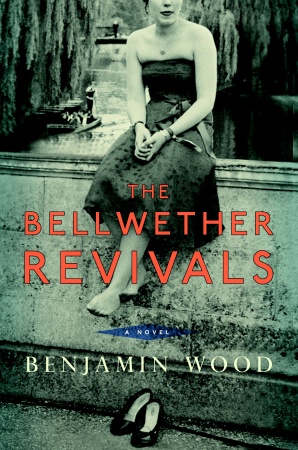
Review | The Bellwether Revivals, Benjamin Wood

Ever read a book you love so much it takes you forever to write a review for it? A book so amazing that you realize whatever you can write just won’t give it justice. That’s how I felt after reading Jo Walton’s Among Others, and that’s why it took me weeks to figure out what to write about Benjamin Wood’s amazing debut novel The Bellwether Revivals

Publisher McClelland and Stewart calls the book “part Brideshead Revisited” — how could I resist? The parallels to Brideshead are clear — nursing home care worker Oscar Lowe is drawn to the Bellwethers, a wealthy family of academics. He falls in love with Iris Bellwether, a Cambridge student, and befriends her brother Eden and their group of friends. Cambridge in fact becomes almost a character itself in this novel — characters speak of it so lovingly, so knowledgeably, that it almost takes on the mystique of Brideshead. Like Oscar, we are attracted to this world where we don’t need to worry about putting food on the table; rather, we can spend hours debating philosophy and discussing literature. The novel is set in the early 2000s, but something about the way Wood writes makes the story feel like it was set in the past. Perhaps this insulated world Oscar inhabits with Iris, Eden and their friends insulates us as well, provides us as much of an escape as it does Oscar.

With the Brideshead comparison, I was expecting the book to be mostly about Oscar’s relationship with the Bellwethers, but the story takes a much darker turn. The very first chapter, “Prelude,” does give us an idea of the tragic outcome at the end — Eden Bellwether is “still breathing, but faintly,” there are other bodies around, and Oscar says, “It’s over now…We can’t go back and change it.” What happened? We don’t know, but we know the story won’t end well. I agree with this blog review that revealing the end in advance allows us to then focus on the nuances within the events. From a lovely tale of romance and privilege, we are introduced into a chilling story of psychopathy.

Much of Bellwether Revivals focuses on music, something hinted at by the prologue being called a “prelude.” When we are introduced to the Bellwethers, it’s because Oscar is drawn to a church where Eden is playing the organ. I love Wood’s description: “There was a fragility to this music, as if the organist wasn’t pressing down on the keys but hovering his fingers above them like a puppeteer.” I imagine thready, tentative notes, and almost ethereal melody with the power to cast spells.

Eden is a gifted musician, but more than that, he believes music has the power to heal. Literally. Many acknowledge the power of music to bring comfort and influence emotions, but Eden, influenced by the ideas of Johann Mattheson, believes music can actually, physically affect behaviour. He says Oscar entered the church not just because of a generic attraction to Eden’s music, but because the music was specifically designed to get someone to enter a church and sit down. It’s a disturbing notion, one we could easily dismiss as utter nonsense, yet it also offers an intriguing possibility of hope. What if music can do more than just comfort those with terminal illnesses? What if music can actually remove tumours, reverse Alzheimer’s? What if music can, literally, heal? Eden firmly believes it can, and that he can create such music.

Iris believes her brother is a narcissist, as in actually has a psychological disorder and isn’t just being arrogant, and she turns to Oscar for help. To be honest, I thought her insistence on her brother’s psychopathy was a bit odd — it seemed a harmless enough belief, and I wasn’t sure why she was so determined to have her brother examined. I also didn’t really understand why Oscar was so willing to be involved. I found the romance between Iris and Oscar the weakest element in the story — I saw that he was attracted to her, but I didn’t really see how he became so devoted to her so quickly. I didn’t really see him in love, which bothers me mostly because he ends up having to go to such lengths to help her out in this story. That being said, it wasn’t enough to turn me off from the story, because all the other plot lines were so gripping.

As we learn more about Iris and Eden’s childhood, and as Eden takes his belief in music’s healing ability to even greater extremes, we begin to understand that Eden isn’t quite as harmless as we may have thought. One of the most fascinating characters in the novel is Dr. Herbert Crest, a psychologist who has studied Narcissistic Personality Disorder and who, losing his personal battle with cancer, is writing a book Delusions of Hope, about his failure to find an alternative cure for his condition. This makes him a prime candidate for Oscar to approach for help regarding Eden; perhaps Dr. Crest can expose Eden as a fraud. Or, perhaps, can Eden possibly prove Dr. Crest wrong?

Here’s the thing: Eden’s charisma affects even us. What if Eden isn’t a fraud? What if his music really can heal people? A rational part of my mind kept insisting that his ability couldn’t possibly be real, and yet another part of me couldn’t help but hope it was. As Dr. Crest says, “Hope is a form of madness. A benevolent one, sure, but madness all the same.” Yet it is a madness that we almost want to embrace. I’ve lost several loved ones to cancer, I also know others who have survived it, and I can’t even begin to describe how much I think cancer just really, really sucks. So when we have a character who might, conceivably, have the ability to cure cancer with music, well, it’s a seductive idea. Even within fiction, the tiniest, slimmest chance of a cure is offered, and yes, I want to believe in it. Eden, to me, had his controlling, arrogant moments, but I also wanted to believe he was a hero, that he did have this power, that, even in fiction, cancer could be conquered.

The potential of Eden’s power seduced me, and the reality of Eden’s megalomania devastated me. His desperation to have his power proven right, and to be viewed as a hero and a healer, leads to some truly horrifying acts. I think it’s because I was so sucked into this world that I was affected so completely. It was almost painful to be so disillusioned by Eden, not so much with regard to the veracity of his healing power, as with the realization that Eden is ultimately only after power.

I absolutely love Bellwether Revivals! A powerful, gripping story that seduces us much as the charismatic, frightening Eden Bellwether casts a spell over the people around him. In so many ways, Eden is a predator, and like any predator, he also has the ability to lure his victims. Bellwether is chilling because we realize how easy it is to be sucked in, indeed to want to be sucked in. For the reader, as for the characters, the return to reality is painful, but necessary. Difficult to believe this is a debut novel. Benjamin Wood is definitely an author to watch, and I can’t wait to see what he comes up with next.

Follow Benjamin Wood on Twitter: @bwoodauthor.