
Review | The Watch, Joydeep Roy-Bhattacharya

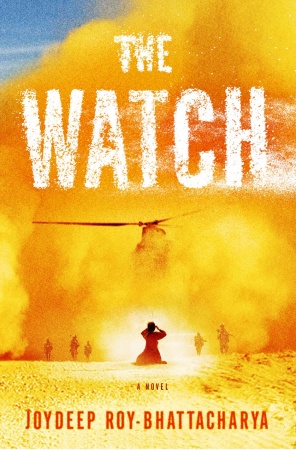
The Watch relates the account of an incident during the Afghan war from multiple perspectives. A legless woman, called Antigone by the other characters, has dragged herself over twenty kilometers to an American outpost, in order to request the body of her brother for a proper burial. Her brother, however, is a suspected Taliban insurgent, and higher ups have ordered the American soldiers to send the body over, so that they can have incontrovertible proof of the man’s death. The soldiers also view Antigone with suspicion — is she really there for her brother, or is she a Taliban decoy? Seeing the story first from Antigone’s perspective, then from the perspective of various soldiers, reveals how complex the situation is, and how horribly war affects people on both sides.

It’s pretty powerful material, and raises some important observations about the experiences of war. There are things I liked about it, and I could see what Roy-Bhattacharya was trying to do, but overall, the book just didn’t really grab me. I think it may be a matter of personal preference, and I can see other readers being really affected by this book, possibly even having their lives changed.

The woman’s name is Antigone, and that’s pretty much an indication of the style employed in the book. The language is lyrical, the first chapter in particular, which was narrated by Antigone, highly emotional. The other chapters, all in first person narratives, with the narrator generally identified by his rank, each had its striking, poignant moments. For me, the glimpse into each character’s experience of Antigone’s stand is not as interesting as the glimpse into each character’s back stories. A couple stood out — the story of a soldier who had met his girlfriend in a classics course, and whose girlfriend had left him while he was stationed abroad, and the story of the Afghan interpreter, who faced derision from the American soldiers with him.

The overall story picks up as well in the end, particularly with the chapter from the captain’s perspective. That final chapter gives a rather harsh commentary on chains of command and the dictum to soldiers to obey orders without question. When lower ranking officers raise reasonable objections to unreasonable orders (i.e. to withhold the brother’s body from Antigone), when they argue for idealism, and when the higher ups are revealed to possibly have hidden agendas, the entire structure and purpose of the American garrison in Afghanistan is challenged. At the same time, however, particularly in the final chapter, you can’t help but be caught up in the fear and paranoia — who can you trust, in a situation of war?

Overall, however, while each chapter had its interesting moments, the consistent shifts in viewpoint kept the story from really gelling for me. Aside from the Afghan translator and Antigone herself, I found it difficult to tell the other characters apart. I’m sure the various narrators showed up again in other chapters, particularly in the last one, but they were generally so interchangeable that I found it difficult to recognize and therefore care for each soldier beyond his own chapter. Overall, the characters were more like tropes than people — this is most probably deliberate on Roy-Bhattacharya’s part, given the association with Antigone, but it kept me detached.

Like I said, it’s possible that it’s just not my kind of book. Other reviews have, I think, been more positive:

The Independent
Publisher’s Weekly
NPR
Goodreads

+

Thanks to Random House Canada for the ARC of this book, provided in the goodie bag at the awesome RHC Blogger Love Fest.
Review | In One Person, John Irving

“My dear boy,” a character tells Billy, the narrator of John Irving’s In One Person“My dear boy, please don’t put a label on me — don’t make me a category before you get to know me!” If only such a statement were no longer relevant today; if only such sentiment were limited to the 70s and 80s, when Billy was growing up. Unfortunately, homosexuality is still a big issue; unfortunately, there are those who still regard it as unnatural, even immoral. Society has taken big steps since the one Billy refers to when he says “I might take seriously the idea of service to my country when my country begins to demonstrate that it gives a shit about me!” Homosexuality is no longer considered a psychiatric ailment, for example, nor is it a criminal act. Still, gay marriage remains a hot button topic in many US states, and publicly funded Catholic schools in Ontario continue to fight the establishment of Gay Straight Alliances. I wish I could say that Billy’s story in In One Person shocked and appalled me, yet all I could think of is how relevant it still is today.

An interesting twist in Irving’s book is that Billy isn’t just gay, he’s bisexual. I never really thought about how that might be more difficult than being homosexual, so Billy’s perspective made me think. Billy writes that he faces discrimination from gay men, who believe he is hiding his attraction only to men behind the veneer of also being attracted to women. So he feels he doesn’t completely fit in either with the gay community or with the straight one. It’s an especially narrow form of isolation.

In One Person begins with Billy’s childhood. I love how his stepfather introduces him to the library, and basically encourages him to find himself there. As a booklover, I especially love this line about reading, spoken by the librarian Miss Frost:

Savor, don’t gorge. And when you love a book, commit one glorious sentence of it — perhaps your favorite sentence — to memory. That way you won’t forget the language of the story that moved you to tears.

I wish I’d done that more often.

I love that Billy’s stepfather takes him to the library to help him find the answers about why he has “crushes on the wrong people.” I especially love that while the well-meaning stepfather tells Billy that “there are no ‘wrong’ people to have crushes on,” Miss Frost replies, “are you kidding? … On the contrary, William, there is some notable literature on the subject of crushes on the wrong people.” She was referring to Wuthering Heights and Jane Eyre, rather than to the homosexual crushes Billy meant, yet it does bring up an interesting point — the problem of restricting people’s behaviour goes far beyond the gay community. At various points in history, race, class and all sorts of other issues were raised as barriers to people’s happiness. The shame Billy feels about his “crushes on the wrong people” is not just a homosexual problem; it’s a human one, and I love that a library, of all places, provides venue for such insight.

In One Person is a tribute as well to other forms of art as venues for freedom of expression. Along with Billy’s finding comfort and understanding with Miss Frost in the library, Irving also gives us community theatre. As an Agatha Christie fan, I personally would have liked to see on stage the Christie plays Irving derides, but fine, Ibsen and Chekhov may well provide more dramatic value for the story. I love how theatre gives Billy’s grandfather the freedom to dress and act as a woman — he may have to hide his sexuality in real life, but on stage, he’s a star when he dons women’s clothing. Billy does notice how some in the audience, who are friends of his grandfather, cannot hide their looks of disgust at the cross dressing, and that unfortunately keeps this story realistic. The grandfather is a compelling, delightful character, and the image of an elderly man totally in his element onstage in women’s clothing is rather touching.

The novel is especially poignant because it’s partly set in the 80s, right at the height of the explosion of AIDS into mainstream consciousness. This is long before Jonathan Larson raised a glass “To people living with, living with, living with / Not dying from disease,” when AIDS was much scarier and more mysterious than it is now, when having it was a death sentence. And because people didn’t really understand how HIV was transmitted, there was a moralistic element to the fear as well — AIDS was thought of as a disease limited to homosexuals. In Irving’s novel, Billy reflects that it’s no longer no big deal to have a nosebleed during a wrestling match. It’s sad, yet understandable, to see the men in the wrestling club with him viewing Billy’s blood with fear yet at the same time be too polite (too thoughtful, maybe?) to actually come right out and admit it.

AIDS is a horrible illness, with tragic consequences not just to the patient, but to the patient’s loved ones. At one point, a character says that you shouldn’t leave a loved one alone in a room with the deceased, especially when the aforementioned loved one is a widowed mother with no other children. The reason behind that is absolutely, horrifyingly, tragic. That scene almost made me cry.

In One Person does get to be too much like a manifesto at times — I felt like we get the point, move on with the story — and characters put it to forward the novel’s argument. Still, overall, it’s a powerful book, and beautifully written. And the arguments it makes still most definitely need to be heard.

+

Thank you to Random House Canada for an ARC of this book in exchange for an honest review.

Review | The Absolutist, John Boyne

It takes great courage to fight for your country, but sometimes it takes even greater courage to refuse to fight. An absolutist, according to Corporal Wells, a character in John Boyne’s The Absolutist, goes “one step beyond conscientiously objecting.” I’ve heard of conscientious objectors — conscripted soldiers who are morally opposed to fighting in a war, and therefore opt to serve their country is less violent ways, i.e. working in hospitals. An absolutist, on the other hand, Wells says, is “at the far end of the spectrum… He won’t do anything at all to further the war effort. Won’t fight, won’t help those who are fighting, won’t work in a hospital or come to the aid of the wounded.”

A long time soldier, Wells considers absolutism as “cowardice on the most extreme level,” and on one hand, it’s easy to see where he’s coming from. Here are men risking their lives every day to fight the Great War (World War I, before the world even dared consider the possibility of a World War II) and keep their country safe — it’s completely understandable that they would resent those who refuse to fight and therefore stay away from enemy fire. On the other hand, for someone who truly believes that anything to do with the war is immoral, there is also much courage in being able to look at your fellow soldiers, all of whom are pressuring you to join in, and just say no.

When I first read the publisher’s description of The Absolutist, which says that a soldier, Tristan, has a secret he is working up the courage to confess to the sister of his fellow soldier Will, I thought that the big secret was going to be that Tristan and Will have a romantic relationship. (I’m not posting a spoiler one way or the other; this is just what I guessed would happen from the publisher’s description.) The story, after all, was set at a time when there was still a social stigma against homosexuality (sadly, that stigma still hasn’t been completely eradicated). Boyne does touch on the difficulties of being in love with a fellow soldier of the same sex, and I love how faithful he is to the language of the era. Delicate rather than overt, much like E.M. Forster’s suggestion of same-sex romance in A Passage to India, Boyne’s writing emphasizes how much Tristan has to hide his sexuality, even as other characters are free to broadcast their homophobia.

However, The Absolutist shows that there are much more dangerous confessions than coming out as gay. While being gay is seen by the soldiers in the novel as an object of ridicule, being an absolutist is viewed as a betrayal. Will is conscripted into the army and from the very beginning, launches formal proceedings to be recognized as an absolutist and released from military duty. There’s something appealing about his being so honest about his intentions, especially in the world of confusion and chaos of the Great War. And when he witnesses something so terrible he demands justice, you realize how heroic he is.

Yet the best thing about Boyne’s writing is that he offers no easy answers. While we applaud Will’s unwavering morality, Boyne also immerses us in the atmosphere of horror and fear that the other soldiers endure. In one scene, Tristan is talking to a fellow soldier when “I am immediately rendered blind by what feels like a bucket of hot mucus being chucked in my face.” The other soldier has just been shot in the head, “one eye completely gone — somewhere on my person, I suspect — the other hanging uselessly from its socket.” Just reading that made me shudder — I don’t even want to imagine how it would feel to live it day after day after day. How can I blame the soldiers who resented Will refusing to take part in any aspect of the war effort? Yet how can I accept how horribly they in turn reacted to Will’s objection?

What is cowardice? What is heroism? When you’re down in the trenches, should your loyalty be to an idea or to people? Where is the line between understanding someone and excusing his behaviour? The Absolutist raises more questions than it answers, and creates a web of morality that is as ambivalent as it is realistic. And the moment when we learn Tristan’s secret — and his motivation behind it — is, for me, probably the most heart wrenching scenes in the novel. A powerful ending to a very complex tale.