
Review | The Rising, Kelley Armstrong

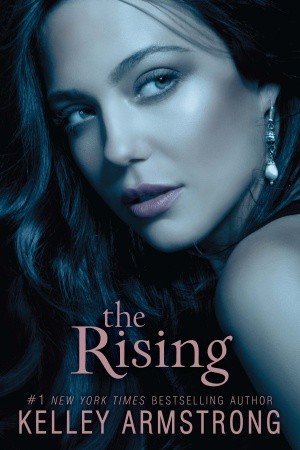
cover-3Kelley Armstrong’s novels have long impressed me with their strong female characters and in-depth character development amidst heart-pounding action. Her young adult fiction has impressed me even more with remarkably mature, level-headed teenagers. In The Rising, the final book of The Darkness Rising trilogy, Armstrong plunges Maya and her friends into morally obscure situations where the question of whom to trust is unclear. I loved both the first and the second books of this trilogy, and this finale lives up to expectations.

The Rising picks up right after The Calling leaves off, and leaves little room to play catch up. With so many characters, and such complex relationships, and not having read The Calling in a while, I was a bit lost at the beginning trying to remember exactly what was going on. Still, it didn’t detract much from my enjoyment of the story, and I quickly found myself sucked in. As well, I haven’t read the Darkest Powers trilogy so when Chloe and the other characters from that series showed up, I liked them as characters in this story, but I didn’t feel the same thrill of recognition I imagine I would have if I had read about them before. Often, when authors bring it characters from other books or series, the combination feels forced, and the crossover characters little more than cameo appearances. To Armstrong’s credit, the appearance of Chloe and her friends actually enhanced Maya’s story, and provided a resolution to both story lines.

The Rising also gives us deeper insight in to characters’ relationships. Maya takes a turn as a more typical angsty teen in her relationship with her biological father, but in this case, it is perfectly understandable. I absolutely love the romance that develops here, and even though the will they/won’t they aspect does get a bit old after a while, the payoff is well worth it. Armstrong also reveals how high the stakes really are, and how difficult the task for Maya and her friends: how can they find freedom from the Cabal, when the Cabal has the technology needed to help them control their powers? And is freedom even worth fighting for when it might mean reverting to a more animal state of consciousness?

There are no easy answers, and kudos to Armstrong for writing an ending that reflects that, while still satisfying the need for a resolution. In such a series as Darkness Rising, it’s difficult to pull off a quiet ending that doesn’t quite tie up all the loose ends — the temptation is to write an epic, triumphant resolution. Armstrong’s ending took me by surprise, and while she left the possibility open for a sequel, I rather wish she wouldn’t. In a series that has so far subverted so many of my expectations when it comes to YA fiction, this ending, with some remarkably mature decisions from some of the young adult characters, wraps up the trilogy perfectly.

+

Thank you to Random House Canada for a copy of this book in exchange for an honest review.

Review | The Blondes, Emily Schultz

cover-1They call it the Blonde Fury. For no apparent reason, blonde girls and women are turning into homicidal maniacs — zombies that rip people to shreds and spread death and destruction around the world. For some reason, the virus affects only females, and it affects even those with dyed hair. Emily Schultz’s The Blondes is a sharp social commentary on gender relations and the premium placed on physical beauty. Despite a concept that could quite easily have become a hilarious B movie, Schultz takes the cerebral route, a thoughtful, academic blonde zombie thriller.

Much of the tone is due to the protagonist: Hazel Hayes is a PhD candidate doing her thesis on aesthetology or “what women look like and what we think they look like.” [p. 8] Part of the story is pure zombie thriller — Hazel is pregnant and alone in the woods waiting for the wife of her baby’s father to come back for her. The Blonde Fury has taken the world hostage and Hazel is terrified about the world her baby will be born into. Yet because of her academic background, Hazel is hyper-aware of the socio-cultural issues the author brings to light. Scenes of blonde women throwing furniture around are sandwiched between flashbacks of academic discussions on the Hollywood preference for blondes during the silent film era, because dark haired women were too “ethnic,” and therefore dangerous. Beyond the immediate irony is sharp satire — why does hair colour render a woman “harmless,” and more importantly, is the preference for a more generic type of beauty systemic of a larger disenfranchisement of female power?

At one point (and tellingly before the Blonde Fury had been diagnosed), Hazel discusses her thesis with an expert in the field (also tellingly, a blonde, beautiful woman):

“Beautiful women are full of anger over their privilege,” I said. “They use deceit as a kind of trade. They receive more attention than other women, and want to be the centre of attention at all times. It’s an addiction. And like all addicts, they’re controlling and abusive, full of insecurity and rage.”

“Oh my,” Kovacs said. I think she bit her glass a little. “Is that what you really think? […] This is personal for you.” [p. 79-80]

In the character of Hazel, Schultz turns the spotlight on to the unfortunate reality that the subjugation of women is done just by men — women too are guilty of putting other women down. Hazel admits she may “simply [be] afraid of beautiful people,” and her self-awareness offers a certain perspective by which to read this book.

As a story, there are quite a few weaknesses. The virus affecting even peroxide blondes makes sense from the social commentary perspective, but makes zero sense scientifically, as does the way that shaving off hair protects you from the virus. The shifts between time periods got very confusing, and while I’m usually fine with ambiguous endings, this one just seemed to peter out.

Still, as social commentary, The Blondes is potent. Schultz subverts the stereotype of the brainless blonde by turning them into violent zombies. She also explores the fear of female power and the resulting objectification to subdue that power. In the book, the object of fear is given form — the real-life fear of women taking over corporate boardrooms and governments (and yes, unfortunately there are still people who believe a woman’s place is in the kitchen) is concretized in the characters’ fears that women will take over the world by killing everyone else. That blondes are targeted is significant, given the premium society places on blonde beauty, as stereotyped in the Barbie doll.

Perhaps most potent is the idea that the subjugation of one type of woman (in this case, blondes) eventually leads to the subjugation of all. In a twist that’s distressing because it’s so believable, women who travel are asked to present their pubic hair for inspection for any trace of blonde-ness. The degradation and the humiliation are horrific, yet is that really so far from the ridiculous amounts of security checks we go through at airports? Is that really so different from the intense scrutiny many women are subjected to on a regular basis, when their physical appearance is given primary importance?

Like any good satire, The Blondes takes elements from real life and blows them up to absurd proportions. And, as with any good satire, we soon realize that the absurdity we’d just found so humorous is far too close to reality for comfort.

+

Minor aside, just because I love it so much — kudos to CS Richardson for an amazing, amazing cover design.

+

Thank you to Random House Canada for a copy of this book in exchange for an honest review.
Review | The Twenty-Year Death, Ariel S. Winter

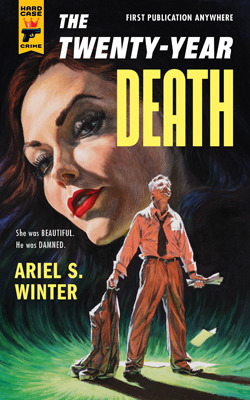
13089521I really, really wanted to like this book. When I first heard about it, I immediately begged Random House for a review copy. As a lifelong mystery fan, I was immediately hooked by Ariel S. Winter’s concept: three complete mystery novels, each set in a different decade, each told in the style of a famous mystery writer from that decade, and yet all part of a single 700-page story. Seriously. A daring idea, an amazing hook, and I applaud the author for coming up with it.

Unfortunately,  The Twenty-Year Death failed to live up to its (admittedly ambitious) promise. To be fair to Winter, noir/hard-boiled isn’t a mystery genre I’m very familiar with, so it’s possible this book is just not my cup of tea. Also to be fair, while I am familiar with Raymond Chandler (one of the authors Winter mimics), I’ve never read Georges Simenon and Jim Thompson, the other two authors Winter imitates. So I am unable to say how successful Winter was in either paying homage to or re-interpreting the genre, and these writers’ works in particular. Rather, I read it as a standalone book, hoping to discover a new and exciting mystery writer.

The three books within Twenty-Year Death tell the story of Clotilde and Shem Rosenkratz. In the Simenon-style Malniveau Prison (Book 1), the year is 1931 and Clotilde’s father has been murdered in a gutter, but he was supposed to have been locked up in a prison and no escapes had been reported. Chandler-esque Book 2, The Falling Star, takes place in 1941 — Clotilde, stage name Chloe Rose, is in a Hollywood movie and fears for her life, and a PI steps in to investigate. Book 3, Police at a Funeral, mimicking Thompson, turns the spotlight on Shem, an alcoholic writer whose life is basically falling apart.

Despite the overarching storyline, it’s difficult to review this book as a whole, because each story within is so different from the others. While Clotilde and Shem appear in all three novels, they are minor characters until the last book — the action is somewhat driven by them, but we never really get invested enough in either of them to really care about them as characters. The three plots are disjointed, and having Clotilde and Shem in all three books just gives the impression that they are the unluckiest couple ever.

I’m generally a fan of police procedurals, so the introspective Malniveau Prison is probably most to my taste. However, while the puzzle was intriguing enough, the story just didn’t hook me. I was bored, and after several tries, gave up on finishing this story. The Falling Star, with its Hollywood glamour and soap opera subplots, actually turned out to be my favourite of the three. The story was intriguing, but ultimately unmemorable. Police at a Funeral may have suffered from being the last story in a largely underwhelming but lengthy book. I admit: if it hadn’t been a separate story, but just the end of a single long novel, I wouldn’t have read that far. So I did decide to give it a chance, but, in all honesty, didn’t have much patience for it. The main character was Shem, who I really didn’t like, even when he appeared in the first two books. And while I don’t believe that all protagonists should be likeable, I also didn’t care enough about this man’s story to read beyond the hundreds of pages I’d already read about it. I gave up on this third novel fairly early.

Part of it may be the writing style. Winter had set out to mimic three classic writers, and while I am unable to tell if he succeeded in that, I thought that by the third book, his writing style was fairly standard throughout. I figure that even with the homage to various writers, a distinct Ariel S. Winter style still came through. Unfortunately, while his writing is solid enough, it just isn’t compelling. It’s okay, but that’s it. I do wonder how it would be if he didn’t bother with the homage at all, and simply wrote an original mystery. It’s possible I might have enjoyed that better.

Overall, a disappointment. Again, in fairness, it may just not be my type of mystery, or perhaps Winter was constrained by certain stylistic conventions to which he was paying homage. Still, the overarching story just wasn’t compelling enough to merit three separate novels within a novel. As well, and this is an unfortunate yet perhaps expected reaction to Winter’s project no matter how well or poorly executed: I couldn’t help thinking, if all this is is an imitation of three classic writers, why not just read the originals?

+

Thank you to Random House Canada for a copy of this book in exchange for an honest review.