
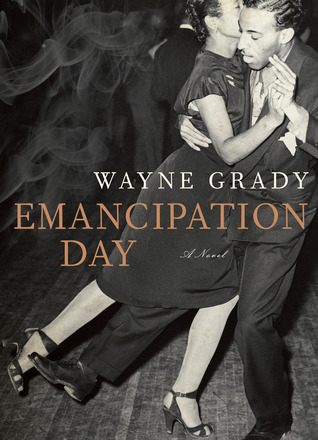
Review | Emancipation Day, Wayne Grady

16169861Wayne Grady’s Emancipation Day is a thought-provoking novel on race and racism in Windsor, Ontario in the 1950s. Jack Lewis is light-skinned enough to pass for white, and despite his mother’s protests that she never slept with another man, his father rejects him for the first month or so of his life. In the highly racialized society of his time, Jack grows up belonging nowhere – the black neighbourhood children refuse to play with him, and he resorts to bribing white children (who generally lived in a more affluent neighbourhood) to let him into their gangs. Jack desperately tries all his life to escape his heritage, even joining a band called the “All Whites” and identifying himself to everyone as white.

The novel focuses on Jack’s relationship with Vivian, a Newfoundland woman whom he meets while in the Navy, and who marries him despite her reservations regarding his secretive nature. Even when she moves with him to Toronto and they visit his mother and brother in Windsor, she realizes there’s something off about what Jack has been telling her about his family, but she is unable to put her finger on it. “Why does you mom wear so much face powder?” she asks. And, more importantly, why didn’t Jack tell his family about her, and why can’t she meet his father?

This is a powerful book, about a man struggling with his own identity, and kudos to Wayne Grady for not providing any easy answers, nor indeed for giving his characters a major, moralizing epiphany. On one hand, there are characters I wish had developed much more over the course of the book; on the other hand, Grady’s decisions reveal how much of an underlying problem racism continues to be, and how far people can go to escape their own past.

Jack Lewis is far from a likeable character, but there are moments when he’s certainly a sympathetic one. His father once comments that Jack’s rejection of his family hurts Jack most of all, which is true, but at the same time, hurts so many others as well. Jack as well has a real temper problem, and the way he tries to control Vivian’s behaviour – at one point, Vivian suspects him of hiding her book so she wouldn’t read on a train and would instead talk to him – is deeply disturbing. Yes, we understand he has issues, but his inability to face up to these issues is making life miserable for so many other people. And, of course, as a reader myself, I found his taking offence at Vivian’s reading itself a petty, childish, downright offensive act.

That being said, Grady gives us a glimpse of how much one’s skin colour determined one’s future at that time, particularly in Windsor where, as Vivian herself notices, the racial lines are heavily pronounced. We also get glimpses of Jack as a lonely child, unable to fit in anywhere, and seizing an opportunity at a better life. More complexity would have rendered his character more sympathetic – as it is, he has such outright, seemingly uncomplicated hatred towards his family for their skin colour that it’s difficult not to judge him as one would the KKK. When, during a race riot, he makes a single attempt to stop his father and brother from being attacked the ultimately leaves them to burn, we feel his pain, yet cannot help but judge his decision.

Grady keeps the stakes deliberately personal – Jack’s fear at being found out extends primarily to his wife finding out. He is also concerned about his boss finding out and what that would mean for his future, but we don’t see enough of his professional life for this to appear a real threat. The result is that Jack’s behaviour towards the people in his life appears even more reprehensible, and one can’t help but want to urge him to grow up.

Much more sympathetic is the character of Jack’s wife Vivian. Slowly learning about her husband’s family, despite his best efforts to keep it from her, she struggles with trying to get Jack to accept who he is, while at the same time, acknowledging her own, deeply buried, mostly latent, racial prejudices. It comes to a head for her when she realizes she’s pregnant, and has to deal with the possibility that not only will her child face racism all their life, but their own father may completely reject them as well. In a particularly striking scene, one of Jack’s neighbours presents her with a candy egg in mock celebration of her pregnancy. When split it half, the egg reveals a curl of dark chocolate shaped like a fetus. Vivian is forced to face her own personal prejudice against the idea, and more importantly, her realization that her family may itself find it difficult to fit in.

Grady presents in harsh detail the racial tensions of the era, and leaves us with a relatively peaceful ending whose very calm is utterly disturbing. The discussion around this subject isn’t easy, and yet it’s an important one. A thought-provoking read, and Grady refuses to let his readers off the hook.

+

Thank you to Random House of Canada for a copy of this book in exchange for an honest review.

Review | MaddAddam, Margaret Atwood

17262203To end the trilogy that began with Oryx and Crake, Margaret Atwood returns to the past in MaddAddam. That is, it continues where Year of the Flood left off, with Snowman the Jimmy in a coma and Toby left as the de facto story teller for the Crakers (an all new type of humans). One of the things I love most about The Handmaid’s Tale (by far my favourite Atwood) is its insistence on the importance of stories, of words and of the power of storytelling. MaddAddam expands upon this theme with the Crakers, who are true innocents, shielded for most of their lives from the outside world and learning about reality only through the stories first of Snowman the Jimmy and now of Toby.

There is action happening in MaddAddam – the threat of Painballer (evil men) attack is ever present, the Pigoons (mutated pigs with human intelligence) also pose a physical threat, and Toby is dealing with her feelings for Zeb and a woman named Swift Fox who threatens their relationship. There’s even a strikingly emotional subplot about a woman struggling to cope with rape and abuse and a rather disturbing subplot about human women deliberately trying to impregnate themselves with a Craker baby. I was somewhat disappointed by their desperation to become mothers, as if their life wouldn’t be complete without that, but at the same time, it does raise some interesting biological issues – what new breed of human will be formed by that, and how will the child be raised within such a society?

Still, for me, MaddAddam is primarily about story telling, and more to the point, myth making. We saw a hint of it in Jimmy’s storytelling in Oryx and Crake – how he reinterprets tangible, science fiction-ish, events into myth, turning Oryx into a god and Crake into a deified Eve figure. And it makes sense – even while we know Oryx and Crake are humans like us, to the Crakers, they certainly are the creators, and therefore a form of deity. Still, in Oryx and Crake, Atwood was mostly concerned with world building, and there was plenty within those stories to catch our eye.

With MaddAddam, the world has already been created for us, and Atwood, through the character of Toby, can relax into showing in loving detail how these stories are reinterpreted. It helps that the story of Zeb and his brother Adam (Adam One) are a bit less science fiction-like than that of Oryx, Crake and Jimmy, providing us more grounding to distinguish reality from myth. Toby herself is also dealing with threats of Painballers and Pigoons, as well as her romance with Zeb, and so we are continuously being pulled out of her storytelling, and constantly see her struggling to frame real events as myths, and re-imagining interpretations of certain events in order to fit with the mythology that Jimmy had set up. I love the depiction of Jimmy’s distaste for the mythology he himself created, especially in contrast with the desire of one of the Crakers to commit all of the stories to memory, and to learn to write so that future Crakers may know it as well. This is a society coming to form, and a sacred text being written, and for us readers, being privy to the reality behind the myth holds a particular fascination.

The big, climactic scene where it all comes to a head is striking in its narrative style. Atwood chooses to have us hear it from the perspective of a storyteller, and while, having read about these characters for so long, we can imagine the harsh tones of certain points, the story is swathed in epic, and a Pigoon, who has otherwise not been featured as an individual in the trilogy, takes a pivotal role.

MaddAddam is not my personal favourite of the trilogy – I much preferred the more glamourous unreality of Oryx and Crake. But it does bring the trilogy full circle, and ends it right on the cusp of a new tomorrow.

+

Thank you to Random House of Canada for a copy of this book in exchange for an honest review.

Review | The Unlikely Hero of Room 13B, Teresa Toten

16280081The Unlikely Hero of Room 13B is an important book, yet I think it’s for the very same factors that make it important that also made it difficult for me to connect with the book. I had the pleasure of meeting Teresa at a Random House blogger event a few months ago, and she basically stole my heart by talking about Puff, the Magic Dragon and reading from Rudyard Kipling’s “If.” So I read Unlikely Hero wanting, really wanting, to love it just as much as I loved meeting its author.

Yet I didn’t, and to be fair, I find it difficult to put my finger on just why I didn’t. Because Toten does a lot of things right. Unlikely Hero is about Adam, a teenage boy with OCD, who falls in love with Robyn, a girl in his support group. The members of the group are all given superhero nicknames, and Adam, naturally, chooses to become Batman to his Robyn.

Toten has clearly done her research on OCD, and it’s heartbreaking to see how difficult Adam sometimes finds such mundane tasks as entering a door. In one particularly moving scene, he invites his support group friends to his church and realizes at the threshold that he needs to perform an elaborate, ten minute or so ritual before he can enter. The other members of the group, and Robyn herself, are sensitive enough not to make a big deal out of it, and simply walk in to wait for him. Even more striking is another scene where he worries about his mother needing urgent help, but upon reaching his own front door, realizes he is unable to pass through, again without performing an elaborate, time-consuming ritual. Toten does a great job making Adam’s struggles real for the reader – his rituals form a barrier than almost feels physical, and thanks to Toten’s gift with language, certainly feels as impenetrable to us as to Adam himself.

There’s a touching sweetness to Adam. He desperately wants to be a hero, desperately wants to help Robyn overcome her own fears, and to rescue his mother from a hateful anonymous letter writer who tells her to kill herself. Yet, try as he might, he is unable to escape his own weakness – how can Batman save the world if he can’t even enter a doorway?

I think it’s this sweetness that, ironically, eventually sours me to Adam. He seems too earnest, his sweetness almost cloying, and he seems too close to perfect to be real. It’s not that he has no weaknesses – the source of his personal struggle is all too real – but the depiction of his heroic nature seems almost heavy handed, and I found myself searching for a character flaw.

Even the constant reference to other group members by their chosen superhero names – regardless of how realistic this may be – felt cutesy after a while, and I found it difficult to see them as real people. They serve mostly as a foil to Adam – we see their own OCD quirks, and see how they respond to Adam as an inspiration – but never really come into their own as characters.

Robyn, in particular, since we’re seeing her mostly through Adam’s eyes, appears a dream girl – yes vulnerable, yes struggling with OCD tendencies – but ultimately unreal.

As I said, this is an important book, mostly because of how much it plunges the reader into the experience of having OCD. I just wish the characters had a bit more of an edge to their personalities.

+

Thank you to Random House of Canada for an advance reading copy of this book in exchange for an honest review.