
Review | Kiss Me First, Lottie Moggach

16169852Kiss Me First has an intriguing premise: what if the main thing that stops people from acting on suicidal tendencies is the thought of the grief their loved ones will suffer? And what if, thanks to people’s ever-increasing digital footprint, a website can help you ease that transition? What if this website can help you distance yourself slowly from your loved ones even after you’re gone, so that by the time they’re aware of your death, their grief won’t be as sharp?

It’s an audacious idea, and a sobering realization that for some people, this might actually work. How many of our friends and family members interact with us only through email and social media channels? If it were someone else emailing and posting on Facebook on our behalf, how many of our family and friends will really know the difference? We’d like to think that the difference would be obvious, yet for someone who is determined to disappear, how difficult would it really be to do so?

Moggach tells the story from the perspective of Leila, a lonely, isolated woman who finds a sense of belonging in the website Red Pill, where members engage in ethical debate. She soon catches the attention of website founder Adrian, who invites her to join the inner circle and help a woman named Tess arrange her own death. Here’s where the story becomes especially powerful: the concept of using the internet to mask one’s suicide is compelling enough, but Moggach points the spotlight on the people who can make it happen. A perennial outcast, Leila is understandably caught up in what she learns about Tess’s life. As Leila practices impersonating Tess online, she begins to fall in love with Tess’s life, and eventually, begins to allow it to dominate her own. The lines between the reality of her life and the fantasy of Tess’s blur, and it’s an easy slope for Leila to fall, because, after all, this fantasy is no longer a life that Tess wants for herself. And when Leila’s genuine, albeit horribly misguided, attempts to form human connection are cruelly rebuffed, it is heartbreaking to read.

Even though told through Leila’s point of view, Moggach creates a compelling character in Tess as well. Beautiful, beloved and successful in so many aspects, Tess is nonetheless deeply troubled. She desperately wants to escape her life, to the point of paying Adrian to help her make it happen, but her decision to escape is itself another kind of trap. Having hired Leila to impersonate her, it gets progressively harder for her to back out and decide to live after all. At times she hesitates, and Leila convinces her to keep going, and it is to Moggach’s credit that Leila doesn’t appear a monster in such scenes — rather, we feel her pain and understand her desire to clutch on to Tess’s life, even as we hope Tess does choose to live.

It’s an intense, emotional thriller, and the conversation around assisted suicide remains unresolved. The story does have its clear villain, though perhaps the tougher question is about the way of life that allows such a person as Leila to reach such a depressing level of isolation, and a person like Tess to be able to disappear, if not easily, at least believably. Kiss Me First is a powerful debut novel, and highly recommended.

+

Thank you to Random House of Canada for a copy of this book in exchange for an honest review. 
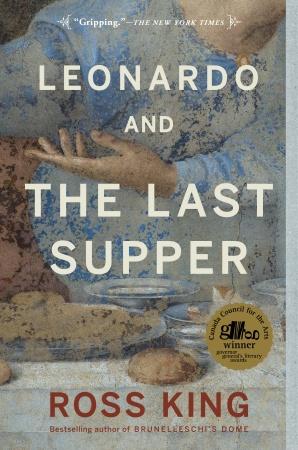
Review | Leonardo and the Last Supper, Ross King

9780385666091Ross King’s Leonardo and The Last Supper is a solid historical work on the artist and one of his most famous paintings. King does a good job setting the stage, by writing about the historical context in which da Vinci creates, as well as examining details of da Vinci’s distinct style and how it fit in within the larger context of art history.

The Last Supper has been the subject of many other art works, and yet da Vinci’s version became iconic long before Dan Brown launched a new generation of conspiracy theorists. King does a good job in examining what set da Vinci’s version apart from all others, in terms of technique, form and treatment of subject matter.

It is also interesting to get to know a bit of the man behind the work. Da Vinci has become such a cultural icon that it’s difficult to separate him from the mythos around him. King keeps the book firmly on the ground, and contextualizes da Vinci within his time, as well as paints a portrait of a man who is much more flawed than his “genius” moniker suggests.

My only concern with this book is that despite the rich history it explores, the writing itself is very dry. The beginning seemed a bit slow, and snippets of really interesting observations seemed almost lost within paragraphs of detail. I wanted to love the book, and I did learn some interesting tidbits throughout, but unfortunately, it was just very, very slow-going for me.

+

Thank you to Random House of Canada for a copy of this book in exchange for an honest review.

Review | Sex and the Citadel, Shereen El Feki

13152722How does one explore their sexuality in a society where open discussion of the subject is taboo? In Shereen El Feki’s Sex and the Citadel: Intimate Life in a Changing Arab Worldthe author explores various aspects of the sexual lives of men and woman in Arab society. She writes with an engaging style, using first-person accounts and historical research to create a compelling portrait of a society’s attitudes towards sex.

In one humorous anecdote for example, she tries to explain a vibrator to a group of women who had never seen one. Trying to find the right Arabic word, she comes up with one that means “a thing that makes fast movements,” but then realizes that could equally apply to a hand mixer.

El Feki uses this and other such anecdotes to reveal a world that many Western readers may find difficult to imagine. She doesn’t present her subjects as exotic, but rather presents them with warmth, empathy and humour. As with the vibrator anecdote above, the similarity between a sex toy and a kitchen tool is funny, but also reveals the rather radical misunderstandings that can occur in a society where it is forbidden to speak of the subject in public.

Through the lens of sexuality, El Feki examines various aspects of Arab life. She speaks about the struggle for female empowerment, attitudes towards marriage and the single life, and other such topics. Particularly striking to me is an interview with a man fighting for LGBTQ rights in the Middle East. Unlike much of the Western world, this man desires to be seen as equal but is staunchly against same sex marriage, because this goes against his religious beliefs. El Feki therefore presents an alternative perspective even to subjects that Western readers may initially find familiar. More significantly, she presents dissenting views within the society, thereby preventing any impulse to generalize.

I grew up in the Philippines, where religious and political institutions have long suppressed a certain form of discourse around sexuality. A recent political battle has brought this struggle to the public eye, and while major steps have been taken to open this discussion, and many more continue to be taken on the level of the individual, there is much work left to do, and this indeed impacts upon many other aspects of society — women’s rights, LGBTQ rights and general perceptions of equality to name a few.

El Feki tackles an important subject and presents a wonderfully frank view of an aspect of Arab life. The book makes real the human beings behind movements and issues we may have only heard of, and therefore makes us care even more deeply. There is a fine balance between respect for custom and propagating institutional ignorance, and El Feki makes a compelling case about the dangers of the latter, and reveals how current events may, in fact, already be turning the tide.

+

Thank you to Random House of Canada for a copy of this book in exchange for an honest review.