
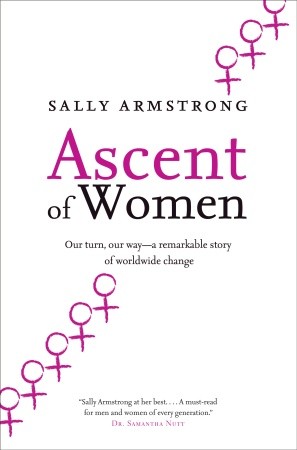
Review | Ascent of Women, Sally Armstrong

coverSally Armstrong’s Ascent of Women is an unflinching look at the brutality experienced by women around the world, and yet still manages to maintain an optimistic outlook. Armstrong’s primary thesis is that through education and the free exchange of information, women are changing the world at the grassroots level, and that this change will just keep happening.

Rather than stats and figures, Armstrong tells stories, personalizing for the reader horrific acts of violence and giving faces not only to victims but also to women around the world who are making change happen. Former US Secretary of State Hillary Clinton and feminist icon Gloria Steinem are mentioned, but for the most part, Armstrong focuses on lesser known individuals, unsung heroines whose stories may not have been heard.

In a disturbing, yet probably all too common, account, Armstrong relates the story of Muslim women gang-raped by Serbian soldiers in Sarajevo. Since she worked for a magazine at the time, and wouldn’t be able to publish the story herself for another three months, she took her information to an editor of a newspaper. To her dismay, the story took almost two months to see publication, and was relegated to a four line blurb in Newsweek magazine. She confronted the editor, who admitted he forgot about it.

I was astounded. I said, “More than twenty thousand women were gang-raped, some of them eight years old, some of them eighty years old — and you forgot?” [p. 38]

This outrage, and this unwavering conviction in the importance of making sure that such stories are heard, fuels the rest of the book. In some ways, Armstrong says nothing new — many of us are already aware of the horrible injustices women face around the world, and whether or not we believe the current level of change is enough reason to be optimistic, we will likely not be convinced otherwise by Armstrong’s book. As well, Armstrong makes some assertions that aren’t sufficiently proven, in particular the argument that if women ruled the world, poverty and war will be alleviated. This seems rather simplistic, and reliant on stereotypes regarding female pacifism.

That being said, the strength of Armstrong’s book isn’t in her arguments but rather in her examples. These are tales that have been suppressed or, worse, ignored or forgotten, and Armstrong reports them in brutal, memorable detail. Take for example a school in Saudi Arabia where hundreds of young girls died in a fire because they weren’t allowed to escape without traditional head covering. Girls who somehow succeeded in getting out were forced back in because their heads were bare. There’s also a story about a woman who was raped and urinated upon by six men. Armstrong is unflinching in her portrayals, and we readers flinch in response. These accounts aren’t easy to read, but they reveal a reality many women face, and they should make us uncomfortable.

Armstrong does hold out a ray of hope that change is happening, with the assistance of education. She writes about a town in Africa where child marriage was legal and accepted — until a man took his 11-year-old niece out of class to marry her off. The niece’s school friends and teachers banded together to protest, and the town outlawed child marriages, making 16 the minimum age to give informed consent. Armstrong also writes about female circumcision in some villages in Africa — it was a widely accepted practice for years until a group of women held information sessions that exposed the horrific effects of this practice. Male villagers professed to being unaware of just how horrible the effects are, and while I find their claim of innocence suspect, the sessions worked, and female circumcision was outlawed in many of the villages.

Ascent of Women is a powerful read. Change is happening, one step at a time, and thanks to Armstrong’s book, we are a tad more aware of it.

+

Thanks to Random House Canada for a copy of this book in exchange for an honest review.
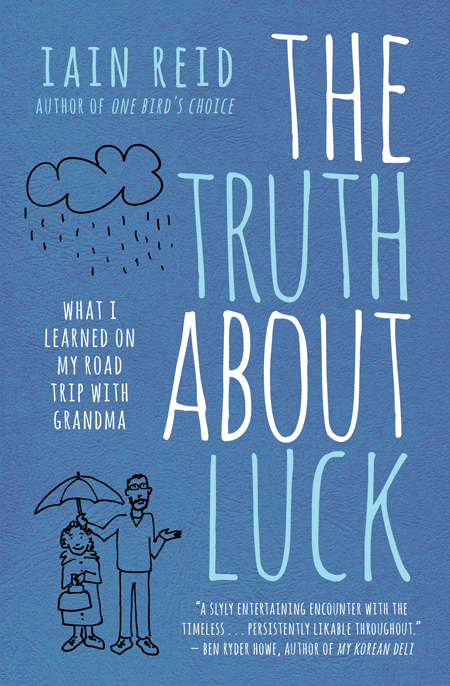
Review | The Truth About Luck, Iain Reid

978-1-77089-241-5_lIain Reid has a gift for getting right into his readers’ hearts. In One Bird’s Choice, he made us fall in love with his quirky, hilarious parents, as well as with a certain bird named Lucius. These characters make an appearance The Truth About Luck as well, but Reid’s second memoir shifts the author’s focus to his adorable, utterly loveable 92-year-old grandmother.

The premise of the book is practically guaranteed to make anyone with a grandmother go “Awww…” When Reid’s brother reneges for the first time on a joint birthday gift for Grandma, Reid decides to take his grandmother on a week-long road trip, gifting her with something far sweeter than a quirky portrait: his time. Unfortunately, for reasons that are unclear to me (finances? lack of planning?), the much-anticipated road trip turns instead into a staycation in Kingston. I do wish I understood better why Reid opted for a staycation instead, especially since the original plan had allowed for the possibility of the grandmother paying for the trip. As it is, I felt bad for Grandma, who’d looked forward to a road trip for months, and had possibly even brought her swimsuit. Worse, Reid admits he had no idea how to entertain his grandmother for a week — a cringe-worthy admission, though admittedly, we’ve all been there.

Reid is endearingly self-aware, unflinching in his portrayal of himself and unafraid to make fun of his own quirks. At times, he tries a bit too hard at self-deprecation — people likely aren’t paying as much attention to his treatment of Grandma as he imagines — but this as well is rather sweet, a heightened concern for his grandmother’s well-being. A wonderfully wry passage near the beginning of the book sums up Reid’s self-deprecating humour pretty well:

I called a friend to see if he had any ideas for me, tips on how to inject some carefree mirth into the trip. He reminded me that I wasn’t really the fun or adventurous one in our group. […] When pushed for which one in the group I was, he used the word egghead and asked what the opposite of an adrenaline junkie was. I wonder if I can offer Grandma a sherry first thing tomorrow morning? [p. 60]

Fortunately for Reid, his grandmother is such a sweet, gracious woman that she genuinely seems as excited over a week in Kingston as she originally was over a road trip. Grandma is the heart of this book, and Reid’s prose is a lovely, loving tribute. The staycation offers him the chance to listen to his grandmother’s stories about her past, a rare opportunity with a woman more accustomed to asking about her grandchildren’s lives than speaking about herself. In a coffee shop, as his grandmother speaks about her life during World War II, Reid notices the other customers busy with their books, laptops and mobile phones, and feels the urge to command them all to listen. Grandma’s life is far too interesting to ignore.

My own 89-year-old grandmother, who has always been a feisty, chatty woman, has recently begun exhibiting signs of dementia. She has difficulty remembering events and recognizing people, and is most comfortable speaking in Chinese, her first language and, unfortunately, one I don’t speak myself. Reid’s book makes me think of all the stories I may now never have the chance to hear, and makes me wish I’d paid closer attention all those times my own grandmother spoke about her past. I remember our trip to China, and my grandmother’s attempts to teach me Chinese, and wish I could remember more of what she taught.

This book then, perhaps more than any road trip, may just be the best, most precious gift Reid could have given his grandmother. Not only will he forever be able to remind himself of her stories, but he has also immortalized her past for people who have never even met her. Time and again, his grandmother frets that she is boring him with her stories. Time and again, Reid assures her that he is fascinated. And thanks to Reid’s masterful prose, so are we.

+

Thank you to House of Anansi for a copy of this book in exchange for an honest review.
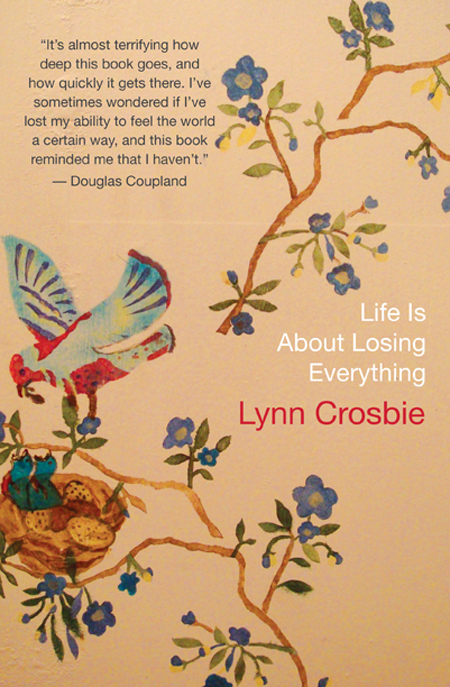
Review | Life Is About Losing Everything, Lynn Crosbie

978-1-77089-003-9_lIn Doug Coupland’s blurb to Lynn Crosbie’s Life is About Losing Everything, he comments that “it’s almost terrifying how deep this book goes, and how quickly it gets there.” The book is certainly intense, a blend of fact and fiction about a time period in the author’s life. I made the mistake of beginning it after a rather bad day, and after the first few chapters, had to stop because it was too depressing. Then again, with a title like that, what did I expect, eh?

To be fair, I think Crosbie’s book will strike a certain kind of reader as utterly beautiful, poignant and heart wrenching. It just didn’t work for me. (That’s not just because of my first, aborted attempt at reading it. I did give it another couple of tries before giving up. Full disclosure: I did not finish the book. I did try, but ultimately I decided to move on.)

The book saunters from vignette to vignette, some chapters in the form of lists, others more straightforward narrative. The story wanders, as if we had a glimpse right into the mind of the author as she thinks first of one memory and then another, and then perhaps doubles back to an earlier event, and so on. It’s not an easy read — the writing is soaked in bitterness and anger. Crosbie’s style is just sharp and biting enough to avoid being whiny, but hell, this novel cuts deep.

There’s a fine line between raw emotion and self-indulgence, and to my mind, this book crossed that line. The randomness of the vignettes, and the slapdash nature in which they were compiled added to the feeling that despite the hodgepodge of episodes, they all began to sound equally bitter. Blogger Buried in Print says that rather than the traditional beginning, middle and end narrative, Life is “all middle.” This maintains just that intensity that Crosbie is clearly going for, and is perhaps the reason other book reviews recommend dipping into Life a bit at a time rather than in one sitting.

Crosbie’s writing is tight and with a definite bite. However, the format of the book just didn’t work for me, and I ended up realizing that I simply didn’t care what other horrible, depressing slice of life was going to be revealed next.

+

Thank you to House of Anansi for an advance reading copy of this book in exchange for an honest review.